
India can become an important part of global value chains, says CII vice president Shashwat Goenka
ADVERTISEMENT
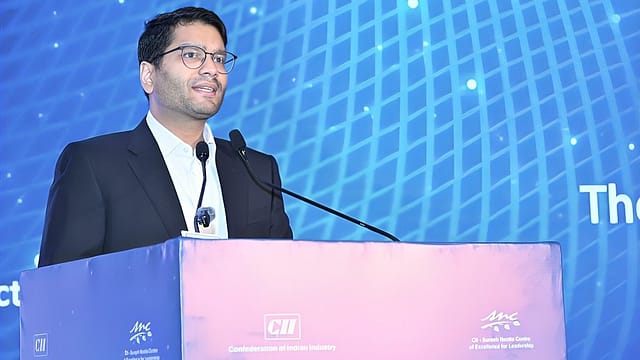
India can become an even more important part of global value chains, build global champions coming out of the country, and help shape the industries of the future, Shashwat Goenka, vice president, CII, said on Wednesday.
Speaking at the opening session of the CII National Leadership Summit in Mumbai, Goenka said that this will require enterprises that are globally competitive, technologically capable, resilient in their operations and agile in their decision-making.
"The enterprise of the future, therefore, cannot simply be built around a five-year plan. It must be built around the capacity to continuously learn, to adapt and to evolve," he told a packed audience. This is where leadership must evolve and can no longer be about having the right answers, said Goenka, also vice chairman of the RP-Sanjiv Goenka Group.
"It is about asking the right and better questions, about creating the confidence to experiment, about bringing people together around a shared vision, and building organisations that can make good decisions in times of uncertainty. And perhaps most importantly, leaders must create cultures where people are not afraid of change."
Goenka said organisations do not become antifragile because their strategy says so. "They become antifragile when their people, their culture, their systems and the institutions are designed to learn from change," he said.
The theme of this year's conference is 'The Antifragile Enterprise: Thriving at Strategic Inflection Points.' "Normally we talk about resilience. Resilience is about absorbing a shock and continuing. Antifragility goes a step further. It is about learning from disruption, adapting because of it and emerging stronger," Goenka said.
Goenka said as technologies transformed industries and with AI reshaping business models, "business is becoming more interconnected and at the same time more uncertain".
"Geopolitical realignments are affecting trade, supply chains and investment decisions. Sustainability is moving from a parallel corporate agenda to a central business imperative, and businesses are facing growing expectations from customers, from employees, from investors and from society at large, " he said.
For Indian industry, these shifts come at a particularly important moment. "India is entering a phase of unprecedented opportunity, with a growing domestic market, a deepening entrepreneurial ecosystem, strong digital capabilities, and Indian enterprises increasingly looking beyond our borders," Goenka said.
Strategic inflection points will test leadership, not when the future is clear, but when signals are ambiguous, and the consequences of inaction are high, he said. "The challenge for leaders is therefore not simply to predict what comes next. It is to build organisations that can respond to what comes next, even when we cannot predict that with certainty."
"I believe this requires three shifts in how we think about leadership. Leaders must become better at recognising early signals. By the time disruption becomes obvious, the window to respond may have already narrowed. Listening, observing, questioning assumptions and identifying emerging shifts are becoming increasingly important leadership capabilities," the CII vice president explained.
"Second, organisations must become capable of continuous reinvention. What made an organisation successful yesterday may not be the formula for tomorrow. Leaders must create the ability to rethink, to experiment and to evolve. At the same time, reinvention does not mean abandoning everything that made an organisation successful in the past. The challenge is knowing which capabilities, which values and which advantages must be protected, even as the business and the business model evolve."
"And third, leadership must balance speed with judgment. The pressure to move quickly is real, but speed without direction can be as dangerous as caution without action. Leaders must know when to accelerate, when to experiment, and when to commit and when to change course."
He also added that the ability to balance performance with purpose and with responsibility was equally important. "Enduring value will depend not only on growth and shareholder returns, but also on how organisations treat their people, how responsibly they use technology, how they approach sustainability, and how they build trust with the wider ecosystem," Goenka said.