
India’s tourism ambition meets ground reality: Leaders flag demand-supply, access gaps
ADVERTISEMENT
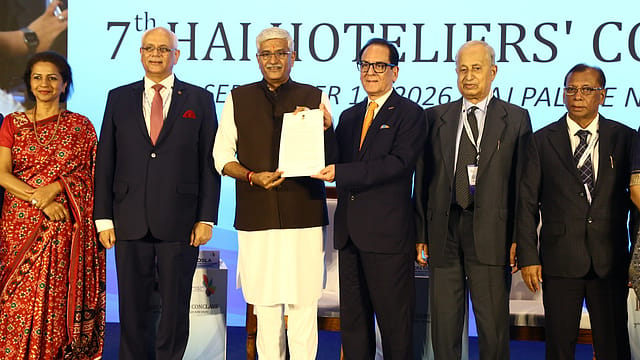
India’s tourism opportunity is growing, but the sector needs to close a widening gap between ambition and ground reality, with industry leaders flagging shortages in supply, ease of access, quality of experiences and policy consistency across states.
The concerns come as the government looks at tourism as part of its broader development vision for 2047, even as the nature of travel and hospitality itself begins to change. Union tourism and culture minister Gajendra Singh Shekhawat, at the 7th HAI Hoteliers’ Conclave 2026, said India now has an opportunity to rethink tourism around experiences rather than simply accommodation and destinations.
“We have come together at such a time when the definition of experience is four walls, four rooms of a hotel, a good, comfortable bed and a good meal,” Shekhawat said, pointing to the changing expectations of travellers.
According to him, the hotel and hospitality industry will have to adapt to this shift. “The coming time will not only be limited to accommodation; it will not only be limited to destinations or monuments. Now, it will be a time of complete transformation of destinations and experience transformation.”
The travel & tourism market in India is projected to generate $34.44 billion in revenue in 2026 and grow at a CAGR of 12.08% to reach $54.34 billion by 2030.
Tourism’s next challenge: turning potential into capacity
While the government sees an opportunity to build on India’s cultural and economic strengths, the industry says the country still has significant ground to cover before that potential can translate into a globally competitive tourism offering.
M.P. Bezbaruah, secretary general and member, executive committee, Hotel Association of India, said there is “a huge gap in demand and supply”, while India also needs to compete with other countries on ease of access and the quality of experiences it offers travellers.
The industry is also seeking stronger tourism promotion capabilities and changes to ease doing business, particularly to attract investment into the sector. “We need robust promotion capability and we can leverage our strong economic resurgence to attract investments by pragmatic ease of doing business changes,” Bezbaruah said.
“India has moved on to becoming a $4 trillion economy. India has become a tech power in many ways. So, this rapidly growing and advancing power of India needs to be demonstrated in many ways,” concurred Amitabh Kant, former G20 Sherpa of India & Former CEO, NITI Aayog.
He added, “Whatever you want to term it—India 2.0 or 3.0—but India needs to be branded, India needs to be promoted, India needs to be marketed in a very big way globally.”
Another challenge is the fragmented regulatory environment across states. Bezbaruah said rules and procedures need to be harmonised, while safety, hygiene and other visitor-related concerns need to be addressed to make the Indian tourism experience more competitive.
“Incredible India cannot be just a tourist hotel. Incredible India can be incredible if it becomes a liberal India. Not if the cities are full of slums, if the cities are full of garbage, if the cities are full of drainage and sewage that is not working—it is not a liberal India,” Kant asserted.
The focus, according to him, has to be on improving urbanisation in India.
“We have to harmonise the rules and procedures all across the states and take this ease of safety, hygiene and hassles to make the Indian experience truly incredible. We have the resources, we have the opportunity and we can all do it together,” Bezbaruah said.
The push comes at a time when technology and climate change are adding another layer of uncertainty for the industry. Shekhawat said the world is changing rapidly, with artificial intelligence already influencing people's lives and decisions, while climate change is “a big concern” affecting every sector.
Yet, he argued that India has demonstrated resilience amid these global pressures. He pointed to the country’s first-quarter economic performance, saying expectations that growth and exports would come under pressure had not materialised, with services, manufacturing and engineering exports registering better progress.
For tourism, however, the next phase will depend on whether that broader economic momentum can translate into capacity, investment and better experiences on the ground. India, Shekhawat said, has the cultural strength and capacity to lead this transition, making the transformation of destinations and experiences a central opportunity for the sector.