
Jio sells prepaid cards through just one distributor—Reliance Retail
ADVERTISEMENT
Reliance Industries (RIL) does not just own Jio Platforms but has created a moat around the telecom major’s ancillary businesses through its own group entities.
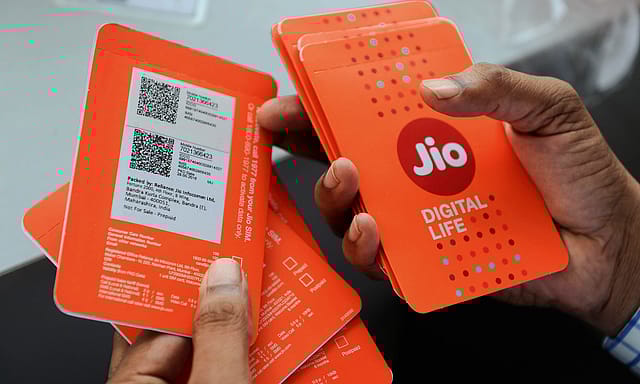
For instance, Reliance Retail, the conglomerate’s group company, is the sole distributor of Jio’s pre-paid service, which accounts for 77% (Rs 1.13 lakh crore) of Jio’s consolidated revenue from operations of Rs 1.47 lakh crore in FY26.
In contrast, Airtel sells through its own network of independent dealers, and no single partner controls the distrbution and none of them is owned by Airtel. Airtel's FY26 annual report states that nearly 62% of its standalone sales came from a network of 8,863 dealers and distributors, which in turn supply to more than a million retailers across the country.
Jio owns its customers and network electronics, but its parent and sister companies handle the last-mile distribution, the towers, the fibre, much of the equipment and even the brand name.
The details are mentioned in the the RHP of Jio Platforms, which is going public with a valuation of $108.3 billion (Rs 10.3 lakh crore) with 533 million subscribers (including 285 million 5G users), making it the country’s largest telecom carrier.
How the recharge money moves
Jio sells recharge vouchers in advance to Reliance Retail, which in turn sells them on through its distributors, its stores, online and every other channel it has. Because Reliance Retail pays up front, Jio records the money as an advance and then counts it as revenue as customers use their plans.
Reliance Retail also does much of the work a telecom company does itself: it signs up new customers, carries out identity checks, collects payments and handles marketing. Jio pays this as selling and distribution expenses, which was Rs 4,374 crore in FY26, to group companies. The cost of each new customer is spread over the average time that the customer stays on the network.
The deal works well for Jio as it gets paid early, does not have to manage thousands of distributors and it can use one of India’s largest retail networks. While the prospectus highlights the downside that if the arrangement is broken down, Jio would have to build a network of distributors across India and train them to sign up customers and do the necessary on-boarding due diligence besides collecting payments. So, while Jio’s largest revenue stream depends on a single distributor, it belongs to the same parent.
The other connections
Besides the prepaid service, there are other important connections within the group network.
In 2019, Jio moved its towers and fibre into separate companies: Summit Digitel, and the fibre to Jio Digital Fibre. Digitel owns about 1.74 lakh of the 3.6 lakh towers Jio uses, and Jio Digital supplies about 98% of its fibre. As the anchor tenant, no other customer can get better terms, and it gets first refusal on spare fibre. It also has to pay minimum charges and cannot terminate either contract.
Similarly, on the equipment side, Reliance Industries sold Jio Rs 3,904 crore of equipment and other network assets in FY26. Reliance Retail and Sanmina-SCI India supplied about another Rs 1,100 crore between them. Sanmina-SCI India is a 5G equipment maker that is 50.1% owned by the Reliance group. Together these related parties supplied about 17.5% of Jio's FY26 capex, excluding spectrum. In the June 2026 quarter, the share jumped to 36%. RIL also builds telecom projects under construction contracts and rents its data centres to Jio.
There is also money that flows to the parent and back to Jio.
Of the Rs 3,800 crore paid as professional fees in FY26, most of it went to RIL, along with Rs 2,776 crore in network operating costs. But Jio too earned Rs 6,330 crore from the group, much of it for managing RIL's IT needs.
To top it all the Jio trademark too belongs to RIL, which licenses it to Jio and, currently, charges no royalty.