
Mumbai airport seeks airlines’ transition plans by Nov 3 for Navi Mumbai shift
ADVERTISEMENT
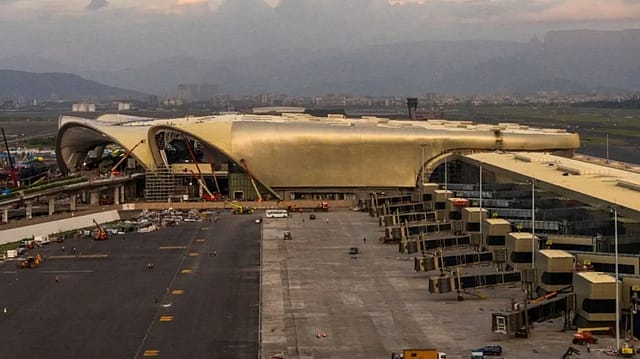
Representatives of more than 35 airlines and Mumbai airport officials on Wednesday discussed the transition plan for partially shifting international flights from the airport to Navi Mumbai, with some carriers seeking more time to decide on the relocation of operations, according to sources.
Mumbai airport operator Mumbai International Airport Ltd (MIAL) has requested the airlines to provide their transition plans by November 3, they said.
MIAL initially planned to implement the partial shifting of international operations from October 25 and later deferred the deadline till March 2027 following concerns raised by various foreign airlines about the transition plan.
Against this backdrop, more than 35 members of the Airline Operators' Committee (AOC) and MIAL officials met for over one-and-a-half hours on Wednesday to discuss the issues related to the shifting of international operations to the Navi Mumbai International Airport (NMIA).
At the meeting, MIAL requested airlines to share their transition plans by November 3 and they were also assured that the temporarily transitioned international traffic of 5 mppa will be fully restored back to Mumbai airport once the T2 expansion is completed, the sources said.
Many of the airlines sought time till the next winter schedule that starts in October 2027 for relocation of the international flights, they added.
The sources said both sides had a constructive dialogue and MIAL presented a detailed redevelopment schedules for T1.
One of the sources said airlines have insisted that T1 redevelopment should be done in a phased manner and rejected any unilateral decision by MIAL for reduction of slots from the next summer schedule starting from March 2027.
At the same time, Air India, Air India Express, IndiGo and Akasa Air jointly with Adani Airport Holdings Ltd (AAHL) have announced shifting their international operations to NMIA in a phased manner in the coming months.
Mumbai and Navi Mumbai airports are part of Adani Airport Holdings Ltd (AAHL).
A Chhatrapati Shivaji Maharaj International Airport (CSMIA) spokesperson said artistic impressions outlining the redevelopment of T1 was shared with AOC during the meeting on Wednesday.
CSMIA (Mumbai airport) has the capacity to handle around 55 million passengers annually. After redevelopment of T1 and T2, the total capacity will increase to 65 mppa.
With renovation of Terminal 1 (T1) at the Mumbai airport set to start next year, MIAL wants airlines to partially shift their international flights from Terminal 2 (T2) to NMIA so that the vacated space at T2 will be utilised by the carriers for domestic operations. The renovation of T1 is estimated to be completed by 2030.
One of the country's busiest airports, it has two terminals -- T1 and T2. T1 handles domestic operations, while international flights operate from T2.
The phased, equitable transition will ensure passenger safety and minimal operational disruption while developing Mumbai as a world-class aviation hub, the sources said.
Initially, AAHL asked airlines to cut 33 per cent of their international flights or shift them to NMIA by October 25, also the start of the winter schedule.
Following opposition from the operating airlines, it was decided to defer the deadline by a a few weeks.
The move followed Civil Aviation Secretary Samir Kumar Sinha chairing a meeting of stakeholders on October 6 to discuss the transition plans.
A week later on October 13, at a meeting of representatives of AAHL and airlines, it was decided that the partial shifting of international flights to the Navi Mumbai airport would be deferred till the summer schedule that commences in March 2027.
On Tuesday, Akasa Air said the airline would make a phased transition of the carrier's Mumbai-Jeddah services to NMIA from December.
Air India Group and IndiGo, on Sunday, said they would progressively shift international flights to NMIA from December onwards. Air India Group comprises Air India and Air India Express.
NMIA is designed to handle 20 million passengers annually in its initial phase, with future expansion planned to take the capacity to 90 million.
(Except for the headline, Fortune India has not edited the content of this PTI report.)