
Sebi examines higher position limits for non-agri commodity contracts, phased physical settlement
ADVERTISEMENT
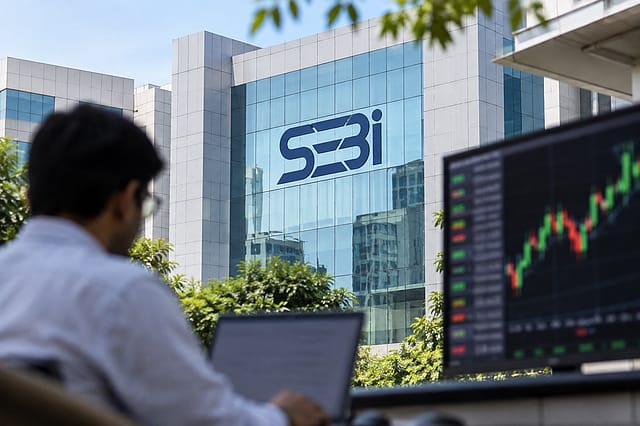
Securities and Exchange Board of India (Sebi) Chairman Tuhin Kanta Pandey on Saturday said the regulator is examining position limits for non-agricultural commodity contracts to improve liquidity and market depth without weakening risk controls. He also said consultations have been completed on a phased approach to physical settlement in select agricultural commodity derivatives, with guidelines to follow.
Speaking at the 12th Convention of the Commodity & Capital Market Participants Association of India (CPAI) in New Delhi, Pandey said India’s capital markets need to mobilise savings, provide opportunities for investment and help businesses manage risk.
India’s real GDP has grown at an average rate of 7.4% over the last three financial years, Pandey said. Over the last decade, Indian companies have raised an average of around ₹10 lakh crore annually through equity and debt. The investor base has more than tripled to around 15 crore, while mutual fund assets stand at around ₹87 lakh crore and outstanding corporate bonds at around ₹61 lakh crore.
Sebi seeks deeper commodity derivatives market
The commodity derivatives market has also expanded rapidly. In FY2025-26, aggregate turnover in futures and options stood at around ₹1,388 lakh crore on a notional basis, with bullion accounting for about 59% of the total. In the first six months of FY2026-27, turnover has already reached around ₹1,538 lakh crore, 11% higher than the full-year figure for the previous financial year. “Scale is not inclusion. Our next challenge is to widen meaningful participation,” Pandey said, adding that success in commodity derivatives should be measured by how effectively these markets help manage risk, rather than turnover alone.
He cited the volatility in commodity-price expectations as an example. In late 2025, the World Bank had expected commodity prices to decline by around 7% in 2026. By April 2026, following severe disruptions to commodity trade, it projected prices to rise 16%, with energy prices expected to rise 24%. “In some agricultural commodities, physical settlement from the outset can impede market development. A phased approach can allow the contract to mature before physical settlement becomes mandatory,” Pandey said.
Sebi is also examining position limits for non-agricultural contracts, while continuing engagement on GST-related issues affecting participants who give or receive commodities through exchange platforms.
Pandey said electricity futures provide generators, DISCOMs and industrial consumers with a regulated mechanism to manage power-price risk, while weather derivatives can address financial risks linked to objective meteorological data.
He also said wider FPI access to commodity indices and physically settled non-agricultural contracts can add liquidity and strengthen price discovery, while position limits and delivery safeguards protect the physical market.
Sebi reviews derivatives settlement framework
Pandey said Sebi is also examining concerns relating to the settlement-price framework for derivatives on expiry days following the introduction of the Closing Auction Session (CAS).
In a separate interaction on Saturday, Pandey said Sebi had received more than 3,500 comments on its consultation covering changes to CAS, market timings and the settlement methodology for derivative contracts. He said the regulator would quickly examine the responses and move ahead with the framework. Asked whether a circular would be issued soon, Pandey said, “Yes, it will be.”
Sebi is also reviewing Settlement Guarantee Fund requirements and has moved stress testing towards historical scenarios that better reflect commodity-price behaviour. It has revamped the Vault Managers Regulations to strengthen infrastructure and oversight for the bullion market.
On the broader market, Pandey said Sebi has reintroduced open-market buybacks through stock exchanges with a simpler process and made IPO disclosures easier for retail investors through a concise, standardised abridged prospectus at the DRHP stage. The regulator has also widened the investor base for corporate bonds, REITs and InvITs and introduced greater flexibility.
Sebi has streamlined access for foreign investors through SWAGAT-FI, permitted netting of funds for FPI transactions and eased re-KYC requirements for NRIs. It has also revamped mutual fund regulations, consolidated the PMS framework and introduced GARUDA for faster AIF scheme launches.
Pandey said the regulator’s supervisory approach is becoming more risk-based, with greater attention directed towards higher-risk entities and areas. He also stressed that regulated entities using AI or machine-learning tools remain responsible for investor-data protection and system outputs.
Under Project Jagrook, Sebi will strengthen awareness of commodity derivatives among farmers, FPOs, MSMEs, hedgers and other market users. “Access without understanding is not inclusion,” Pandey said.
He added that simpler regulation cannot mean weaker compliance, and that controls over client funds, margins, reporting and supervision remain fundamental. “Trust and market integrity” must not be compromised, he said.