
'The laptop has become an AI device by itself': Dell's Manish Gupta on AI PCs in India
ADVERTISEMENT
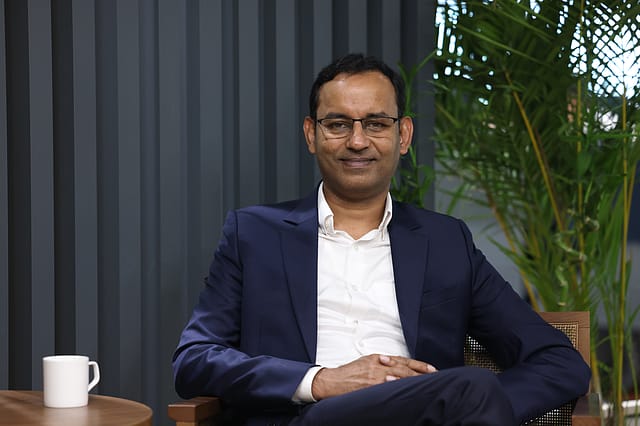
Dell Technologies is betting on artificial intelligence to drive the next phase of India's PC market while expanding its AI infrastructure business as enterprises move from generative AI experiments to larger deployments. The opportunity comes with a complication. More capable AI processors are pushing up hardware costs even as AI becomes cheaper to run. India's PC market grew 31.1% year-on-year to 4.4 million units in the first quarter of 2026, according to IDC, but rising component costs are already putting pressure on prices.
For Dell, the response is not simply to sell more expensive AI PCs. The company is building an AI proposition that spans laptops and workstations at one end and data-centre infrastructure at the other, with local computing increasingly sitting between the two. “While you have those big machines sitting there, the machine that you and I have now access to as a laptop has become an AI device by itself,” Manish Gupta, President and Managing Director, Dell Technologies India, said in a conversation with Fortune India.
Dell's AI PC portfolio covers consumer and enterprise devices as well as systems aimed at developers. Gupta said demand is no longer restricted to specialist users, as newer applications are being developed to use the AI capabilities built into PCs. “Enterprises of all sizes are demanding AI PCs, for the simple reason that newer applications are getting developed, newer ISVs are developing applications that would utilise the AI capability of a PC,” Gupta said.
Are rising AI chip costs making PCs too expensive?
The biggest challenge for PC makers is that adding AI capability comes at a time when processor and component costs are rising. IDC's Q1 data showed PC prices continuing to increase because of component shortages, even as shipments crossed 4 million units for the third consecutive quarter. The market remained resilient in the June quarter, with PC shipments rising 12.1% year-on-year to 3.9 million units. However, enterprises and retailers brought forward purchases ahead of expected further price increases, while higher prices could weigh on demand going forward.
Dell is looking at the economics of AI beyond the sticker price of the machine. Gupta said the cost of AI tokens has fallen sharply as newer infrastructure delivers more computing capability. “Specifically, when you look at the AI world, the token costs have actually reduced drastically. Year over year, the token costs have reduced over 80%. Now what that does is with every new technology, for the same infrastructure or with the improvement in technology, the infrastructure that's coming in new is able to create so many more tokens,” he said.
But lower token prices do not automatically mean lower AI bills. As companies increase their use of AI, the number of interactions can rise enough to push up overall spending. That is driving Dell's argument for a mix of cloud and local computing rather than putting every AI workload in a public cloud. “Not one model is going to fit everything. Organisations like ourselves also use multiple models because the right model has to be used for the right thing. And the architectures underneath have to be done in that manner,” Gupta said.
Dell's AI Factory with Nvidia is part of that strategy—a full-stack infrastructure and services offering combining compute, storage, networking, software and services. Dell says suitable desk-side agentic AI workloads can reduce cloud API costs by up to 87%, though that is not a blanket saving for every deployment or a reduction in the purchase price of an AI PC.
The same approach is increasingly relevant at the desk side, where some workloads can run closer to the employee or developer instead of being sent to a remote model. Dell does not see local computing replacing data centres, but rather AI workloads spreading across infrastructure based on the use case.
Why does Dell see India as a bigger AI and PC opportunity?
India is also becoming important to Dell because of its manufacturing and supply-chain footprint. The company has been manufacturing in India for nearly two decades, with laptops, desktops and servers produced at its Chennai facility. Dell said it spends about $1.1 billion, or roughly ₹8,740 crore, with suppliers in India for the India market. “India is a microcosm of everything that exists in Dell globally. We have got manufacturing, engineering, R&D, and functions like accounting, executive business centres, sales here,” Gupta said.
The company is also investing in skills as demand grows across AI and semiconductors. Dell's Udaan initiative aims to create skilled and employable capabilities for 23,000 young people in its first year, including training around AI, semiconductor and electronics manufacturing roles. That gives Dell several positions in India's expanding AI ecosystem. It wants AI PCs to become part of mainstream computing while its infrastructure business captures the enterprise demand being created behind those devices.
For Gupta, that makes India a strategic market not just because of its size, but because several parts of Dell's global business are now developing together. “The opportunities are multifold in India, and we clearly see India as a strategic market for us, and we have seen that for a long time, not just in terms of talent, but even in terms of the market opportunity that resides,” Gupta said.