
EU 'inviting disaster' with carbon tax on steel, says Piyush Goyal
ADVERTISEMENT
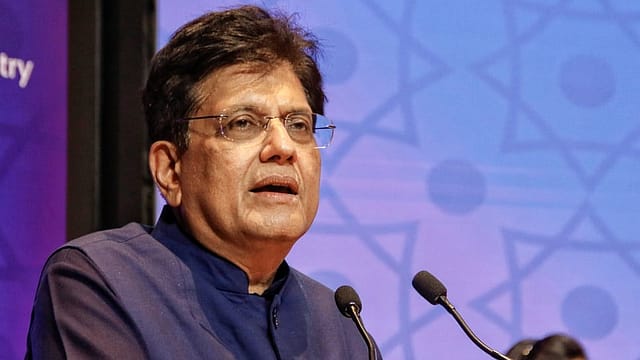
The European Union (EU) is "inviting disaster" by imposing a carbon tax on its steel products, Commerce and Industry Minister Piyush Goyal said here on Thursday.
Participating in the Berlin Global Dialogue, he also said the EU is "shooting" themselves in their own feet by bringing in more and more regulations, restrictions on themselves, and closing their borders, something which actually helped them become a developed set of nations.
"You put a CBAM (Carbon Border Adjustment Mechanism) on yourself. You put a 50% import duty to bring steel into your country. You're inviting disaster. Your cost of living will go up," he said.
He added that through these battery of regulations, the EU is trying to voice an artificial situation onto themselves, trying to create boundaries into Europe, trying to bring in "absolutely ridiculous" at times standards or levels of protection to safeguard certain sectors, steel being one of them, and only hurting their own economy.
"Now, imagine going forward, every infrastructure, whether it's a port or an airport or your autobahns in Germany or your expressways, your utilities, your water pipelines, you name the infrastructure with costlier steel, costlier aluminium, costlier cement, with all the overlay of CBAM and deforestation rules," he said.
He added that the EU has 75-77 regulations.
"We've lost count. You keep adding to your regulations, add to the burden of your industry, make yourself uncompetitive. And of course, in some sense, it'll also create non-tariff barriers for others to trade with you," Goyal said.
He cautioned that the world is a reciprocal world now.
"And I don't say that. Much bigger leaders are saying that. And in this reciprocal world, you bring in a regulation and stop some other country from working with you. They'll bring in two regulations, which will hurt your businesses," he said.
He added that at the end of the day, cost of living in Europe will go up, business competitiveness will go down and inflation will be high.
"You will not be able to compete in global markets. Your auto industry is suffering that already. I think auto sales are down from Germany by 15% or 20% in the last decade or so," the minister said, adding, "How will you be competitive in the future? You will ultimately outprice your industry."
He added that India is working on increasing competitiveness and is also working at a win-win partnership with everybody.
"We've got fair, equitable, and balanced agreements with every one of the partners with whom we are working. At least in the last four or five years, post-2014 particularly, we're forging friendships, basis competitiveness. We are building complementary strengths," he said.
He added that India would trade with countries such as Singapore, where there is no CBAM and deforestation.
India has raised concerns on multiple occasions over these regulations. Under the EU's Carbon Border Adjustment Mechanism (CBAM), Indian exports of steel, aluminium, and cement to the EU could face tariffs of 20-35%.
Goyal added that India accounts for only 3-3.5% of global carbon emissions despite supporting 17% of the world's population.
The European Union's anti-deforestation regulation (EUDR) is a form of a non-tariff barrier. The regulation imposes strict regulatory requirements on sectors such as rubber producers and exporters targeting European markets, as it is a non-tariff barrier.
Goyal said that the EU's contribution to carbon emissions is "humongous" and it is about 20%.
He noted that those nations used low-cost energy earlier to push through growth. But at present, India's contribution is low, and even the per capita damage to the ozone layer or carbon emission is probably 7-8 times lower than in Western nations.
The minister said that India has about 17% of the world population and it has the fastest clean energy programme.
"We are greening our steel," he said, criticising developed nations for failing to meet their climate finance and technology transfer promises to the developing and less developed countries.
He added that the CBAM does not recognise the principle of common but differentiated responsibilities.
(Except for the headline, Fortune India has not edited the content of this PTI report.)