
India looks to cut critical tech dependencies over 20-25 years, build resilience: Ashwini Vaishnaw
ADVERTISEMENT
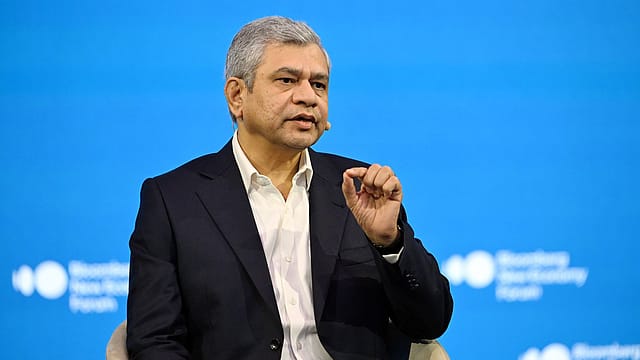
The government is focusing on semiconductor inputs, domestic manufacturing and applied research while preparing for heightened global turbulence from artificial intelligence and financial risks.
India is looking at a 20-25-year horizon to reduce critical technology dependencies and strengthen its resilience against global disruptions, Union Minister Ashwini Vaishnaw said on Wednesday, warning that technological upheaval and financial risks could intensify turbulence in the coming years.
Speaking at the Bloomberg New Economy Forum 2026, Vaishnaw said India was identifying strategic dependencies that could leave its production and economy vulnerable to geopolitical tensions and changing policies. The objective, he said, was not complete self-sufficiency but building domestic capabilities while remaining integrated with global technology supply chains.
“Things change, politics change, geopolitics play a big role, so we have to constantly calibrate our approach, and we in India are thinking at least 20 years ahead,” Vaishnaw said.
The minister outlined short-term goals spanning three to five years, medium-term targets of five to 15 years and long-term objectives covering 20 to 25 years.
Trust becomes critical in global technology supply chains
Vaishnaw said technology would remain a globalised industry, with supply chains spanning multiple countries and geographies. However, governments and companies would need to continually assess their partners to ensure strategic dependencies did not undermine resilience.
“...Strategic dependencies, which are the countries you can trust, which are the places where you believe that your production, your design, your dependency on a particular country or a company does not make you lose your resilience...Those are the decisions which will have to be taken again and again, continuously,” he said.
He added that India was seeking to strengthen its position in global value chains while developing capabilities in strategically important areas.
Semiconductor ecosystem, telecom capabilities in focus
Vaishnaw stressed the need to develop the entire semiconductor ecosystem, including materials, chemicals, gases and substrate materials, alongside chip design and manufacturing. He said the second phase of India's semiconductor programme placed greater emphasis on these inputs.
“Without ecosystem, no manufacturing effort will ever pay off,” he said, citing India's gradual shift in the mobile phone industry from assembly to manufacturing modules and components, some of which are now exported.
The minister also highlighted India's end-to-end 4G telecom stack, developed through government-private sector collaboration in three-and-a-half years and deployed on more than 100,000 towers. He called for higher research and development spending, particularly on applied research.
AI, debt risks could deepen global turbulence
Vaishnaw warned that artificial intelligence could disrupt employment, particularly in services, as debt accumulated by advanced economies posed additional financial risks.
“In my understanding of the way the world is moving today, the turbulence is going to be much more than what it was in the past decades,” he said, citing technology and developments in global finance.
“The biggest issue that we all have to be prepared for is the turbulence, which is coming in the next few years,” he added.
Vaishnaw said India's public debt-to-GDP ratio had declined from 61% to 55% over the past five years as the country worked to strengthen its financial and economic resilience.
Cisco Chairman and CEO Chuck Robbins backed India's approach, saying the country's scale, engineering capabilities and partnerships with trusted companies created an environment conducive to investment.