
Fortune India Exclusive: Adani moves forward with next-gen leaders driving a mega $120-bn investment plan

This story belongs to the Fortune India Magazine November 2026 issue.
ADVERTISEMENT
The Fortune India team first met Adani Group founder and chairman Gautam Adani in the summer of 2022 at the group’s 16-storey headquarters in Shantigram, a modern township created 16 years ago on 600 acres along the SG Highway near Vaishnodevi Circle in Ahmedabad, Gujarat.
It was his first detailed interview with any English business magazine in recent years. He was about to turn 60 on June 24, 2022, and it would ordinarily have been considered too early to ask a businessman of his age and stature about succession plans.
But we did ask. Some family members were already working across the group, including two of his four brothers, two sons, and nephews and nieces. The businesses had also grown enormously in scale and complexity. If the group revenues were near ₹98,000 crore in FY20, they grew to almost ₹2.3 lakh crore by FY22 and to near ₹3 lakh crore in FY26.
Four years on, the group operates across more than two dozen businesses and is eyeing further expansions. Gautam Adani is one of the world’s richest billionaires. He owns 10 private jets, including a ₹1,000-crore Boeing 737-8 BBJ and a Bombardier BD-700 Global Express. His expensive car fleet follows a personal quirk: the numbers on their registration plates add up to 20, his lucky number.
And yet, even today, there is little of the billionaire aura one might expect. His demeanour is remarkably understated. He speaks in plain, simple English, using short, carefully considered sentences. Complex business equations and management jargon are often distilled into easy one-liners, punctuated by apt similes and euphemisms.
Four years ago, he did not offer a direct answer to our question about succession. Instead, with a broad smile, he had said: “Family is nothing but a partnership of multiple generations, and it depends on your family structure, responsibility, and respect among members. You can’t have all ‘five fingers’ of the same size, yet five fingers together will have more power.”
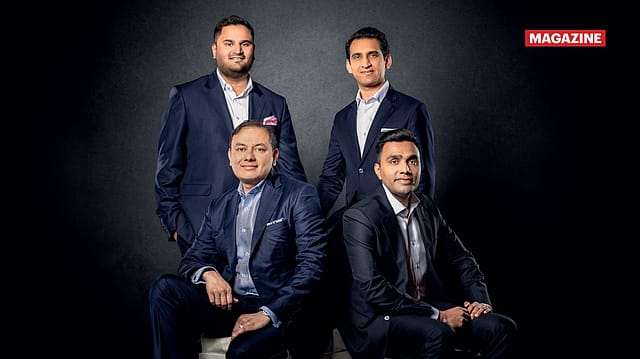
Four years on, much has changed. The business has expanded at express speed, despite challenges. And Gautam Adani has chosen four next-generation leaders to eventually take forward his sprawling business empire: Pranav Adani (the son of his elder brother Vinod Adani), Karan Adani (his elder son), Sagar Adani (the son of his brother Rajesh Adani) and Jeet Adani (his younger son).
“The next generation does not inherit leadership. They inherit the responsibility to earn it. I expect them to challenge our assumptions, think on a scale larger than ours, and move with greater speed, while having the patience to build businesses that may take decades to mature. They must have the courage to enter difficult sectors, the wisdom to learn from those around them, and the humility to realise that the institution will always be bigger than any individual or family,’’ Gautam Adani tells Fortune India. “Ultimately, I do not want them to be measured by how faithfully they preserve what we have built, but by how much stronger, more trusted, and more enduring they make the businesses for generations that follow.”
All four joined the group after completing their education overseas and were groomed directly by Gautam Adani. Over the years, they have stayed together, taking on larger responsibilities across different businesses. They have worked on the group’s most complex projects and proven themselves through execution. At an appropriate time in the near future, Gautam Adani will step back and hand over the reins to the “G2” leadership team.
One striking similarity in their thought process and demeanour with the founder himself is their ability to look ahead, identify business adjacencies, and emerging opportunities. Like him, they think at scale and remain passionate about building the infrastructure of future India. Like Gautam Adani, they also relish the challenge of choosing high-risk, big business opportunities that never existed before, and building large-scale infrastructure projects within near-impossible timelines.
“Taking charge of a group with such a diverse portfolio and significant market capitalisation requires strategic clarity, operational discipline, and a relentless focus on institution building. Pranav, Karan, Sagar, and Jeet bring complementary experiences across infrastructure, energy, ports and logistics, consumer businesses and emerging sectors,’’ says Vishal Kampani, vice chairman and MD, JM Financial. He notes that their decision to embrace a shared leadership model underscores the importance of continuity, collective decision-making, and individual accountability in sustaining a diversified group.
Professor Kavil Ramachandran, member, Supervisory Council, Thomas Schmidheiny Centre for Family Enterprise at the Indian School of Business (ISB), Hyderabad, points out that for strong and very successful founders across the world, the succession plan remains more on paper than in reality. The biggest challenge that successors face is to develop the skills and play the game together without the founder watching like a coach or manager.
“Their shadows are so long and their influence so strong, with loyalists all around, that successors find it difficult to step out on their own until the founders [are no longer in the picture],” says Ramachandran.
