
Fortune India Exclusive: We are fully funded to reach 50 GW of renewables by 2030, says Sagar Adani

This story belongs to the Fortune India Magazine November 2026 issue.
ADVERTISEMENT
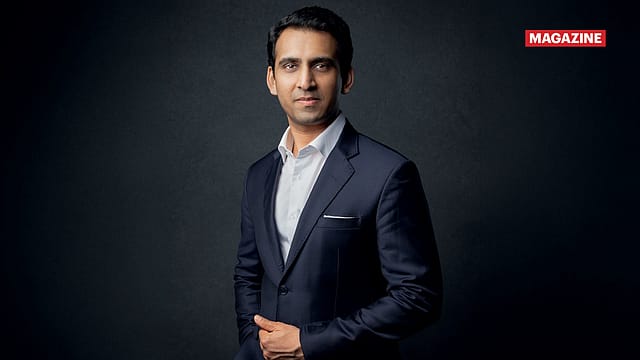
Executive Director, Adani Green Energy, Sagar Adani, 32, joined the Adani Group in 2015 after graduating in Economics from Brown University, USA. He began his career in projects and is credited with building Adani Green Energy Ltd’s (AGEL) entire solar and wind portfolio. Apart from AGEL, he oversees the other energy portfolio companies of the group–Adani Energy Solutions, Adani Power and Adani New Industries. He is also responsible for the finance function of the group and holds all key strategic financial relationships and capital allocation responsibilities across companies. Edited Excerpts.
On the ability to build large projects like China
This is not just my experience; it is pretty much the story of the group over the last 35 years. Whenever we enter a sector, we operate at a very different scale and in a different context compared with other Indian and global companies. Our chairman always motivates and guides us to think at China’s scale.
We have learnt a lot from China. In 2015, when companies were setting up 10, 20, 30, or 40 MW power plants, our first plant at Adani Green was a 648-MW single-location project—at least 10 times larger than anything anyone else had done in India at the time. In China, 400, 500, 600 and 800 MW plants were already being built.
Our philosophy has always been not to make decisions based on what others are doing, but on what India will require. How do you satisfy the demand of 1.4 billion people? The only comparable success story is China.
Today, we have 20-GW operational capacity, and are targeting about 50 GW by 2030. That is by far the largest capacity-addition programme in India and one of the most ambitious outside China. China has been adding 60, 70, 80 and even 100 GW of solar a year. In fact, we believe what we are doing is still too little compared with what India will require.
The Adani Group’s strength is its ability to execute large, complex infrastructure projects at a scale others have not done before. We have repeatedly solved issues around land, permits, supply chains and financing across ports, power, renewables, transmission and distribution.
Adani Green has reached 20 GW, largely through greenfield development and without major acquisitions. The additional 30 GW required to reach 50 GW will also be developed entirely through greenfield projects.
On 50 GW renewable target by 2030
We are fully funded. To reach 50 GW by 2030, we do not need a single dollar of external equity. We have access to domestic banks, domestic debt markets, international banks and capital markets, as well as private-placement institutions in the U.S. offering 20-25-year debt. Renewable energy is clean and sustainable, so virtually every pool of capital wants to finance it.
We also have 100% of the land required for the additional 30 GW. The necessary grid connectivity is also in place. The same applies to the two pumped-storage projects under execution. When we announce a target, we ensure it is executable after accounting for transmission, evacuation and land constraints. What we have today is effectively constraint-free capacity to reach 50 GW by 2030.
We have PPAs with SECI, NTPC, the Centre and states. But we are keeping some capacity open because we expect very large volumes of demand from data centres over the next 3-4 years. We want the flexibility to tie up this capacity with those projects.
On fast capacity addition and risk aversion
We are very disciplined about returns. Over the last 6-7 years, our asset base has quadrupled, despite operating across almost every state and under different governments. Yet our returns have remained broadly the same.
Over the next 5-6 years, our asset base will become 2.5x its current size, but our return profile will likely remain constant or improve from current levels. Normally such an intense capex cycle results in declining returns because of the sheer scale. We have been able to maintain our return threshold because we do not pursue businesses that dilute returns.
The opportunity in India also helps. The country has so much unmet demand and infrastructure to build that companies do not need to destroy each other’s returns to win projects. There is enough opportunity for everyone.
On energy security as a major business strategy
Even with India’s renewable capacity expanding rapidly, sufficient baseload generation is critical for reliable supply and grid stability. Adani Power is reinvesting its own cash flow to support India’s baseload requirements and is expanding its thermal capacity from 18 GW by adding another 40 GW by FY35.
This ambitious power generation expansion will need to be matched by an equally ambitious build-out of the supporting transmission network. With 15 projects, representing an investment of around ₹90,000 crore, AESL is creating this energy backbone–from renewable-energy evacuation and pumped-storage integration to strengthening inter-regional corridors and supplying green energy to digital infrastructure hubs.
Since acquiring the Mumbai distribution business in 2018, AEML scaled annual distribution capex nearly 2.8x to ₹1,200 crore, cutting losses in half to 4.46% and dropping outages (SAIDI) from 39.15 to 12.97 minutes. Alongside this, a critical ₹7,000 crore, 1,000-MW HVDC corridor was built to resolve Mumbai’s transmission bottlenecks and secure a direct path for clean energy. This massive grid modernisation was achieved while keeping consumer tariffs (ABR) practically unchanged since 2019, successfully anchored by a dramatic pivot in renewable energy penetration from 3% to nearly 38%.
Further, AESL’s under-implemented smart metering pipeline stands at ~2.5 crore smart meters with a revenue potential of around ₹30,000 crore. Of this, we have already installed ~1.5 crore meters across Maharashtra, Bihar, Assam, Uttarakhand and Andhra Pradesh.
This energy scale-up acts as an advantage in many futuristic sectors. For example, in data centres, our customers benefit from capabilities across power generation, transmission and distribution, helping ensure energy availability, reliability and scalability for hyperscale and AI workloads. That is the reason why majority of the data centre capacity being signed in India is with the Adani Group. We have reached around 1 GW of developed capacity this year, achieving the original 2030 target five years ahead of schedule, with a commitment to scale to 3 GW by 2030.
(For details on the Adani Forward gameplan, read the November issue of Fortune India.)