
Fortune India Exclusive: We will invest $4-5 billion in the first phase to develop Dharavi, says Pranav Adani

This story belongs to the Fortune India Magazine November 2026 issue.
ADVERTISEMENT
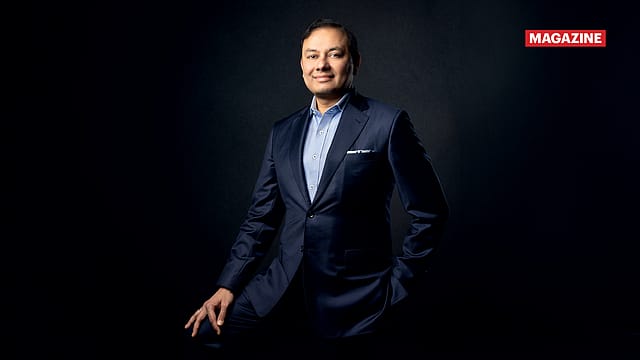
Pranav Adani, 48, director, Adani Enterprises Ltd and MD, agro, oil & gas, heads a diverse portfolio of businesses, including real estate, urban infrastructure, city gas distribution and natural resources. At the group level, he plays a key role as the chief custodian of brand Adani and oversees its communications and branding arms. An avid squash player, Pranav is passionate about sports, and is driving talent development. Edited excerpts.
On urban infrastructure and Dharavi redevelopment
As a group, we are not just a real estate developer—we are more of an urban infrastructure developer. We look at larger developments and city development in particular. Shantigram in Ahmedabad, our 600-acre township, is a classic example, with residential, commercial and retail spaces, sports facilities, schools and social amenities.
We are planning townships in Navi Mumbai and the Mumbai Metropolitan Region (MMR). The largest urban regeneration project we are undertaking, and possibly one of the largest in the world, is Dharavi.
Of the 620-acre Dharavi area, only around 270 acres are available for redevelopment. Eligible residents will be rehabilitated within Dharavi, while others will be provided homes on additional land identified by the Maharashtra government, with similar facilities. Nearly one million people live there—and we have to build over 1.5 lakh units, including residential, commercial, etc. This means we will be constructing over 200 million sq. ft.
Construction of rehabilitation housing has begun for over 10,000 rehabilitation apartments, plus commercial and industrial units.
What makes Dharavi different is that everybody gets a house. If you have a house in Dharavi, you will get a house. Those who qualify as pre-2000 residents will get it in Dharavi, while post-2000 residents can get housing anywhere in the MMR.
This is not just a housing project. We are building the entire urban infrastructure —residences, schools, hospitals, commercial spaces, hotels, entertainment centres and sports facilities. Over about seven years, we plan to rehabilitate all the slum residents. Our overarching purpose is to provide dignity in living. We want to improve living conditions while supporting the livelihoods and communities that make Dharavi what it is. The initial investment will be around $4-5 billion and will increase over time.
We plan to rejuvenate the Mithi River waterfront and develop gardens, parks and balwadis that can significantly improve the living environment. We are planning a multimodal logistics corridor with metro, MRT and buses, similar to what Hong Kong and Singapore have done, for which we have engaged the best international architects. The important point is that Dharavi cannot be planned only for today’s needs. It has to be planned for the city it will become. Infrastructure will therefore need to evolve as the population, economy and mobility requirements change.
On more cities within cities
Mumbai is an island city where almost every available piece of land is either occupied by slums or dilapidated structures. MHADA (Maharashtra Housing and Area Development Authority) and the Mumbai Municipal Corporation own much of the city’s land, and large locations are now being tendered out.
The largest township MHADA has bid out so far is the 143-acre Goregaon West project. It consists largely of ground-plus-one structures built in the 1960s and is now in a dilapidated condition. We are developing the entire area, including infrastructure, roads and other facilities, while addressing waterlogging issues. Eligible residents will get 1,600 sq. ft. houses, while the remaining area will be developed commercially. We are also looking at other MHADA redevelopments.
Near Navi Mumbai airport, we are developing a township of more than 1,000 acres. Over the next five years, at least $1-2 billion will be invested initially in its basic infrastructure. Navi Mumbai is becoming the new development centre, and the right infrastructure, entertainment and other facilities will make it possible to live, work and stay there.
In the NCR, we have taken over the assets of the Jaypee Group, including significant real estate development opportunities as well as marquee hospitality assets. These provide us with another platform to create value through redevelopment, repositioning and execution.
In all, we are currently looking at a development potential of more than 500 million sq. ft. across various locations.
On energy and nation building
Energy is basically the raw material for any industry or for anything we do. At the core of the Adani Group’s nation-building philosophy is a commitment to securing India’s long-term energy resource sovereignty. We are an execution-biased business group. Everything that sets us apart is our execution capability.
City gas distribution (CGD) is an important part of our energy portfolio. Through Adani Total Gas and its joint venture with IndianOil, we are expanding networks supplying piped natural gas to homes, businesses and industry, and compressed natural gas for transport. In city gas distribution, we have a market share of around one-fifth and have been allotted 53 Geographical Areas (GAs).
Over the next five years, we plan to invest about $120 billion, over $20 billion a year, across all our businesses. We have a five-year rolling plan. What we plan today is for the next five years, with one year becoming firm and the remaining four years being floating. As the business expands, the plan can increase.
On natural resources play
We need to have energy security as well natural resource security. From a nation-building perspective, it is very important that we look closely at commodities and natural resources. Take coal, for instance. People used to say coal was a bad word. But from the point of view of energy security, affordability, consistent availability and base-load power, we have to depend on coal. We have the fifth-largest coal reserves and are the second-largest coal producer.
The Adani Group pioneered India’s Mine Developer and Operator (MDO) model in 2009 and has since emerged as the country’s largest private-sector MDO, with 15 coal mine service contracts across its portfolio.
On listing of new companies
Listing is a very strategic call that we have to make at every point in time. As a group, we generally like to go public when we know we’ve achieved the real potential of the business. We will never take a business public at a very early stage, because then you are not really able to unlock its value. Value creation happens after you show action, achieve certain Ebitda levels or hit certain benchmarks. After that, it makes sense to go public.
Our incubation model will continue. Adani Enterprises incubates businesses and, once a business grows to a certain level and can stand by itself, we take it for listing. So, like all the businesses that have come out of Adani Enterprises, there will be more businesses coming out in the future. But it is very tough to put a timeframe on which businesses will be listed in the next one, two or three years.
(For details on the Adani Forward gameplan, read the November issue of Fortune India.)