
Fortune India Banking & NBFCs Summit 2026: Product suitability could make F&O safer for retail investors, says NSE MD & CEO Chauhan
ADVERTISEMENT
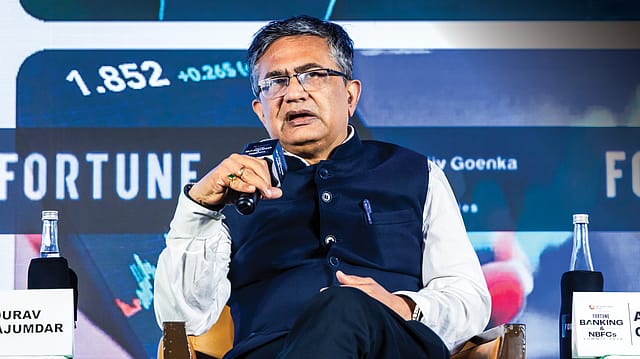
Product suitability criteria for derivatives, similar to frameworks followed in some global markets, could help make futures and options (F&O) trading safer for retail investors, said Ashishkumar Chauhan, Managing Director and CEO of the National Stock Exchange (NSE).
Speaking at a fireside chat titled Compounding the India Growth Story with Sourav Majumdar, Editor-in-Chief of Fortune India and Group Head-Business Publications at RPSG Group, at the Fortune India Banking & NBFCs Summit 2026, Chauhan said repeated warnings by regulators and exchanges may not be enough to prevent retail investors from taking excessive risks in derivatives.
“There are several sorts of complexities in decision-making and in a regulatory structure,” Chauhan said, responding to a question on why investors continue to lose money in F&O despite repeated warnings.
He pointed to international markets, including Singapore, where product suitability or minimum qualification criteria are used for certain financial products.
“Can you have product suitability for trading in derivatives?” Chauhan asked, suggesting that India could consider a similar framework for F&O.
Such a framework, he said, need not necessarily keep small investors out of derivatives altogether, but could ensure that those participating meet certain minimum criteria and understand the risks involved.
Chauhan also cautioned against assuming that investors in developed markets are inherently better equipped to trade derivatives. “You assume that America is the perfect population through trading derivatives. It’s not true because most of them are equally bad as ours,” he said.
A suitability-based framework, he argued, could allow professional and experienced participants to continue trading while reducing the exposure of inexperienced investors to complex products.
“If you keep what I call a minimum qualification criteria or product suitability guideline, all of them will meet,” Chauhan said, referring to professional traders who account for a large share of derivatives activity.
“It’s not that people are going to have less derivatives in Indian markets, it’s just that you’ll have a more safer market for small investors,” he added.
The issue assumes significance as retail participation in F&O remains high despite sustained regulatory warnings and measures aimed at curbing speculative trading.
Notably, nearly nine in 10 individual traders lost money in India’s F&O market in FY26, according to Sebi’s latest study. About 87.7% of individual traders incurred losses, with aggregate net losses of around ₹91,685 crore. The average loss per loss-making trader stood at about ₹1.17 lakh.
Individual traders cumulatively lost around ₹3.85 lakh crore in equity derivatives between FY22 and FY26. The number of active individual traders fell 20% to 78.6 lakh in FY26 from 98.1 lakh, while new entrants declined by around 40%. Despite this, the share of traders losing money fell only marginally from 90.9% in FY25 to 87.7% in FY26.
Regulation is an evolving process
Chauhan said there is no single solution to protecting retail investors in derivatives. Regulators have to balance investor protection with market development and access.
“Regulators use some of them at some point in time, and if it doesn’t work, they’ll do something else,” he said.
“It’s not black and white, or yes or no, and that’s how India will continue to evolve,” Chauhan added.
He also pointed to the rapid expansion of India’s investor base. The country had around 1.67 crore investors when Prime Minister Narendra Modi took office, compared with about 13.5 crore unique investors today.
With a much larger investor base, some participation in derivatives is inevitable, Chauhan said. The challenge, therefore, is to create safeguards that allow experienced participants to trade while protecting smaller investors from the risks of products they may not fully understand.