
NSE IPO: MD Ashishkumar Chauhan explains why NSE shares can’t be listed on its own exchange
ADVERTISEMENT
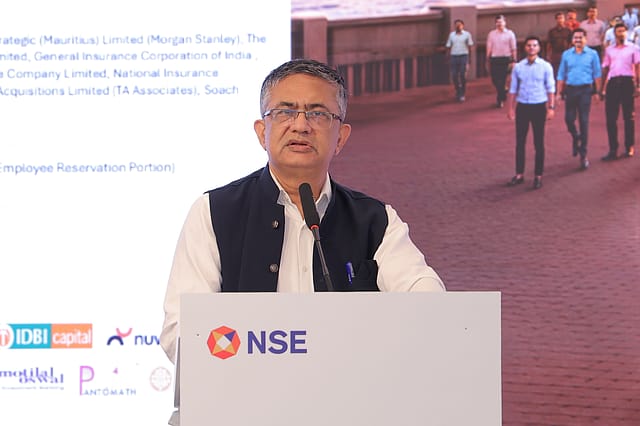
The mainboard initial public offering (IPO) of the National Stock Exchange (NSE) is set to make its much-awaited stock market debut next week, giving investors an opportunity to participate in the public listing of the country’s largest stock exchange. NSE shares will be listed only on the BSE and will not trade on both major exchanges, unlike most mainboard IPOs.
Explaining why NSE cannot list its own shares, managing director and CEO Ashishkumar Chauhan said the regulatory framework governing stock exchanges does not allow an exchange to regulate itself. The framework, introduced around 2016, requires an exchange to be listed on another exchange.
“The stock exchange cannot regulate itself,” Chauhan said at the exchange’s IPO press conference in Delhi on Tuesday.
The NSE chief pointed to BSE as an example of how the arrangement works. BSE’s shares were listed exclusively on NSE in 2017, allowing the exchange to remain subject to regulatory oversight even after becoming a listed entity.
NSE IPO opens September 17
NSE will launch its IPO on September 17, with the bidding window remaining open until September 21. The shares are expected to make their stock-market debut on the BSE on September 24.
The exchange has fixed the IPO price band at ₹1,700-1,785 per share and is looking to raise ₹22,561.5 crore at the upper end of the price band, valuing NSE at about ₹4.42 lakh crore.
The offering will comprise entirely an offer for sale (OFS), with no fresh equity being issued by NSE. As many as 12.64 crore shares will be sold by 10 existing shareholders, including State Bank of India (SBI), Bank of Baroda, MS Strategic (Mauritius), General Insurance Corporation of India, Canada Pension Plan Investment Board and Aranda Investments (Mauritius).
The number of shares on offer is around 15% lower than the 14.89 crore shares proposed in NSE’s draft red herring prospectus (DRHP) filed in June. The IPO received Sebi’s approval on September 4.
NSE has also reserved shares worth up to ₹70 crore for its employees. Eligible employees will receive a ₹170-per-share discount on the final IPO price.
Anchor book sees stronger-than-expected demand
Ahead of the opening of its public issue, NSE’s IPO is seeing strong demand from both foreign and domestic institutional investors for its anchor book. The anchor book is estimated at around ₹6,250 crore and will open for a day on September 16.
Chauhan said institutional demand for the anchor book has been “unexpectedly large”, with significant interest from foreign portfolio investors (FPIs) and domestic mutual funds.
“You will see the numbers tomorrow. It’s pretty nice,” he said, adding that the banker book was “pretty large” and much bigger than what the exchange had expected.
Chauhan said the anchor book, which was earlier expected to be around ₹9,000 crore, had been reduced to around ₹6,254 crore, partly due to the allocation framework for different categories of institutional investors. Despite the lower anchor allocation, overall demand was much larger than the number of shares available for allocation.
“The demand is much larger,” Chauhan said, pointing out that mutual funds, pension funds and other domestic institutions, as well as FPIs, have separate allocation requirements.
(DISCLAIMER: The views and opinions expressed by investment experts on fortuneindia.com are either their own or of their organisations, but not necessarily that of fortuneindia.com and its editorial team. Readers are advised to consult certified experts before taking investment decisions.)