
Sebi keen to continue to develop, rather than disrupt, derivatives market: Tuhin Kanta Pandey
ADVERTISEMENT
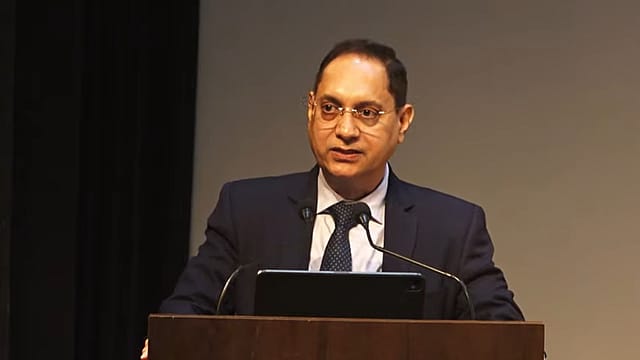
The Securities and Exchange Board of India on Wednesday said it is keen to develop the derivatives market, despite all the concerns over investor losses and tighter regulation, and not do something to disrupt it.
Speaking at the 13th annual SBI Banking & Economics Conclave, Sebi chairman Tuhin Kanta Pandey told the gathering: “We have to really see how do we really envision the situation going forward, and certainly things would be to really develop the market in a more positive sense than just doing something which will unnecessarily disrupt it,” he said, speaking to moderator Ashwini Kumar Tewari, SBI’s managing director (corporate banking and subsidiaries).
According to Sebi’s latest study, 87.7% of individual traders lost money in FY26, with aggregate net losses of around ₹91,685 crore. The average loss per loss-making trader rose marginally to about ₹1.17 lakh. Individual traders have cumulatively lost around ₹3.85 lakh crore in equity derivatives over FY22-FY26.
Nearly nine in 10 retail traders lost money in India’s futures and options (F&O) market in FY26. Despite steep losses and tighter regulations, traders continue to return to derivatives, drawn by the possibility of outsized returns, easy access and the psychological pull of recovering losses.
“The derivative market is a very important market, and it's a link between cash and futures,” Pandey said. “The problem that we had faced, particularly relating to index options, which are short-dated, along the period of expiry. We have many other derivatives where the need to much more. For example, longer-term derivatives, the futures, and also stock futures, and stock options of longer-dated versions. Unfortunately, the market is quite limited in favour of particularly options trading, and that too around the index options,” the Sebi chief said.
Between 2023 and 2026, Sebi conducted three studies on this segment, being possibly the only regulator in the world to come out with a profit and loss study for individuals in the capital market.
After regulatory measures were taken over the past two years, such as position limits coming to risk categories, changing into delta, and also looking at larger contract sizes, these have had some impact in terms of behaviour.
“But we have also put it out, the losses remain high. Of course, there are many people who are new, the new people enter, and some people also quit,” Pandey said.
In his speech, Pandey said the relevant question was not about economic growth in the last quarter.
“It’s what will be required to sustain India's growth over the next decade and beyond. Part of the answer lies in productivity, infrastructure, technology, and human capital,” Pandey said.
“A growing economy needs a growing pool of capital. We need capital for infrastructure and manufacturing. We need it for urbanization and energy transition. We need finance for MSMEs as well as large companies. We need capital for traditional businesses and for enterprises built around technologies that may not even have existed a decade ago. These requirements cannot all be met in the same way,” he said.
He said that some businesses need debt, while others would need risk capital. Growth should be financed by banks and the capital markets.
“Banks and capital markets are not competing destinations. They are complementary parts of the same financial ecosystem. And over the last decade, the role of securities markets within this ecosystem has expanded significantly.”
Over the ten years, Indian companies have raised an average of around 10 trillion rupees every year through equity and debt issuances in the securities market. The pool of domestic savings coming into the markets has also expanded substantially.
Mutual fund assets under management have grown from around ₹12 lakh crore in FY16 to about ₹87 lakh crore by August 2026, a compound annual growth rate of more than 20%.
Pandey stressed that the corporate bond market, though growing, had huge potential. As of August 26, outstanding corporate bonds had increased to around ₹61 lakh crore. To put that number in perspective, it is equivalent to around 55% of outstanding bank credit to industry and services.
Recently, Sebi introduced the next generation of market infrastructure through a pilot tokenisation of corporate bonds under DMAT 2.0.
“The objective is to explore whether technology can make issuance, settlement, and servicing more efficient. At the same time, we should also recognize the journey is not complete. Greater liquidity, broader investor participation, and stronger price discovery mechanism remain important areas of work,” he said.