
Sensex declines over 2,000 pts in five sessions; what’s next for Dalal Street this week?
ADVERTISEMENT
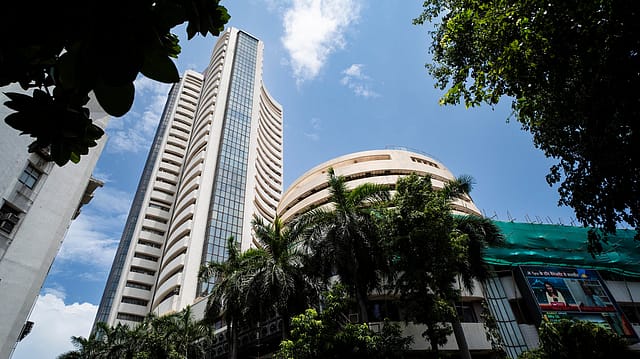
Dalal Street heads into this week on a cautious note after benchmark indices suffered their steepest weekly decline in months during the week ended July 24, weighed down by surging crude oil prices, renewed geopolitical tensions, and disappointing earnings from several banks.
The BSE Sensex plunged 2,092 points, or 2.68%, over the week to close at 76,059.77, while the NSE Nifty 50 fell 2.33% to settle at 23,767.45, its lowest closing level since June 12.
The weakness was broad-based, with midcap and smallcap indices also declining between 1.29% and 2.18%, reflecting widespread selling across sectors.
Persistent foreign institutional investor (FII) selling and weakness in the rupee further dampened investor sentiment despite resilient domestic macroeconomic indicators.
On the sectoral front, banking, financial services, and realty stocks emerged as the biggest laggards after mixed Q1FY27 earnings, while weakness extended to select IT, energy, and pharmaceutical counters. In contrast, the auto sector outperformed, supported by robust quarterly results from Bajaj Auto and TVS Motor.
Fed policy, crude oil, geopolitics, and earnings to steer markets this week
According to market experts, equity markets are expected to remain volatile this week as investors track developments in the US-Iran conflict, crude oil prices, the US Federal Reserve's policy decision, and the ongoing Q1FY27 earnings season. Domestic macroeconomic data, including June industrial production (IIP), fiscal deficit figures, and foreign exchange reserves, will also be closely monitored.
Market participants believe global developments will continue to dominate sentiment after benchmark indices ended last week with sharp losses amid rising oil prices, geopolitical tensions, and persistent foreign institutional investor (FII) selling.
"Developments surrounding the US-Iran conflict, shipping activity through the Strait of Hormuz, and movements in crude oil prices will remain key drivers of global risk sentiment," said Ajit Mishra, SVP, Research, Religare Broking.
He added that the US Federal Reserve's policy meeting would be another major event, with investors closely watching its commentary on inflation and the future interest rate trajectory.
On the domestic front, Mishra expects June IIP data, fiscal deficit figures, and foreign exchange reserves to provide fresh cues on the economy, while the ongoing earnings season will continue to drive stock-specific action.
FIIs continue to sell, offload ₹7,180 crore
Pabitro Mukherjee, Deputy Vice President-Research at Bajaj Broking, said foreign institutional investors (FIIs) remained net sellers last week, offloading ₹7,180 crore, while domestic institutional investors (DIIs) bought ₹8,640 crore worth of equities, helping cushion the market decline.
According to Mukherjee, foreign flows are likely to remain volatile until there is greater clarity on geopolitical developments and crude oil prices. He believes these factors will be crucial in restoring investor confidence and improving the outlook for equities.
Ponmudi R, CEO of Enrich Money, said the escalating conflict in the Middle East has once again made crude oil the most important macroeconomic variable for financial markets.
"The U.S. Federal Reserve's policy meeting will be the defining macro event of the week," he said, adding that while rates are widely expected to remain unchanged, investors will closely examine the central bank's assessment of inflation, particularly in light of higher energy prices.
He also expects earnings from major US technology companies, including Microsoft, Amazon, and Meta Platforms, to influence global risk sentiment, especially regarding artificial intelligence spending and cloud demand.
Domestically, quarterly results from consumer and defence companies will remain in focus, with investors looking for management commentary on demand trends, input costs, margins, and capital expenditure.
Technical outlook
According to SBI Securities, the technical setup remains weak for both benchmark indices.
For the Sensex, the 75,500-75,300 zone is seen as a key support area. A decisive break below 75,300 could trigger further downside towards 74,500 and 74,000. On the upside, the 76,700-76,800 zone is expected to act as a strong resistance.
For the Nifty, immediate support lies in the 23,650-23,600 range. A sustained breach below 23,600 could extend the correction towards 23,450 and 23,300. Resistance is placed around the 23,950-24,000 zone, where the 50-day exponential moving average is likely to attract selling pressure.
Analysts recommend maintaining a selective approach, focusing on companies with strong earnings visibility, healthy balance sheets, and resilient business models. Sectors such as automobiles, select pharmaceuticals, industrials, and quality NBFCs are expected to remain relatively better positioned, while caution is advised in sectors facing margin pressure from elevated energy costs.
(DISCLAIMER: The views and opinions expressed by investment experts on fortuneindia.com are either their own or of their organisations, but not necessarily that of fortuneindia.com and its editorial team. Readers are advised to consult certified experts before taking investment decisions.)