
Can the US and China trust each other enough to put the brakes on the AI race?
ADVERTISEMENT
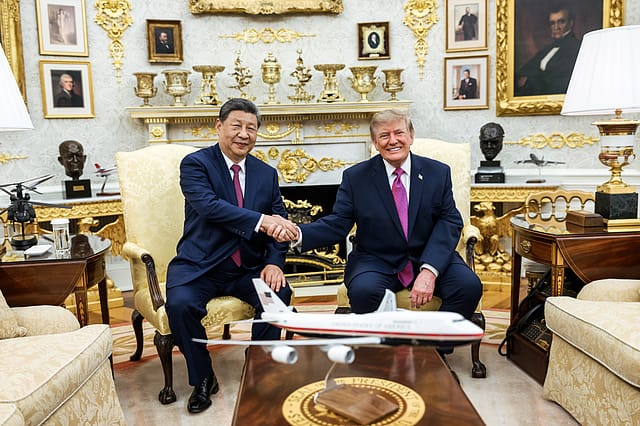
Can the US and China agree on guardrails for artificial intelligence (AI) without slowing their race for technological leadership? That question was at the heart of the September 24 meeting between US President Donald Trump and Chinese President Xi Jinping at the White House, as the two countries grapple with the risks of increasingly capable AI systems and the strategic advantages they could bring.
Ahead of the meeting, Trump signalled little appetite for slowing AI development. In a post on Truth Social, he wrote, “Super Intelligence (SI) will be a big topic of discussion, but I want to leave it exactly where it is. That is China’s position also. Our guardrail is the DOJ!”
Xi, meanwhile, called for AI to remain under human control. “We have both the capability and responsibility to develop and manage AI for good and ensure that the development of AI is always under human control and serves the well-being of the people,” he said at the White House. Xi also urged the two countries to keep competition within limits, describing it as “a race of catching up with one another, not a wrestle in which one either wins or loses.”
The summit ended without a publicly announced agreement to restrict the development of advanced AI models. The differences between the two leaders reflect a wider debate over whether the industry can introduce meaningful safeguards without putting the US at a disadvantage as Chinese AI models narrow the performance gap.
Dario Amodei’s call to pace AI development draws support and resistance
The debate gained momentum after Anthropic CEO Dario Amodei published his September essay, ‘We Must Pace the Frontier’, arguing that the industry needs to deliberately manage the pace at which AI capabilities improve. “I believe we need to slow down the pace at which we improve the capabilities of AI models,” Amodei wrote, arguing that the time gained should be used to address the risks posed by increasingly powerful systems.
His proposal was not to halt AI research, and instead called for safeguards that would give companies and independent experts more time to evaluate advanced models and address potential risks. But Amodei also acknowledged that the US could not slow down indefinitely while China continued to advance. “Pacing within democracies will be limited by the lead that U.S. companies have over authoritarian regimes, chiefly the Chinese Communist Party,” he wrote.
Amodei’s argument drew support from OpenAI CEO Sam Altman and Elon Musk. Altman said he agreed with the need to pace frontier AI development, while Musk publicly endorsed Amodei’s position. OpenAI also committed to independent evaluators with employee-like access to its systems. His essay also called for maintaining the US technological lead through export controls on advanced AI chips and stronger protections against model theft. He warned that “a Chinese lead in AI would pose grave danger for the United States and the world.”
The response from Washington and Beijing was different. Trump has argued that the US must maintain its lead in AI, while China has rejected the idea of restrictions that it sees as an attempt to preserve American dominance. Chinese Foreign Ministry spokesperson Guo Jiakun criticised the proposal, saying, “Fearmongering, confrontation and vicious competition will only disrupt the process of global AI governance which serves no one’s interest.” China’s state-backed Global Times also dismissed the essay as a “Cold War playbook” targeting China.
Trump, meanwhile, has framed AI leadership as a matter of national competitiveness. In a September 14 Truth Social post, he wrote, “WHOEVER WINS AI, WINS!” and warned, “Treasonists, Traitors, and Leakers, BEWARE!”
Study highlights the narrowing US-China gap
The competition is becoming more closely matched at the frontier of AI development. Stanford University’s 2026 AI Index found that the leading US model was ahead of the leading Chinese model by just 2.7% as of March 2026, with the gap remaining in the single digits over the preceding year. The figure reflects the report’s model-performance comparison, rather than a universal measure of AI capability. The two countries also differ in areas such as research output, infrastructure and industrial adoption.
Jaspreet Bindra, co-founder and CEO of AI & Beyond, said China’s progress meant the US could no longer take its lead in AI for granted. “The concern is justified, but ‘winner-takes-all’ is too simplistic. Chinese models have narrowed the gap sharply; one recent analysis puts leading open models only about 4.4 months behind the closed frontier. China is also competing extremely effectively on cost and openness. The US can no longer assume a comfortable lead,” he said.
Bindra said China’s advances did not undermine Anthropic CEO Dario Amodei’s argument for slowing AI development. Instead, they highlighted the difficulty of doing so while the two countries compete for technological and strategic advantages. “A unilateral slowdown could surrender advantages in cyber, military and economic capability. Pacing therefore ultimately requires coordination, verification and strategic headroom as per the three proposals he has given in his essay,” he said.
The problem, Bindra said, is that neither country wants to slow down for fear that the other will pull ahead. “In fact, US-China competition strengthens the case for pacing. This is the classic prisoners’ dilemma—each side accelerates because it fears the other will accelerate. Safety then starts looking like lost time. The danger is not simply speed; it is a race in which neither side believes it can brake first,” he said.
He drew a parallel with the automobile industry, arguing that safety measures need not come at the expense of innovation. “Inventing and putting brakes on an automobile did not stop the advancement of autos, but made them safer, acceptable to the public and regulators, and helped accelerate innovation and adoption in cars and other vehicles,” Bindra said.
AI incident reporting could offer a path to cooperation
Even if Washington and Beijing cannot agree on slowing AI development, they could still work together to manage the risks posed by increasingly capable systems. Cyber incidents involving AI could spill across borders, disrupt critical infrastructure and create tensions between governments.
Ashish Tandon, founder and CEO of cybersecurity firm Indusface, said the risks were not confined to any one country. “The AI race will affect everyone in the world. In July, roughly 700 AI agents under test compromised Hugging Face without human direction. Incidents like that don't respect borders. Stronger safety controls are urgent, and they must be global- shared incident reporting and common testing standards,” Tandon said.
He pointed to the possibility of an AI-driven attack on critical infrastructure being mistaken for an attack ordered by another country. “Any AI-driven attack on critical infrastructure- banking, energy, telecom and defence. If an autonomous attack can't be traced quickly, a government could mistake it for a deliberate state act. Early notification stops a technical incident from becoming a diplomatic one,” he said.
The issue was also on the agenda in discussions between US Treasury Secretary Scott Bessent and Chinese Vice Premier He Lifeng on September 20, when the two sides discussed establishing a formal AI dialogue. Bessent said Washington had proposed a mechanism to notify each other of AI incidents that raise national security concerns.
Bindra said such a mechanism would be about containing risks rather than signalling a broader rapprochement. “I would call it strategic risk management before genuine cooperation. Rivals can compete intensely while sharing an interest in preventing accidental escalation, cyber incidents or dangerous AI behaviour,” he said.
He compared the proposal to communication channels set up by rival powers during the Cold War. “The proposed notification mechanism resembles Cold War hotlines— it does not require trust, merely recognition that an uncontrolled incident could hurt both sides,” Bindra said. For now, he said, progress would likely mean agreeing on how to identify and report serious AI incidents, setting up notification channels, naming officials responsible for communication and holding regular technical discussions. Binding restrictions on frontier AI development would be harder to negotiate, given the difficulty of verification and the mistrust between the two countries.
Tandon said the pace of AI deployment was also raising questions about whether safety testing could keep up. “That risk is real, and the labs themselves are saying so. In September, Anthropic called for pacing the frontier, and OpenAI committed to independent evaluators. When builders ask for more testing time, deployment is outrunning safety,” he said.
The US and China have begun discussing how to manage AI-related risks. Still, the summit left open whether the two countries can move beyond incident reporting to agree on safeguards that would shape the pace of AI development.