
'Improve people’s lives': Sundar Pichai outlines Google’s big AI push across health, weather and education
ADVERTISEMENT
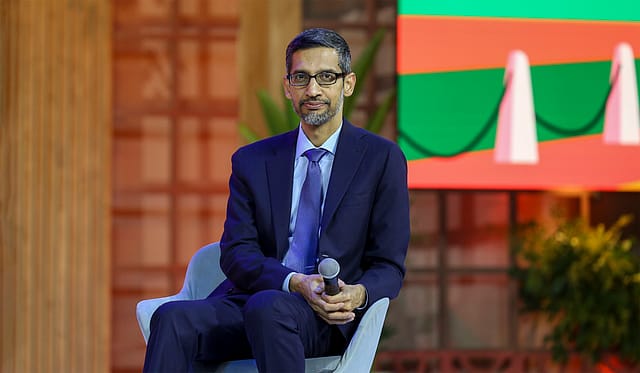
Google CEO Sundar Pichai has outlined how the company is expanding its use of artificial intelligence beyond generative AI, with a focus on healthcare, weather and disaster prediction, education and economic opportunity. “Today we have set out how we’re building AI to accelerate science and improve people’s lives,” Pichai said in a post on X, highlighting some of Google’s AI developments from the past few weeks.
Pichai pointed to four areas where Google is focusing its AI efforts--health, natural disaster and weather resilience, learning, and economic opportunity. His post came alongside a Google blog by James Manyika, SVP, Research, Labs, Technology & Society, which detailed the company’s work across these areas.
How is Google using AI in health and weather?
Pichai highlighted Google’s AlphaGenome Atlas, saying it had mapped “all 9B possible single letter genetic changes across the human genome” and made the resource openly available to researchers. Google’s blog provides more detail on the project. AlphaGenome Atlas contains predictions for the effects of all 9 billion possible single-letter changes in the human genome. Google said the resource builds on AlphaGenome and AlphaMissense and is intended to help researchers understand how genetic variations can affect molecular biology.
Google also pointed to AI applications in disease detection. The company said a recent breast cancer study with Imperial College London and the UK’s National Health Service showed that AI could detect 25% of interval cancers previously missed in mammograms involving 175,000 women. Its AI tools are also being used for tuberculosis screening and diabetic retinopathy. Google said its diabetic retinopathy model has supported more than 1.15 million screenings globally, with plans to expand to 6 million over the next decade.
On weather, Pichai said, “Billions of decisions depend on weather predictions so we introduced WeatherNext 3, our most accurate and capable global weather AI model to date.” Google said WeatherNext 3 provides 50% more accurate precipitation forecasts a day or more ahead and uses real-time satellite observations to generate high-resolution, hourly forecasts. The model has also been integrated into Google’s products.
Google said its AI-based flood forecasts now cover areas at risk of significant flooding for 2 billion people across more than 150 countries. In India, the company said its monsoon predictions provided information for 38 million farmers in 2025. The company has also introduced an Earth AI Planetary Prediction Engine that brings together information on health, food security and socioeconomic conditions to predict potential crises. Google said it has been used during the ongoing Ebola outbreak in the Democratic Republic of the Congo and to identify vulnerable communities in the US.
What is Google’s AI strategy for learning and the economy?
Learning is another area Google has identified as a key application for AI. The company said AI could help personalise education, make learning material more accessible across languages and assist teachers with research and preparation. Google also acknowledged concerns around the use of AI in education, including accuracy, safety, cheating, critical thinking and learning loss. It said it has partnered with ISTE+ASCD to provide AI literacy training to 6 million educators in the US.
On the economic side, Pichai highlighted AI & Economy ATLAS, which Google described as an open-access resource examining how people around the world are using AI. “We published AI & Economy ATLAS, a comprehensive open-access look at how people are using AI globally,” Pichai said.
Google’s blog said the resource is intended to provide insights into how AI is being used by people and businesses and how the technology is affecting economies and workplaces. The company said AI could change work in several ways, with some jobs declining, others growing and many roles changing as workers increasingly use AI tools. Google also highlighted its skilling initiatives. The company said it has provided more than $1 billion globally through training and skilling programmes, helping more than 100 million people gain digital and AI skills.
How many languages does Google’s AI support?
Pichai also highlighted advances in AI-powered translation. “AI has enabled extraordinary advances in language translation. Today our services are available in nearly 300 languages, spoken by 7B people,” he said. Google’s blog says its technologies now support more than 300 languages spoken by 7 billion people, representing 86% of the global population. The company said its translation technologies are used by more than 1 billion people to translate around 1 trillion words each month.
Google said its longer-term goal is to support the world’s 1,000 most-spoken languages. It is also working on speech technology for languages that have historically had limited digital representation. In India, Google has partnered with IISc Bengaluru and ARTPARK on Project Vaani, which aims to create and open-source speech and image datasets covering 109 Indic languages.
Google also cautioned that the benefits of AI are not guaranteed. “The benefits of AI are not guaranteed,” the company said in its blog, adding that making those benefits real while addressing the technology’s risks “demands that society works together.”