
Microsoft’s AI strategy moves beyond models to the economics of intelligence
ADVERTISEMENT
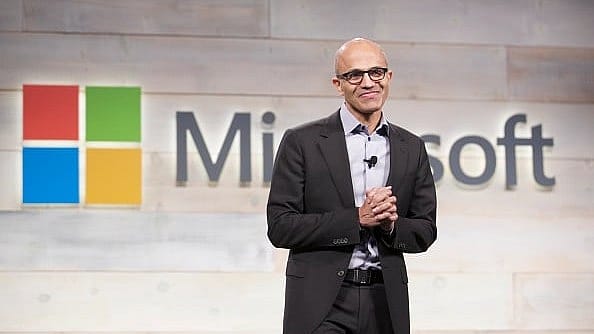
Microsoft is entering the next phase of the artificial intelligence race with a strategy that goes beyond building or backing individual AI models. The company is increasingly positioning itself as the platform through which businesses can choose models, deploy AI agents, connect enterprise data and manage the cost of running increasingly complex workloads.
That direction is becoming more important as the AI industry moves from training increasingly powerful models to deploying them at scale. The economics of inference—the cost of actually running AI models for users—is becoming a bigger concern for enterprises. Gartner has warned that inference costs per agentic workflow could increase more than fivefold through 2028 as AI systems move from simple chatbot interactions to multistep tasks requiring repeated reasoning.
Microsoft CEO Satya Nadella addresses this shift directly in the company’s 2026 annual shareholder letter, describing what he calls the “cost-to-outcome” frontier. “Customers will increasingly measure the cost of tokens against the outcomes they produce,” Nadella wrote. “We call this the ‘cost-to-outcome’ frontier, and we are focused on optimizing it.”
That focus is already visible in Microsoft’s financial performance. For fiscal 2026, revenue rose 18% year-on-year to $331.8 billion, while Microsoft Cloud revenue increased 27% to $214.4 billion. Azure grew 41% and crossed $100 billion in revenue for the first time. Microsoft 365 Copilot, meanwhile, crossed 30 million paid seats.
The strategy is also aligned with a broader industry shift. AI companies are increasingly focusing on inference efficiency, specialised chips, agentic systems and multimodel architectures rather than relying exclusively on ever-larger frontier models. McKinsey expects inference to account for about 60% of AI demand by 2030, compared with roughly 40% for training.
Microsoft’s approach, however, has a particular twist--it is not betting that one model will win. “The tech stack we are building is model-forward and agent-first,” Nadella said. “Models will continue to become more capable, while agents will take increasingly complex workflows through to completion.”
Microsoft has a complicated position in the AI ecosystem. It has a deep relationship with OpenAI, while simultaneously offering models from rivals such as Anthropic and Mistral through Azure. Rather than forcing customers into one model family, Microsoft is attempting to make model choice itself part of its platform.
What makes Microsoft’s AI play different from the rest
The clearest difference in Microsoft’s strategy is its attempt to separate the AI model from everything around it.
Microsoft says its new architecture separates the “harness”—including context, memory and action space—from the underlying model. This allows customers to change models without rebuilding the entire AI system. Its Azure platform now offers more than 11,000 models, including models from OpenAI, Anthropic, Mistral and others, alongside Microsoft’s own MAI models. “The right model for the right job” is effectively the philosophy behind this approach, with Microsoft arguing that enterprises should be able to use frontier models for demanding workloads, cheaper models for routine tasks and their own models where appropriate.
This is not entirely unique to Microsoft. The broader industry is moving towards multimodel and specialised architectures as companies try to balance quality, latency, compliance and cost. Microsoft, however, is attempting to make that flexibility a central selling point of its cloud platform rather than simply another product feature.
Its own earnings commentary makes that explicit. Microsoft said the number of customers building with models from multiple providers had increased fivefold since the start of the year. It also said customers increasingly want to select models based on “quality, latency, cost, and compliance.”
The other differentiator is the company’s access to enterprise context. Microsoft is using products such as Microsoft IQ, Work IQ and Foundry to connect models and agents with corporate emails, documents, meetings, databases and other operational information. Foundry has crossed 100,000 customers, while Work IQ spans more than 17 exabytes of data, according to the annual letter.
Nadella argues that this gives enterprises something that goes beyond access to a powerful model--a proprietary learning system built around their own data. “The world’s most valuable data resides inside customers’ systems,” he wrote. “Every customer should be able to use that data to build agentic systems that improve continuously while retaining control of their IP.”
Microsoft is simultaneously pushing down the infrastructure stack. It added 88 datacenters during the year and is developing its own Maia and Cobalt chips. Maia 300 is claimed to deliver 40% more tokens per watt than leading GPU-based systems, while Cobalt 200 offers more than 50% higher performance than Microsoft’s first custom cloud processor.
This again follows a wider industry trend. Meta, for instance, is also developing custom AI silicon with an inference-first strategy. But Microsoft’s ambition is broader. It wants the same platform to encompass infrastructure, models, enterprise data, agents and applications.
Nadella summed up the strategy in unusually explicit terms. “This combination of widely used first-party agents, a multimodel system grounded in rich enterprise context, and hyperscale infrastructure is our differentiator.”