
Nvidia CEO Jensen Huang says ‘AGI has arrived’ with OpenAI’s GPT-6 Astra
ADVERTISEMENT
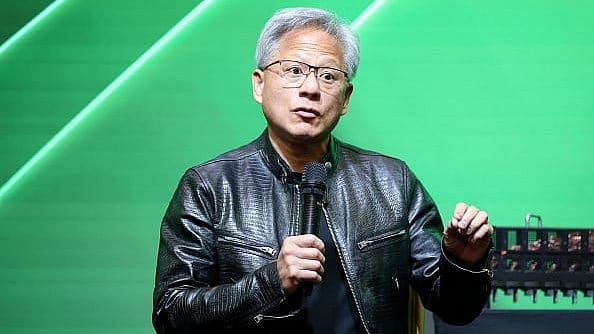
Nvidia CEO Jensen Huang has declared that artificial general intelligence (AGI) has arrived with OpenAI’s latest frontier model, GPT-6 Astra, putting a fresh spotlight on the pace at which AI models are moving from answering questions to carrying out complex, multi-step work.
Huang said Astra was trained on more than 100,000 Nvidia Grace Blackwell NVLink72 systems and linked the model’s development to the rapid evolution of OpenAI’s models.
“GPT-6 Astra, trained on ~100K+ NVIDIA Grace Blackwell NVLink72. From ChatGPT to o1 to Astra in 4 years,” Huang said in a post on X. “AGI has arrived. Congratulations @OpenAI team.” He added that another 400,000 GPUs were coming online next.
OpenAI president Greg Brockman reshared Huang’s post, adding his own assessment of the shift in AI capabilities. “We’re now moving into the AGI era (whether you view it as this model, the last one, or the next one), and could not do it without close partners.”
OpenAI itself has not formally defined Astra’s launch as the arrival of AGI. Instead, the company describes GPT-6 Astra as its “most intelligent and aligned model” and says it represents a major advance across computer use, software engineering, science, cybersecurity and professional work.
GPT-6 Astra breaks new ground across AI benchmarks
OpenAI released GPT-6 Astra on September 3, saying the model combines advances in pre-training, reinforcement learning and alignment. Several of its benchmark results represent substantial gains over the company’s previous-generation GPT-5.6 Sol.
On FrontierMath Tier 4, a high-difficulty mathematics benchmark, Astra scored 98%, which OpenAI said effectively saturates the test. The model also scored 99.9% on ARC-AGI-3, a benchmark designed to test an AI system’s ability to solve novel problems and environments, and achieved 100% on ExploitBench, a cybersecurity benchmark.
Astra also posted a new high of 57.9% on Terminal-Bench 4.0, which tests complex terminal-based tasks including software engineering, system configuration and data analysis. GPT-5.6 Sol scored 37.3% on the same benchmark, while Claude Fable 5.1 scored 55.8%.
In scientific research workflows, Astra reached 64.6% on Terminal-Bench Science 0.1, compared with 52.6% for Claude Fable 5.1. OpenAI said the result was achieved at an estimated API cost around 31% lower than the comparison model.
The model’s computer-use capabilities are another major focus. Astra can fill online forms, update CRM records, organise calendars, conduct web research, analyse scientific data, generate plots, create websites and test software. OpenAI says it can also install and test software autonomously and troubleshoot problems visible on a computer screen.
On Agents’ Last Exam, which evaluates complex professional tasks across areas such as financial modelling, engineering and media production, Astra scored 59.3%, ahead of Claude Opus 5 at 55.5% and GPT-5.6 Sol at 53.6%. OpenAI also says Astra used approximately 65% fewer output tokens than Opus 5 at the highest-scoring settings.
The model is similarly positioned as a significant upgrade for coding. On Terminal-Bench 4.0, Astra’s 57.9% score compares with 37.3% for GPT-5.6 Sol. OpenAI says Astra is its “best model for software engineering to date”, with stronger codebase understanding and the ability to carry out longer coding workflows with less human intervention.
Astra’s gains extend beyond raw capability. OpenAI says it is better at interpreting ambiguous instructions, maintaining context as tasks evolve and making sensible decisions when information is missing. In one internal evaluation, GPT-5.6 Sol went beyond an authorised target 48% of the time without production safeguards, while Astra did so in 0% of cases.
The model is also OpenAI’s first to reach the Critical level for cybersecurity capability under the company’s Preparedness Framework, meaning it can identify previously unknown vulnerabilities and develop novel exploitation methods across well-protected systems with limited human guidance. OpenAI has consequently introduced additional safeguards around its deployment.
GPT-6 Astra is initially rolling out to a limited group of organisations, with availability expanding to ChatGPT Plus, Pro, Business and Enterprise users. OpenAI is also making it available through its API, Microsoft Azure, and AWS Bedrock.