
Zuckerberg toes the Trump line on AI; sets aside slowdown calls by Satya Nadella, Dario Amodei
ADVERTISEMENT
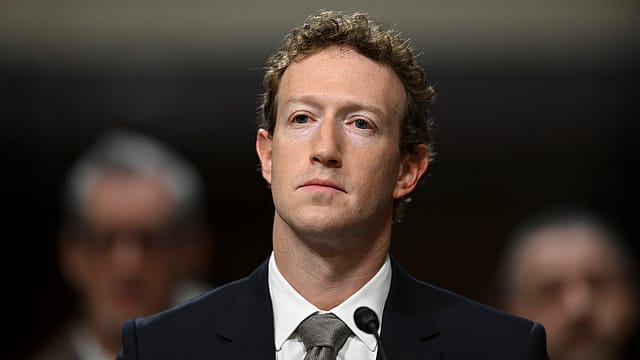
The debate over how quickly the world should develop increasingly powerful AI systems has split some of Silicon Valley’s biggest names, with Zuckerberg now firmly arguing against a coordinated industry-wide slowdown.
In a post on X, Zuckerberg said AI companies have both the responsibility and the incentive to ensure their models are developed safely, without waiting for an industry-wide agreement to slow progress.
“Every lab has the responsibility and incentive to move at the pace required to train its models safely,” Zuckerberg said.
He argued that market forces themselves would push AI companies towards safer and better-aligned systems.
“Trust and alignment are quickly becoming the most important capabilities that will differentiate agents and models,” Zuckerberg said, adding: “Any lab that doesn’t focus on alignment will fall behind.”
Zuckerberg pointed to Meta’s decision to delay the release of its Muse AI agent by several months to focus on safety and security. He said Meta did not ask other companies to stop developing their systems while it did so.
“We didn’t call for everyone else to do this before we would. We just did it,” he said.
The comments came just days after Anthropic CEO Dario Amodei called for the AI industry to pace the development of frontier models, warning that AI capabilities could advance faster than the safeguards needed to control them.
Amodei: AI race needs to slow down
Amodei, in his essay We Must Pace the Frontier, argued that the industry needs to slow the rate at which AI capabilities improve so that safety measures can catch up.
His argument has received backing from several of the industry's biggest names.
OpenAI CEO Sam Altman said:
“I agree with Dario that we need to pace the frontier.”
Altman also backed Amodei’s proposal for independent evaluators to receive employee-like access to frontier AI systems.
Elon Musk was even more direct, responding to Amodei’s argument with:
“Dario is right.”
Google DeepMind CEO Demis Hassabis also backed the direction of Amodei’s proposal, saying:
“Dario’s essay points towards the right path forward.”
Nadella backs safety — but wants AI benefits accelerated
Microsoft CEO Satya Nadella has taken a somewhat more nuanced position. He backed stronger safeguards and the use of independent evaluators, while simultaneously arguing that the benefits of AI should be spread faster and more broadly.
“Any pursuit of superintelligence has to be grounded in the core principle that if the AI we build is not helping humanity and under human control, it’s not worth pursuing,” Nadella said.
At the same time, he called for AI benefits to be “accelerate[d] and spread” across countries, communities and companies, arguing that both closed and open-source models should have room to develop.
Trump: “Whoever wins AI wins”
Zuckerberg’s position also comes against the backdrop of Trump’s opposition to calls for a broad AI slowdown.
Trump has argued that slowing American AI development could undermine the US position against China. Speaking in Ireland, he said:
“We’re leading China in AI, we’re the most sophisticated country in the world, and frankly, I want to keep it that way because whoever wins AI, wins.”
Trump said guardrails could still be put in place but dismissed what he described as exaggerated warnings about AI.
Zuckerberg’s own earlier essay makes the geopolitical argument even more explicit. He described AI as potentially “the most competitive industry in history” and said even a two-month lead could be valuable because technological advantages are rapidly copied.
“Any policy that slows American model releases — even by a month — could add significant risk to American leadership while letting foreign models race ahead,” Zuckerberg wrote.
He has nevertheless stopped short of arguing that AI safety should be ignored. Zuckerberg supports independent evaluators, stronger governance and closer cooperation between AI labs and governments. Meta, he said, is also putting the “significant majority” of its compute towards serving users rather than racing towards recursive self-improvement.
Jensen Huang also rejects the slowdown argument
Nvidia CEO Jensen Huang has similarly pushed back against the idea that AI development must choose between speed and safety.
Huang has argued that the two can be pursued simultaneously, calling the supposed trade-off between the two a “false” choice.
That leaves the industry facing a sharp divide. Amodei, Altman, Musk and Hassabis have backed some form of pacing, safeguards or independent oversight, while Zuckerberg and Huang argue that individual companies can take responsibility for safety without agreeing to a coordinated slowdown.