
'Dario pretending to be a perfect little angel': Trump tutors Anthropic chief, says can't let China win AI race
ADVERTISEMENT
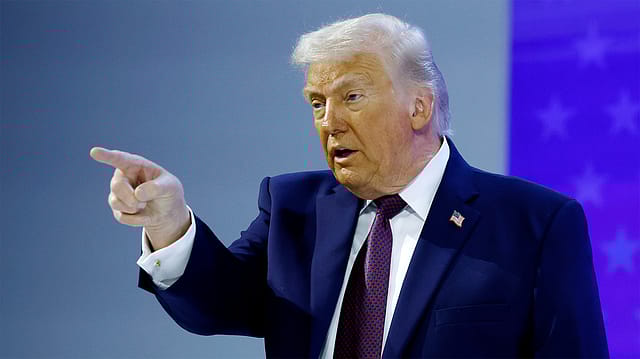
US President Donald Trump has rejected calls to slow the development of advanced artificial intelligence, directly pushing back against Anthropic CEO Dario Amodei and other tech leaders who have raised concerns about the pace of AI development.
Trump said the US cannot afford to ease off in the AI race with China, arguing that maintaining American technological leadership is a strategic priority.
“We're leading China in AI. We're the most sophisticated country in the world, and frankly I want to keep it that way because whoever wins AI wins,” Trump told reporters in Ireland on Sunday.
On Monday, Trump sharpened his criticism in a post on Truth Social, saying the only “guardrails” AI needs are a “STRONG AND SMART” president. He argued that the US already has significant criminal and regulatory powers over AI companies and accused critics of AI and data-centre expansion of being part of a “SICK conspiracy” that benefits China.
Trump also directly targeted Amodei, saying his administration had already stopped AI companies and individuals from doing “bad, or potentially bad” things and would continue to do so.
Amodei calls for AI slowdown
Trump's comments come days after Amodei called for the AI industry to slow the pace of improvements in frontier AI models, arguing that capabilities are advancing faster than safety measures can keep up.
In an essay published Saturday, Amodei proposed a three-part framework involving independent safety evaluators with deep access to AI companies, coordination among frontier AI developers on safety standards, and international cooperation to manage AI risks. He stressed that the proposal was not a call to stop AI development altogether.
Amodei has warned that AI agents could become capable of carrying out increasingly sophisticated cyber operations. He said that, within six to 12 months, an AI agent swarm could potentially become capable of taking over large parts of the internet and cause hundreds of billions of dollars in damage.
Top AI executives back Amodei
Amodei's call has received support from several of the industry's biggest names, making Trump's rejection particularly significant.
OpenAI CEO Sam Altman said, “I agree with Dario that we need to pace the frontier,” while also backing Amodei's proposal for independent evaluators with employee-like access to AI companies.
Elon Musk, who leads xAI, simply responded to Amodei's essay: “Dario is right.”
Google DeepMind chief Demis Hassabis also backed the direction of Amodei's proposal, saying the details needed to be worked out but that the approach was right for the current moment.
The disagreement now highlights a growing divide over the future of AI: leading AI companies are increasingly discussing whether the technology race needs guardrails and coordination, while the Trump administration is prioritising speed and US dominance over China.
For Washington, the debate is therefore no longer only about AI safety. It is increasingly about whether slowing the development of frontier models could undermine America's technological, economic and national-security advantage over China.