Can Bharat Taxi shake up India’s ride-hailing market? Experts remain sceptical
/ 2 min read
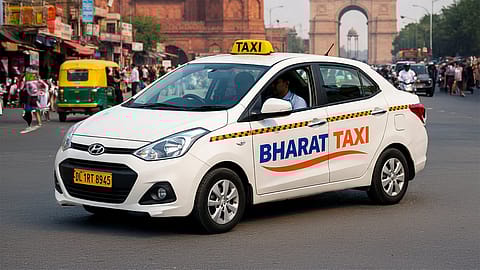
Currently operational in select regions including Delhi-NCR and parts of Gujarat, the platform is attempting to carve out space in a market dominated by private aggregators
Can Bharat Taxi shake up India’s ride-hailing market? Experts remain sceptical
Bharat Taxi, a driver-owned cooperative, enters India's ride-hailing market with zero commission for drivers and fair pricing for riders. While its model aims to empower drivers, experts question its ability to compete with established players like Ola and Uber without significant investment in technology and marketing.
This summary is AI-generated, and Fortune India is not responsible for its content or any associated copyright issues.
A government-backed cooperative promises zero commission and fair fares, but analysts question whether it can rival entrenched ride-hailing giants
Currently operational in select regions including Delhi-NCR and parts of Gujarat, the platform is attempting to carve out space in a market dominated by private aggregators
India’s shared mobility market has a new contender. Bharat Taxi, positioned as the country’s first driver-owned ride-hailing cooperative, has entered the scene with an ambitious pitch: zero commission for drivers, fair pricing for riders, and a governance model that turns “Sarathis” into stakeholders rather than contractors.
Currently operational in select regions including Delhi-NCR and parts of Gujarat, the platform is attempting to carve out space in a market dominated by private aggregators such as Ola, Uber and Rapido. The moot point is whether its cooperative structure can deliver meaningful disruption in a capital-intensive, technology-driven ecosystem.
A model built Around drivers
At the heart of Bharat Taxi’s proposition is its zero-commission structure. Unlike conventional platforms that deduct a percentage from each ride, it allows drivers to retain the full fare, with a nominal fixed subscription fee planned later. The model addresses concerns over shrinking driver earnings amid rising fuel and maintenance costs.
Yet scaling such a framework will require deep resources. “While the cooperative approach is commendable for driver welfare, competing with deep-pocketed aggregators requires massive investment in technology, marketing, and customer acquisition,” said Deepesh Rathore, Founder of InsightEV.
A policy paradox
The launch has also triggered debate about the state’s role in commercial services.
As Avik Chattopadhyay, Founder of Expereal puts it, “The government should not get into such services as it is paradoxical with the encouragement of private enterprise.” With several startups operating in shared mobility, he argues that policy support should focus on enabling private players to scale rather than competing with them directly.
At the same time, Chattopadhyay acknowledged employment generation as a possible rationale. “For the government, there are very few routes of employment generation. This can be one,” he noted.
The passenger litmus Test
Ultimately, success hinges on rider adoption. “Passengers are accustomed to Ola and Uber’s seamless app experience, wide availability, and consistent service standards. Bharat Taxi will need to match these expectations quickly,” Rathore added.
India’s ride-hailing market is now convenience-led — driven by reliability, app stability, transparent pricing and minimal wait times — demanding sustained investment and operational discipline.
Chattopadhyay believes differentiation may lie beyond metros. “If pursued strategically, the service could focus on non-metro and semi-urban India where private operators are less aggressive due to economic constraints,” he noted. In the near term, however, superior value, hygiene and safety standards must define its positioning.
For now, Bharat Taxi represents an alternative ownership model rather than a proven disruptor. Whether it can convert cooperative intent into market scale will depend on execution, capital depth and passenger trust.
NEXT STORY