How Wall St’s ace auto analyst kept tailing Ford CEO over EV claims that’s now a near $20-bn wreck
/ 10 min read
The widening gap between Ford's ambitions and market reality finally culminates into the auto industry's biggest EV retreat
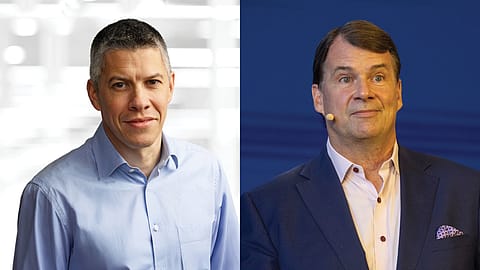
Morgan Stanley analyst Adam Jonas (L), Jim Farley, CEO, Ford Motor Company
V Keshavdev
Ford Motor Company’s CEO Jim Farley, who had moved into the corner office in 2020, was animated on the Q4 2023 earnings call, his voice carrying the conviction of a CEO who believed he’d figured something out that others had missed.
“Someone portrayed the change in the EV [electric vehicle] market as Darwinian,” Farley began, setting up his contrarian view. “That could be a slow evolutionary change, but we think this has been a seismic change in the last six months of last year.”
The trigger according to Farley was a combination of EV manufacturers cutting their price by 20% across all major geographies and a tremendous amount of capital flowing and a ton of new capacity into one single segment, that is, two-row crossovers.
Farley framed it as a vindication. “Our overall EV strategy has never been more relevant as the seismic change happens,” he said.
There were targets being shared. “Our next Gen 2 products will be profitable in the first 12 months of their launch,” Farley promised. Not just profitable, the CEO said Ford would achieve mid-to-high single-digit EBIT profit margins over their lifecycle and deliver profits above Model e’s [a division focused entirely on developing electric models] cost of capital.
Farley kept the momentum going on the call. “We made a bet in silence two years ago,” Farley said, his tone suggesting he was about to share something special. “We developed a super-talented skunkworks team to create a low-cost EV platform. It was a small group, small team, some of the best EV engineers in the world, and it was separate from the Ford mothership. It was a start-up.”
In the CEO’s words: this was supposed to be different, something revolutionary.
Farley explained the mission: “They've developed a flexible platform that will not only deploy to several types of vehicles but will be a large installed base for software and services.”
But even as Farley painted this optimistic picture, he was simultaneously describing a strategic retreat. Ford was spending less capital on larger EVs, adjusting capital, taking timing delays and rationalising the level and timing of our battery capacity to match demand.
Most revealing was what Farley said about customer behavior: “As you scale EVs to 5,000 to 7,000 units a month and you move into the early majority customer; they are not willing to pay a significant premium for EVs. This is a huge moment for us.”
RANK
COMPANY NAME
REVENUE
(INR CR)
(INR CR)
{{#current-rank}} {{current-rank}} {{/current-rank}} {{^current-rank}} {{rank}} {{/current-rank}} {{name}} {{#revenue}} {{revenue}} {{/revenue}} {{^revenue}} {{noi}} {{/revenue}}
Here was Farley portraying an industry challenge as an opportunity.
Enter the Sceptic
If Jim Farley was the optimist-in-chief, Adam Jonas was Wall Street's designated skeptic. The Morgan Stanley analyst, who for nearly three decades was covering the auto industry, didn't waste time with pleasantries.
His first question cut straight to what he saw as the fundamental problem with Ford's strategy.
“Jim, I want to talk to you about Ford vs Ferrari, which is, by the way, a great movie, by the way, and I think the good guys won.”
It was a disarming opening.
Jonas continued: “I remember a time when Fiat owned Ferrari, and I had a valuation of about $4 billion on it. Now, Ferrari is worth $80 billion today. And the business was totally ignored by investors when it was part of Fiat.”
Jonas was on the ball.
“Now, Ford's Ferrari, it’s called Ford Pro,” Jonas continued, referencing Ford's highly profitable commercial vehicle division. “And I think we agree, people are ignoring the cash cow.”
Then came the dagger: “But I disagree with you, Jim. You said it's because of opaque kind of transparency or opaque kind of metrics. I don't agree. I think it's because almost all the profits are funding this EV science project.”
Jonas in one stroke reduced Ford’s holy grail to a “science project”, the kind of experiment done in a lab without expecting commercial returns.
“Am I being unfair, Jim, with that kind of assessment?” Jonas asked, though his tone suggested he knew exactly what he was asking.
Farley’s response was more defensive: “You're going to see a lot of seismic changes in the industry because of this pricing power reality that we've all faced.”
But then Farley admitted that though customers loved the EVs, “it's on us to get the cost right.” Which meant that Ford still hadn't figured out how to make EVs at a cost customers would accept.
CFO John Lawler jumped in to defend the strategy. He said, “We don't do anything with wooden nickels. We don't do any credit into EV, into Model e, or anything like that because eventually, this business has to stand on its own sooner rather than later. And that's a really important point. It's clean.” What Lawler implied was that the company was not engaged in any financial or accounting re-engineering with regards to EV investments.
Buyback vs EV spend
By the second quarter of 2024, the market had rendered its verdict on Ford's strategy, and it wasn't positive. Jonas did an encore at the earnings call. He began his questioning with an observation that must have stung.
“Jim, you said that Ford is a different company from what it was three years ago, but the stock market really doesn't seem to agree with you at all on that,” said Jonas.
According to the analyst the market reaction was self-explanatory: The stock was down about 10% after hours and around $12 a share. His team had just run the numbers which showed Ford ranking 494th out of S&P 500 companies on the PE scale.
It was a dismal ranking for one of America's most iconic companies.
Then Jonas asked a question: “Jim, do you think Ford's stock is good value?”
Farley’s response was prompt. “Yes. Yes, we’re”.
Jonas didn't let him finish: “Then why does your board refuse to authorise a share buyback?”
If Ford's stock was genuinely undervalued, trading at the bottom of the S&P 500, a better use of capital would be to return it to shareholders instead. But Ford wasn't doing that.
Jonas twisted the knife: “And people on this call, I think they understand the reason, like the family element [Ford family controls 40% of voting power through Class B]. But in your opinion, if you're telling me the stock is a good value, and it's like the bottom one-percentile of the S&P, what's the plausible reason why do you really think you have better uses of capital than that?”
Farley’s response was almost defensive: “Yes, we do. And I have to tell you that it's hard for people to understand those possible uses of capital, but we have so many exciting businesses to invest in.”
It was a curious phrase that suggested either that Ford's opportunities were too sophisticated for the market to grasp, or that management saw value where investors saw black holes.
Farley tried to pivot to Ford Pro’s success: “Ford Pro is a very, very high percentage of our company's profit. Just look at the ratio between the overall company's EBIT in Pro and our guidance.”
He gestured toward non-vehicle opportunities, the service network, “very exciting electrical architecture investments,” and to in an effort to be emphatic, Farley said: “I don't want to belabor the point. I'll just tell you there are plenty of opportunities.”
“Anything else?” Farley asked, almost challenging Jonas to continue.
Jonas had plenty more.
The China Question
“Just a follow-up on Skunkworks. Your team has made a number of visits to China over the last couple of years, including, I think, just a couple of months back, I believe, you were there. What are you learning from these trips?” asked Jonas.
It was a loaded question. Everyone in the industry knew Chinese EV makers had massive cost advantages. Jonas made it explicit: “You mentioned China along with Tesla are the cost benchmark, but do you think Ford can bring to market a low-cost EV profitably without help from your partners in China or is China part of the solution? And if China is part of the solution, then what are you going to do about it?”
Farley's response revealed the tightrope Ford was walking. The company had bet big on CATL, the Chinese battery giant, to localise lithium iron phosphate cells in Michigan. “That is a signature partnership,” Farley emphasised. CATL is the largest battery maker in the world, and it had the lead in iron phosphate cost and reliability.
But Farley was adamant about what Ford wouldn't do. “Look what Volkswagen is doing with XPeng, and many others who are kind of taking a Chinese low-cost platform and using that. That's not our strategy.”
Ford would be open to partnering on components but not licensing the entire platform. It was a distinction that sounded principled but was a tough act. “We believe that many of our competitors will turn to their Chinese either independent companies or partners to basically use their platform globally,” Farley said, implying Ford wouldn't take what he seemed to view as the easy way out.
Then Farley made a claim that would prove critical: "We've been scaling MEB [Modular electric platform]. We know the cost of Volkswagen. They're one of the leaders in scale. And what we found in that trip and subsequent trips to China is that we have a very competitive battery with CATL, but many of the Chinese players in the lower cost have very affordable batteries, but they don't have the most efficient design outside of the battery on the other EV components.”
In other words. Chinese companies had cheap batteries, but Ford's engineers could design better non-battery components. The bet was that superior engineering elsewhere could offset battery cost disadvantages.
“And our team, the Skunkworks team, we might as well call it a big team now because it's no longer Skunkworks, we're betting on them as our affordable platform,” Farley said, adding, “They have really designed breakthrough EV components with our own design that we think are better and cheaper.”
It was an audacious claim.
The partnership hitch
Bruno Dossena, analyst from Wolfe Research, asked a question that got to the heart of the industry's dilemma.
“When you compare Ford now to history, earnings are now significantly higher. But the capital base has expanded such that returns really haven't improved. And this isn't just Ford. This is most Western automakers.”
Higher earnings meant nothing if they required proportionally more capital. Returns on invested capital, the metric that matters, hadn’t moved.
Dossena continued: “Given this is a similar dynamic for a lot of automakers, and so many traditional automakers are investing billions in R&D, really trying to achieve the same thing with respect to EVs, make an affordable EV at scale to compete with Tesla and Chinese OEMs, why do you think the legacy OEMs are all doing this by themselves? And why aren't there more partnerships?”
It was a simple question if western automakers were each spending billions to develop similar technologies to compete with the same rivals, wouldn't pooling resources make more sense?
CFO John Lawler's response focused on process rather than economics: “You have to think about how you're going to fundamentally change the development process. I think that's the core thing. It's not necessarily just doing it with somebody else.”
He pivoted to defending the skunkworks approach: “That team is unique for a traditional OEM, the talent on that team. They're doing an agile waterfall systems integrated design process, which no other global OEM has done, a traditional OEM.”
It was jargon-heavy but avoided the core question.
Strangely, Farley jumped in with an admission that seemed to contradict his go-it-alone strategy. “I would just emphasise that the ambition at Ford for partnering on EVs is record level high. We're not going to make any announcements in earning call, but this is absolutely a flip-the-script moment for our company.”
Farley tried to have it both ways: “But we are not going to partner to the level where we delegate our future and the future fitness for cost competitiveness outside the company."
Ford wanted partners to share costs but not partners who would control its destiny, one that might prove impossible to strike.
Writing on the Wall
By October 2024, the cracks were impossible to hide. CFO Sherry House, who had replaced John Lawler, delivered the third quarter results with language that signaled retreat.
“Given current industry trends, it's clear scaling fixed costs is a challenge for most of the industry," House said, with remarkable understatement. "You can see this in the multitude of recent program cancellations and charges globally.”
Then came the admission: “We've been proactive. Over two years ago, we reduced our planned battery capacity by 35%, and last year, we canceled our three-row program, making room for additional commercial vehicle volume.”
It was a complete switch from what the company felt a year ago.
House continued carefully: “Clearly, near-term U.S. customer and market realities for EVs continue to evolve. We will have more to share about how we are adapting to these changes at a later date.”
That “later date” was ominous.
The Reckoning
December 16, 2024. Jim Farley walked through Ford's Michigan design studio on a Monday afternoon, as Reuters would later report, “reflecting on how he was about to wipe out thousands of work hours on electric vehicles that he and his team had hoped would revolutionize the American auto industry.”
Shortly after, Ford announced that it would pull the plug on several battery-powered models and take a $19.5 billion write-down on EV-related assets. It was the industry’s biggest electric-vehicle retreat since President Trump's sweeping auto-policy changes eliminated subsidies and cooled already tepid EV demand.
Farley—the CEO who had spoken so confidently about “seismic changes” and “breakthrough” platforms, who had promised profitability within 12 months and mid-to-high single-digit margins—was now presiding over the dismantling of that vision.
He told Reuters: “We can't allocate money for things that will not make money. As much as I love those products, the customers in the U.S. were not going to pay for them. And that was the end of that."
A Rare Acknowledgment
Before the full scope of the disaster became clear, there was a moment of grace on the third quarter earnings call. Farley did something unusual in the ego-driven world of Wall Street. He acknowledged the analyst who had been right all along.
“I just want to say one thing,” Farley began, departing from the script. “We appreciate all of our investors and the people that analyze our industry very carefully. I just want to note that I know Adam Jonas is moving on to another segment. I wanted to thank you for your activist investor point of view. You certainly helped us be better managers and stewards of the company. I think we just wanted to say thank you as a management team for all of you for what you do. When someone moves on like Adam, we want to highlight that.”
Farley's choice of words was revealing. Jonas hadn't just been an analyst, he’d been an activist, using his platform to push Ford to embrace the uncomfortable truth.
Incidentally, Jonas had announced in August 2024 that he was stepping into a new role, tracking artificial intelligence.
Jonas had gained notoriety as a longtime Tesla bull, but with Ford, he'd played a different role as a bear, pressing management on disconnects between narrative and reality.
Jonas saw what others missed.
Farley insisted investors didn't understand, that Ford had “so many exciting businesses to invest in,” opportunities that were “hard for people to understand.”
As it turned out, investors understood just fine.
Ford's EV journey, from Farley's confident proclamations to that mega write-down, is a case study of conviction untethered from economic reality. More pertinently, Jonas’s persistent questioning stands as a reminder of the value of skepticism, of analysts willing to ask uncomfortable questions even when the management narratives are delivered with absolute confidence.
On those earnings calls, quarter after quarter, while Farley spoke of breakthrough technology and seismic changes, Jonas kept asking variations of the same question: Does it make economic sense?
In the end, Ford's $19.5 billion write-down provided the answer that Jonas suspected all along: No, it didn't.
NEXT STORY