SUVs dominate, but why are carmakers still betting on entry-level sedans?
/ 4 min read
The sub-four-metre sedan market is losing share to SUVs but continues to generate nearly 3.5 lakh units annually, keeping affordability, CNG economics and first-time buyers at the centre of the segment
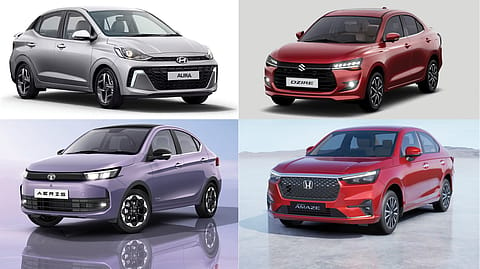
Clockwise from Left-Hyundai Aura, Maruti Suzuki Dzire, Tata Aeris, and Honda Amaze: The four compact sedans keeping India’s entry-level sedan market relevant despite the SUV wave. | Credits: Fortune India
India’s Passenger Vehicle (PV) market is increasingly dominated by SUVs, but carmakers continue to train their guns on sub-four-metre sedans, a segment that still attracts nearly 3.5 lakh buyers annually.
Tata Motors’ launch of the Aeris is the latest example, while Maruti Suzuki continues to back the Dzire, Hyundai the Aura and Honda the Amaze. The numbers explain why. While sedans have steadily lost share to SUVs, entry-level sedans continue to generate meaningful volumes.
Shailesh Chandra, MD & CEO, Tata Motors Passenger Vehicles (TMPV), stated that the compact-sedan segment grew around 25-26% in volume over the past year. During Covid, when India’s overall PV market was around 2.7 million units, compact-sedan demand was approximately 2.7 lakh units. That has since increased to nearly 3.5 lakh units.
“The volume has been growing in an expanding PV market, but the share has been declining,” Chandra told reporters at a recent media roundtable ahead of the Aeris launch.
Dissecting the market
Industry estimates show entry-level sedans sold 3,22,375 units in 2025, up 18.9% from 2,71,082 units in 2024. During January-August 2026, the segment sold 2,52,110 units and accounted for 7.1% of passenger vehicle sales, as per industry estimates.
The contrast is sharper in midsize sedans, whose share fell from 1.7% in 2024 to 0.9% during January-August 2026.
According to industry players, the compact sedan’s proposition remains relatively straightforward: more cabin and boot space than a hatchback, an aspirational upgrade and a price point generally below similarly positioned SUVs.
Chandra said the average selling price of cars in India has risen from around ₹6-7 lakh five-six years ago to ₹11-12 lakh today and could reach ₹15-16 lakh over the next five years.
“Size is also a value that you deliver to a customer. People have moved from a hatch to a sedan. It is a feeling of going bigger in size,” he said.
This proposition remains particularly relevant outside India’s largest cities. Chandra said compact sedans in metros are more heavily associated with fleet demand, while Tier-2 and Tier-3 cities and rural markets have a stronger aspirational personal-buyer component.
At the same time, the SUV shift has not eliminated the sedan customer. Chandra said there is a “clear section of customers” still looking for compact sedans, while another group has moved to SUVs because existing sedans did not meet expectations around modernity, technology and design.
{{#most-powerful-women-snapshot-individual.slug}} {{/most-powerful-women-snapshot-individual.slug}} {{^most-powerful-women-snapshot-individual.slug}} {{/most-powerful-women-snapshot-individual.slug}} {{#showRanking}} {{current-rank}} {{/showRanking}} {{#photo.0.url}}
{{name}}
That is the gap Tata is attempting to address with Aeris, which is positioned specifically for personal buyers and comes with multiple first-in-segment features.
CNG keeps the economics attractive
CNG is another major reason the segment remains relevant.
According to Chandra, CNG retail volumes are growing nearly 46% year-on-year, around twice the industry growth rate. CNG accounts for nearly 60% of compact-sedan volumes, compared with roughly 20-25% for the overall passenger vehicle market.
Penetration is around 53% among personal compact-sedan buyers and 73-75% in the fleet segment. Fleet operators prioritise fuel efficiency, low operating costs, reliability, durability, ease of maintenance and uptime, while personal buyers place greater weight on design, safety, comfort and technology.
Tata has responded by separating the two customer groups: the fleet-focused Xpress will be developed around operating economics and durability, while Aeris is aimed at personal buyers.
Maruti Suzuki’s Dzire rules the roost
Maruti Suzuki’s Dzire provides the clearest evidence of what a well-positioned compact sedan can achieve. The country’s largest carmaker said the model sold around 2.3 lakh units in FY26, making it India’s best-selling passenger vehicle despite SUVs accounting for 66% of the overall market.
During January-August 2026, the Dzire accounted for 1,68,413 entry-sedan sales, giving it a 66.8% share of the segment. Hyundai Aura followed with 49,517 units and Honda Amaze with 26,676 units.
Partho Banerjee, Senior Executive Officer, Marketing & Sales, Maruti Suzuki India, said the Dzire becoming the country’s best-selling car despite the SUV wave showed that “there are still customers who prefer sedans”. Maruti’s share of the sedan segment, he said, had risen from 45.8% in FY2017 to 57.2% in FY26.
At the Dzire’s three-million-sales milestone, Banerjee also said the fourth-generation model had found strong preference among young first-time buyers, who account for nearly 50% of its customers. He attributed its appeal to features, comfort, safety and a more sophisticated proposition.
A smaller share, but still too large to ignore
For Tata, the calculation is ultimately about retaining customers who may otherwise move to another body style or another brand.
“If I had not come with Aeris, I might have lost a customer who was actually looking for a compact sedan,” Chandra said.
The company expects Aeris volumes to be significantly higher than its earlier activity in the segment and has taken steps to ramp up production if demand exceeds expectations.
The broader market, however, remains firmly tilted towards SUVs. Chandra acknowledged that SUV share will continue to put pressure on sedans as vehicle prices rise and customers get more choices across SUV price points.
According to industry observers, the compact-sedan proposition continues to rest on affordability, practicality, running economics and space — factors that remain relevant to value-conscious buyers even as SUVs expand their share.
Puneet Gupta, India and ASEAN Director at Mobility Global, said the compact-sedan market is no longer competing with SUVs purely on body style, but also on the value proposition it offers to buyers. He said affordability, lower running costs, practicality, cabin and boot space, and the availability of CNG continue to give entry-level sedans relevance, particularly among value-conscious and first-time buyers.
Follow Fortune India
NEXT STORY