What will it take for Kia to grow its market in India?
/ 4 min read
Kia accounts for about 5.9% of the domestic market, making it the sixth-largest automaker in India.
THIS STORY FEATURES
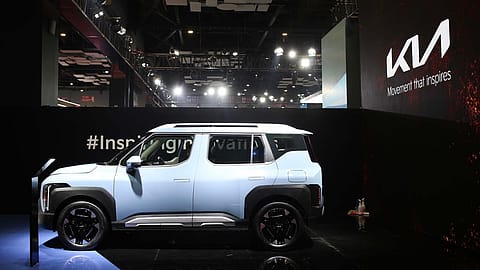
Credits: Sanjay Rawat
It has been something of a mixed bag for Kia in India.
The Korean automaker landed along Indian shores in 2019, on the back of the resounding success of its South Korean counterpart, Hyundai Motors, and looking to capitalize on the growing SUV boom in India.
The Seltos, launched in 2019, was an immediate success and propelled Kia into the top tier of automakers, steadily growing into India’s fifth-largest automaker in just eight years. The Seltos, which shared a common platform with the Hyundai Creta, which in many ways has been responsible for the SUV boom in the country, was first showcased as a concept at the 2018 Auto Expo in New Delhi and was positioned as a made-in-India product for the world.
Since then, the vehicle has sold over 500,000 units in India, in close competition with the Hyundai Creta. In the meantime, the company also launched the Kia Sonet, a made-in-India product, that targeted the sub-compact SUV segment. The Sonet too was a runaway success, with sales of around 500,000 units so far, followed by the Kia Carens, which is now clocking steady sales for the automaker.
But that’s where the problem sets in for Kia.
Apart from the Kia Seltos, Carens, and Sonet, on which the company relies heavily for sales, its other products have yet to show substantial sales. The Syros and Carnival are yet to find large takers. In the process, the company has hit a bit of a stall, unable to grow its annual sales at a time when homegrown automakers such as Mahindra and Tata are taking on the fight in the world’s third-largest automobile market. It has also slipped to sixth in the pecking order, replaced by Toyota, which has found its rhythm in the domestic market after many years and offers a wide array of models.
“Kia’s volumes have stayed healthy, but share expansion has been harder as incumbents and homegrown players have sharpened their SUV portfolios,” Harshvardhan Sharma, the Group Head, Automotive Tech & Innovation Group at Nomura, says. “This is not failure so much as a ceiling created by portfolio concentration and intense SUV competition. The next step up needs new pools of volume, not just refreshes.”
Last week, the company launched its next-generation Kia Seltos, featuring a host of features that it hopes will redefine the segment. “When a brand has high concentration on 2–3 nameplates, growth becomes refresh-cycle dependent and more vulnerable to segment churn,” adds Sharma. “Mid-size and compact UVs have become the most crowded battlegrounds, with rapid launches and pricing resets.”
Lessons from Toyota
The languishing fortunes stand in sharp contrast to those of the Japanese automaker Toyota, which sold fewer cars than Kia in Kia’s first full year of operation in India. In the financial year 2020-21, Kia sold a total of 155,686 vehicles, up from 84,904 in the year before. The same year, Toyota, the Japanese giant, sold 93,124 cars in the country, almost half as many as Kia.
Since then, Toyota has steadily grown its market share in the country, with annual sales of 309,230 vehicles and a market share of 7 percent, while Kia’s sales were 255,207 vehicles and a market share of 5.9 percent, despite the head start it had in the Indian market. With a diverse portfolio ranging from the small hatchback Glanza to the hybrid mid-size SUV Hyryder and the large MPV Hycross, Toyota has been steadily growing its presence in the Indian market, offering multiple fuel options, including hybrid and CNG-powered vehicles.
{{#most-powerful-women-snapshot-individual.slug}} {{/most-powerful-women-snapshot-individual.slug}} {{^most-powerful-women-snapshot-individual.slug}} {{/most-powerful-women-snapshot-individual.slug}} {{#showRanking}} {{current-rank}} {{/showRanking}} {{#photo.0.url}}
{{name}}
That’s where both Kia and Hyundai seemed to have missed the bus in offering multiple powertrains. In India’s automotive industry, petrol powertrains account for about 55 percent of engines, diesel 18 percent, and CNG about 19 percent. Electric and Hybrid vehicles account for the rest. Of this, hybrid power trains have also seen significant traction. For Kia, which recently launched a CNG option in the Carens (dealer-level-fitted), the lack of hybrids is also a concern.
Hyundai, though, has already announced a staggering $5 billion investment in India to expand its manufacturing and research operations. It also plans to launch 26 cars including its first hybrid vehicle tailored for India and launch its luxury car brand Genesis in the country, in its attempt to win back the market, it has lost to Mahindra and Tata Motors.
“Kia executed a rare 'new entrant' playbook well with sharp product, positioning, and fast distribution ramp, anchored by SUV/MPV strength,” says Sharma of Nomura. “Now they must expand and defend in the highest-velocity UV segments with “right price-right powertrain” variants, not only feature-load. They could use big launches to reset momentum.”
This year, however, Kia is expected to improve its numbers in comparison to last year, on the back of the GST rate cuts announced by the Narendra Modi government. Sales for the current year have reached 261,627 units through November, up from 236,043 units during the same period last year. The November figures followed the company's record October 2025 sales, which came soon after the GST cuts.
Kia began operations in India by establishing a manufacturing facility in Andhra Pradesh, following a 2017 agreement with the state government. Production started in August 2019, with the plant's annual capacity at 300,000 units. “Mid-size and compact UVs have become the most crowded battlegrounds, with rapid launches and pricing resets,” says Sharma. “What Kia must focus on now is higher localisation, tighter variant rationalisation, and sharper entry-price ladders, because domestic players are aggressive on value and feature combinations.”
For now, all eyes are on the next-generation Seltos, which the company hopes will drive sales. Speculation is also rife that the company plans to launch a hybrid variant of the SUV next year. Alongside, Hyundai is facing challenges from domestic car makers, and Kia and Hyundai could be looking to increase synergy, similar to the partnership between Maruti Suzuki and Toyota, which is helping the Japanese automaker.
“Group-level moves like battery localisation tie-ups are strategically important if they want mass EVs to be viable at Indian price points,” adds Sharma. “What they must manage is clear brand segmentation, platform sharing behind the scenes, and coordinated sourcing of software stacks, while keeping showroom propositions distinct.”
With changes in management—Kia appointing Sunhack Park as the Chief Sales Officer and Joonsu Cho as the Chief Business Officer—and Hyundai appointing Tarun Garg as the Hyundai India CEO, 2026 may be the year of reset for the Korean automakers.
Follow Fortune India
NEXT STORY