AI EdTech’s next hurdle: Moving beyond pilots to system-wide adoption
/ 2 min read
Experts say AI-led education reforms must move beyond pilot projects to deliver measurable learning outcomes at scale
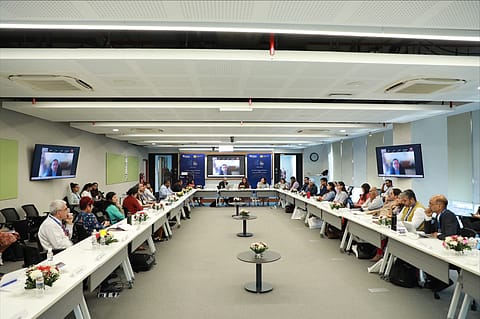
Discussions focused on the challenge of ensuring that AI strengthens education systems rather than remaining fragmented, standalone interventions | Credits: Reliance Foundation
A high-level dialogue on Artificial Intelligence (AI) in education, hosted by Reliance Foundation in partnership with Central Square Foundation, has underscored the need for a fundamental rethinking of education systems as AI adoption accelerates. The half-day roundtable, held at Jio Institute in Navi Mumbai, was organised as an official pre-summit event of the India AI Impact Summit 2026.
The convening brought together over 50 participants from philanthropy, EdTech firms, academia and the private sector to examine how AI-enabled education tools can move beyond pilots and deliver measurable learning outcomes at scale. Discussions focused on the challenge of ensuring that AI strengthens education systems rather than remaining fragmented, standalone interventions.
Participants highlighted that while AI offers potential across personalised instruction, teacher support, assessments and early childhood learning, technology alone does not guarantee improved learning. Emphasis was placed on aligning AI solutions with learning science, ensuring equity and inclusion, and evaluating success through learning outcomes rather than reach.
In the keynote address, Dr. Shailesh Kumar, Chief Data Scientist at Jio and Dean of Jio Institute, said education systems need to be redesigned for a digital- and AI-first world. He stressed the importance of moving away from uniform teaching models towards personalised and student-centric approaches that support mastery learning and critical thinking, enabled by AI.
A recurring theme during the dialogue was the role of philanthropy in enabling responsible adoption of AI in education. Participants noted that philanthropic capital can help de-risk early innovations, support long-term evidence generation and build organisational capacity.
Insights were shared from the LiftEd EdTech Accelerator, a multi-year initiative that has reached more than three million children, particularly in underserved settings. The programme illustrated how sustained support can help EdTech organisations integrate AI while generating credible evidence of learning impact.
The discussions also highlighted that scaling AI-enabled learning solutions is a systems-level challenge. Participants pointed to the need for alignment with government curricula, multilingual content, low-bandwidth access, shared-device use and institutional readiness within public education systems.
The recommendations emerging from the dialogue are expected to inform national and global conversations at the India AI Impact Summit 2026, where policymakers and stakeholders will examine pathways for deploying AI for social impact, including in education.
Follow Fortune India
NEXT STORY