Erode-headquartered Milky Mist is betting on contract farming model to improve milk yield and quality
/ 3 min read
In the last year and a half, the dairy company has set up 500 farms with 15–25 cows across Tamil Nadu. The plan is to establish larger farms with 50–100 cows or buffaloes.
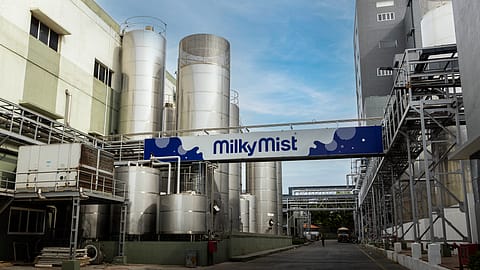
Milky Mist has started developing large contract dairy farms, a model widely adopted in dairy-rich European countries. | Credits: Sanjay Rawat
It is almost twilight, yet there is a flurry of activity in the otherwise sleepy village of Ellamadai, around 40 km from Erode in Tamil Nadu. Milk farmers are queuing up at value-added dairy company Milky Mist's collection centre to pour their evening milk collection.
As darkness sets in, each farmer, on average, pours 5-7 litres of milk. They deliver a similar volume at daybreak as well. Around 35 farmers supply anywhere between 10 and 14 litres of milk per day at this collection centre and walk away earning ₹35–40 per litre. The amount may sound attractive on paper, but that is rarely the case.
The shortage of green fodder and the rainfall deficit have increased costs by 35%-40%, making dairy farming less viable for these marginal farmers. A large number of them have lost interest in dairy farming due to constant price volatility driven by factors such as climate change, trade disruptions, and geopolitical uncertainties, among others.
At the industry level, data points to a shortfall in milk production. India, the world's largest milk-producing nation, which was growing at an impressive 6%–7% annually until 2022, has seen growth steadily decline to around 3.5%–3.78% year-on-year. However, demand for milk continues to rise at 6%–7% annually.
To bridge this demand-supply mismatch, the ₹3,200-crore Erode-headquartered value-added dairy manufacturer has started developing large contract dairy farms, a model widely adopted in dairy-rich European countries.
"The Indian dairy farming sector goes through cyclical phases. When milk supply increases, prices and procurement decline. We are currently at a peak, with farmers getting ₹40–42 per litre of milk. But when procurement and prices fall, many marginal farmers compromise on cattle nutrition and insemination, which further reduces milk production. As a value-added dairy manufacturer, our requirement for milk is much higher. For every kilogram of value-added product we manufacture, we need at least 5–7 litres of milk," explains K. Rathnam, CEO, Milky Mist Dairy Food.
A decline in milk procurement directly impacts the company's high-margin value-added dairy business. To address this, Milky Mist has adopted a contract farming model, partnering with relatively well-off farmers who own larger land parcels to develop dairy farms with 15–25 cows. Over the last year and a half, the company has established 500 such farms across Tamil Nadu. The next phase involves setting up larger farms with 50–100 cows or buffaloes.
Apart from helping farmers secure bank loans to invest in cattle, the dairy company is also encouraging them to cultivate green fodder to improve both milk quality and yield.
"When farmers feed dry fodder to cattle, which is mostly paddy or wheat residue, the animals do not consume it completely. As a result, milk yield declines because the nutritional value is lower. We are now working on producing silage and TMR (Total Mixed Ration), which functions like a balanced compounded cattle feed. These interventions improve farmers' profitability because they generate income throughout the year," Rathnam explains.
Do contract farmers receive higher payments than smaller farmers? "Our payments are at par with what other farmers receive. However, with these interventions, the quality of milk improves, so we pay them an additional 50 paise per litre as an incentive."
The IPO-bound dairy company currently procures 14 lakh litres of milk every day. It manufactures 60–80 tonnes of paneer and 20 tonnes of mozzarella cheese daily. Although contract farming is the model Milky Mist is betting heavily on, Rathnam says the company will continue procuring milk from marginal farmers as well.
Follow Fortune India
NEXT STORY