Fortune India Exclusive: Pernod Ricard bets big on premiumisation, innovation and local scale, says CEO Jean Touboul
/ 3 min read
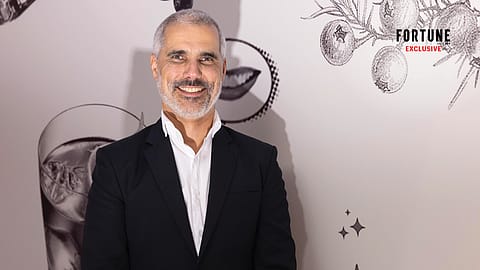
Jean Touboul, CEO, Pernod Ricard India | Credits: Sanjay Rawat
Fortune India Exclusive: Pernod Ricard bets big on premiumisation, innovation and local scale, says CEO Jean Touboul
Pernod Ricard India has sold its mass-market Imperial Blue whisky to Tilaknagar Industries for ₹4,150 crore, marking a strategic pivot toward premium, high-margin spirits. CEO Jean Touboul says the move will fuel innovation, expand premium offerings, and sustain double-digit growth in India, which contributes 13% to the company’s global sales.
This summary is AI-generated, and Fortune India is not responsible for its content or any associated copyright issues.
French spirits major is restructuring its offerings and doubling down on high-margin segments to sustain its growth momentum in India.
THIS STORY FEATURES
Jean Touboul, CEO, Pernod Ricard India | Credits: Sanjay Rawat
Pernod Ricard India, which recently sold its Imperial Blue Indian whisky business to Tilaknagar Industries as part of its strategy to focus on premium and higher-margin spirits, is entering a new strategic phase - one where premium brands, sharper innovation, and a more focused portfolio take centre stage.
In an exclusive conversation with Fortune India, Jean Touboul, CEO of Pernod Ricard India, said the company is restructuring its offerings and doubling down on high-margin segments to sustain its growth momentum in one of its most important global markets.
Touboul confirmed that the company has divested its legacy brand Imperial Blue, calling the decision both strategic and emotional. “It has been part of our legacy… it’s a bit emotional honestly to let it go. But it’s very clear—we want to focus on brands with higher margins which help us premiumise consumption in India.” He added that the move was essential to focus on higher-margin brands and improve the company’s margins and growth rate.
On December 1, 2025, Pernod Ricard India, the Indian subsidiary of the French spirits major, completed the sale of its mass-market Imperial Blue whisky business—the country’s third-largest whisky brand by volume—to Tilaknagar Industries. The transaction involved a lump-sum payment of ₹3,442 crore (approximately €412.6 million), along with a deferred payment of €28 million to be made after four years.

India contributes 13% to Pernod Ricard’s global sales
Calling India one of the company’s “fastest-growing markets,” Touboul said that the business from the country accounts for around 13% of Pernod Ricard’s global net sales. “We are the second market worldwide for Pernod Ricard,” he noted, highlighting demographic and economic tailwinds that continue to expand the premium spirits segment. “We have approximately 20 million new legal drinking-age potential consumers every year. That’s massive.”
To sustain double-digit momentum, Touboul said the company is doubling down on innovations at higher price points. “We want innovation to contribute roughly 25% of our growth in the next decade,” he said, adding that launching new premium offerings and investing more in the top end of the portfolio remain key priorities.
Despite India being largely a whisky market, Touboul said consumer behaviour is evolving, especially among younger drinkers who prefer a wider repertoire. With its new multi-category spirit Xclamation, Pernod Ricard aims to tap this shift. “These consumers drink whisky, but they don’t drink only whisky,” he said. “We came with an offer across five spirits categories… allowing them to consume premium products at an affordable price.”
Competition is good
On rising competition from homegrown liquor companies, Touboul said, “Competition is very good. It pushes us to be better.” He added that Pernod Ricard India is “as local as these local companies,” pointing out that 95% of the company’s volumes are produced in India. “There is nothing more Indian than us.”
On the India–U.K. FTA and the expected duty cuts on Scotch whisky, Touboul said the change will create opportunities but not reshape the market entirely. A price reduction of 10–15% for imported spirits like Chivas or Ballantine’s could make them more accessible, but the gap between imported Scotch and premium IMFL will ensure gradual but not dramatic shifts.
Manufacturing ready for scale
On scaling up manufacturing in India, Touboul stressed that the company already has the capacity to quickly scale production of new brands like Xclamation. “We produce several tens of millions of cases already. We will be able to scale it up very easily when the demand is coming.”
However, the company is investing steadily to modernise its existing units and bottling lines. “If we can produce and bottle more bottles per minute, this helps us respond to higher demand,” he said.
{{#most-powerful-women-snapshot-individual.slug}} {{/most-powerful-women-snapshot-individual.slug}} {{^most-powerful-women-snapshot-individual.slug}} {{/most-powerful-women-snapshot-individual.slug}} {{#showRanking}} {{current-rank}} {{/showRanking}} {{#photo.0.url}}
{{name}}
The company’s most ambitious manufacturing investment—a large single-malt distillery in Nagpur—remains underway. “We need at least another couple of years to build the distillery,” he said, adding that the liquid itself will take four to five years to mature. The project, spread over a decade, represents about €200 million in investments.
Unveils Seagram’s Xclamat!on
On December 2, French spirits major launched Seagram’s Xclamat!on, its most aspirational homegrown brand portfolio to date. The new range brings five premium spirits — whisky, vodka, gin, rum, and brandy — together under one brand, all offered at a single, accessible price point. The portfolio is projected to contribute 10% to Pernod Ricard India’s growth over the next decade, supported by the company’s legacy of premiumization, scale, and Seagram’s hallmark quality, as per the company.
Follow Fortune India
NEXT STORY