From turnaround to take-off: How IndiGo and Air India are plotting their next 10 years amid a looming third rival
/ 6 min read
IndiGo and Air India, which together control 90% of the Indian domestic skies, are busy charting out their growth strategies, even though they could face competition from some unexpected quarters
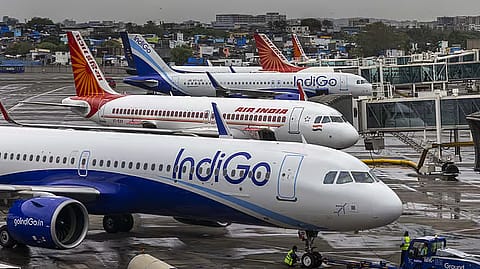
IndiGo and Air India are gearing up for the next decade. | Credits: File photo
It seems like a tale of contrasts.
On one hand, there is the country’s oldest airline, backed by the country’s biggest conglomerate, pouring billions over the past five years to turn around its fortunes. It seems the next five years, or the decade, will also be spent doing the same.
Then there is the market heavyweight, its leader, who is busy firming up its next phase of growth to win India’s domestic and international markets, with cut-throat precision over the next decade. Coincidentally, both will be led by new leaders, one of whom already has a reputation for being a “slasher”.
Either way, IndiGo and Air India, which together control 90% of the Indian domestic skies, are busy charting out their growth strategies, which will see them go head-to-head in the domestic and international market, as India’s skies see a period of sustained growth, despite all the global uncertainties.
“The next decade will represent the most significant phase of international expansion in our history,” Rahul Bhatia, the managing director of IndiGo, said in the company’s annual report. “We are investing in fleet, technology, infrastructure, digital capabilities, and talent to build a truly global aviation network originating from India. Our ambition is not only to connect India to the world but also to establish India as one of the most important global aviation hubs of the future.”
Air India, which is scouting for a new CEO after Campbell Wilson resigned, remains somewhat subdued in their ambitions. For now, it is continuing to focus on a turnaround, which has been slow largely due to external factors. Air India’s transformation must be seen as a five- to 10-year journey, considering the years-long supply chain disruptions in key components, the need to overhaul legacy systems, culture and fleet, and the creation of a large cadre of technical and airline professionals,” N. Chandrasekaran, the chairman of the Tata Group, said on July 28.
Under a plan laid out by the Tata Group in September 2022, Air India had set itself clear milestones focussed on growing its network and fleet, developing a revamped customer proposition, improving reliability and on-time performance, and taking a leadership position in technology, sustainability, and innovation, while aggressively hiring industry talent. The plan was named Vihaan.ai.
As part of that, the first six months were spent addressing accumulated issues, followed by an 18-month programme to invest in systems, people, aircraft, training, and internal products. That was to be followed by the growth phase. But four years later, the airline has yet to show a significant breakthrough, while IndiGo has raced ahead. “Rebuilding Air India is a long journey,” Chandrasekaran, the chairman of the Tata Group, said on July 28. “Fleet renewal, training, service transformation, network expansion. Every great airline in history was built over decades, not quarters.”
The transformative decade
Next month, IndiGo celebrates its two decades of operations.
While that may not seem significant on the face of it, considering how Air India has been around for nearly a century, it’s worth noting that an airline that began operations alongside IndiGo, GoAir, has folded up, while another, SpiceJet, is struggling to stay afloat.
IndiGo has not only stayed afloat but also remained profitable and grown at breakneck speed, adding aircraft and acquiring more passengers as others were collapsing. Much of the early years were spent pioneering a sale-and-leaseback model, in which an airline acquires aircraft, sells them to a lessor, and then leases them back for use.
{{#most-powerful-women-snapshot-individual.slug}} {{/most-powerful-women-snapshot-individual.slug}} {{^most-powerful-women-snapshot-individual.slug}} {{/most-powerful-women-snapshot-individual.slug}} {{#showRanking}} {{current-rank}} {{/showRanking}} {{#photo.0.url}}
{{name}}
By 2015, the company was making profits of more than ₹1,300 crore annually. Today, IndiGo’s profits have swelled to ₹7,253 crore, with revenues exceeding ₹80,800 crore. For comparison, look at SpiceJet, which holds less than 2% of the market and is seeking funds to continue operations.
“In 2011, there were six airlines,” Jitendra Bhargava, former executive director at Air India, had told Fortune India. “IndiGo had 20% market share then. Then, Kingfisher collapsed, and that market share grew to 28%. By 2019, when Jet Airways collapsed, IndiGo’s market share grew to 50%. By the time GoFirst folded up, the market share had grown to 60%. There were other airlines in the market, but none of them could do the same. That’s what makes the airline different. Their foundation is solid.”
It’s into this mix that Air India has unleashed its turnaround programme, but without much to show. In June, for instance, the Air India Group’s domestic market share fell to 23.9%, from 27% in February this year. In fact, barring April this year, the airline has consistently lost market share every month while IndiGo has seen its market share grow despite a government directive to cut flight operations after its cancellation fiasco in December last year. Air India has also reported a ₹22,000-crore loss.
“Globally, big airline turnaround can take up to 10 years, unless you use bankruptcy/receivership provisions, which Air India is not using,” Alok Anand, the chairman of Acumen Aviation, an aircraft asset management and leasing company, had told Fortune India. “You can’t pause operations, and simultaneous fixes are needed for fleet and cabins, engineering and MRO, crew scheduling and rostering, IT, culture and service, network strategy and partnerships. On top of it, supply chain constraints can stall everything. Some comparative examples include British Airways, which took around 10 years to be transformed; Japan Airlines had a faster turnaround only because of bankruptcy levers, and Delta Airlines again had bankruptcy protections and took around four years.”
Still, the Indian customer’s patience might begin to run out soon even though there have been some milestones along the way. Over the past four years, it merged four airlines into two, a massive achievement given the diverse work cultures. AirAsia India was merged with Air India Express to create a low-cost carrier, and Vistara was merged with Air India to form a full-service carrier. The merger also meant that Singapore Airlines took a 25.1% stake in Air India, with Air India Express being its fully owned subsidiary.
Simultaneously, Air India also ordered a record 470 aircraft, only for IndiGo to up the ante a few days later, ordering some 500 aircraft. Air India’s orders comprise 34 A350-1000, six A350-900, 20 Boeing 787 Dreamliners, and 10 Boeing 777X widebody aircraft, as well as 140 Airbus A320neo, 70 Airbus A321neo, and 190 Boeing 737MAX narrowbody aircraft.
But even as it waited for the aircraft to join its fleet, the company had begun a $400-million retrofit programme for many of its older aircraft, which had been plagued by underinvestment. The idea was to change customer perception about the old and shabby planes, with a Tata touch. But supply-side shortage has meant many of its aircraft continued to be plagued by issues such as broken armrests, dysfunctional chairs, and non-functional in-flight entertainment systems.
Consultancy firm McKinsey reckons that only about 7,000 aircraft were delivered from 2019 through 2024—far below the pre-pandemic trajectory, which, if it had continued, would have resulted in about 12,000 aircraft over that same time frame.
What happens now?
Now, even as Air India and IndiGo prepare themselves for the next decade, it’s also likely that the duo will have a face-off from an unexpected quarter.
Last week, speculations were rife that the $191-billion Adani Group was firming up plans to start an airline. Multiple reports claimed that the company had reportedly approached the government, seeking a dilution in policy that restricts airport operators from holding stakes in scheduled airlines. If approved, the proposal would allow for the group, which is already India’s largest airport operator, to foray into India’s duopolistic skies.
That would mean that IndiGo, and particularly Air India, will likely feel the heat. By 2040, India’s passenger traffic is expected to grow sixfold to around 1.1 billion, with India’s commercial airline fleet predicted to grow from 400 in 2014 to around 2,359 in March 2040. The number of airports is also expected to grow to 400 by 2047.
“As India continues its emergence as one of the world’s most important economies, aviation will play an increasingly strategic role in enabling the country’s next phase of growth,” Bhatia added. “The rise of an aspiring middle class, rapid infrastructure development, digital transformation, manufacturing expansion and the increasing global integration of Indian businesses are all driving unprecedented demand for connectivity, factors that will create one of the most compelling aviation growth opportunities anywhere in the world. We firmly believe that India is entering a multi-decade aviation growth cycle, and we are positioning ourselves to lead that transformation.”
For now, India’s skies seem to be at a turning point. And it could soon go from a two-way fight into a three-way fight.
Follow Fortune India
NEXT STORY