
In Air India’s Campbell Wilson dilemma, is there a leadership lesson for India’s airlines?
ADVERTISEMENT
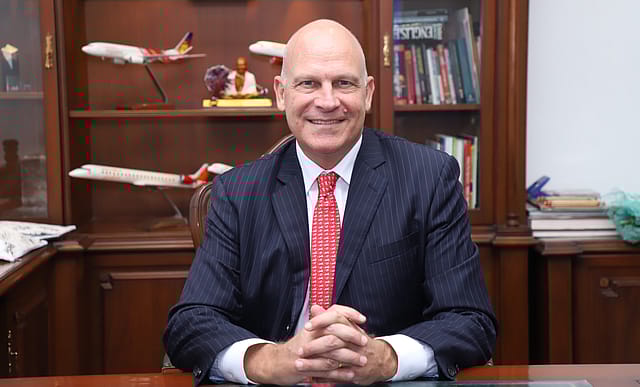
Last month, at the peak of the crisis at IndiGo, one of the frequently asked questions was whether IndiGo’s CEO, Pieter Elbers, might be on his way out.
There was a good reason for that. It was the first time a crisis of this scale had occurred at IndiGo, and perhaps even in India, and the timing made it even worse. Russia’s president, Vladimir Putin, was on a high-profile visit to India, and with all the attention turning to lakhs of stranded passengers at airports, it seemed like IndiGo would soon feel the wrath of the government.
But, a month later, it’s another expat CEO, and the head of India’s second-largest airline, who seems to be feeling the heat. Campbell Wilson, the New Zealand-born CEO of Air India, has reportedly fallen out of favour with the Tata Group, which took on the mammoth task of turning around the airline, once referred to as a white elephant.
Wilson, who perhaps has the most difficult job in aviation in recent times, could be replaced as early as this year, even though his tenure runs until 2027. The Tata Group, which took over Air India from the Indian government amid high expectations, has reportedly spoken with a few US- and UK-based airline CEOs to take the baton from Campbell.
Turning around Air India, especially with the might of the Tata Group, has remained a challenge, four years after the group acquired the airline. While the group signed a deal to acquire as many as 470 aircraft, the airline has yet to make significant gains in market share from the market leader, IndiGo. In November this year, the Air India Group’s domestic market share stood at 26.7 percent, with IndiGo’s well over 63 percent. To put that in context, in January 2023, a full year after the Tata Group acquired Air India, Air India's market share stood at 25.4. percent while IndiGo’s was at 54.6 percent.
That means, in two years’ time, IndiGo’s domestic market share swelled by more than 10 percent (November saw a dip in IndiGo’s market share from 65.6 percent) while Air India’s barely grew. In the meantime, GoFirst, the Mumbai headquartered airline whose market share hovered around 10 percent shut down operations, which seems to have entirely been taken over by IndiGo.
The situation isn’t any different on the international routes, where IndiGo has overtaken Air India to become the largest homegrown international airline, with a market share of 21.88 percent versus the Air India Group’s 21.69 percent during the July-September quarter.
“Wilson came in with a credible plan and has moved the airline in the right direction, but he’s been constrained by aircraft delays, integration complexity, legacy operational inertia, and an overall perception of poor quality,” Alok Anand, the chairman of Acumen Aviation, an aircraft asset management and leasing company, says. “While the intentions were correct and a blueprint was drawn, the execution unfortunately lacked a lot. Boards care only about outcomes and results, so perhaps that’s where the issue lies. On a scale of 1 to 10, I would say 6.5 can be considered a fair rating.”
What went wrong?
Wilson joined Air India in May 2022, a few months before Pieter Elbers was appointed CEO of IndiGo in September 2022.
Until then, both IndiGo and Air India had mostly Indian CEOs: Aditya Ghosh for a long time at IndiGo and government bureaucrats at Air India. The appointment of two foreign CEOs to run two of the country’s largest airlines in a post Covid-19 era meant the flight paths for both looked alike: to become truly global airlines.
But Air India, unlike IndiGo had its fair share of problems. The company had returned to the Tata Group fold after seven decades but had struggled for many years with a lack of investment, poor service, overemployment, mismanagement, and a poorly timed merger with another government-owned airline, Indian Airlines. For many years, Air India had been making losses.
That meant Wilson had a serious task at hand, and he had publicly likened the situation to that of playing test cricket, which required enormous patience. Under a new plan drawn up by Wilson, Air India had set itself clear milestones focused on growing its network and fleet, developing a revamped customer proposition, improving reliability and on-time performance, and taking a leadership position in technology, sustainability, and innovation, while aggressively hiring industry talent. The plan unveiled in September 2022 was named Vihaan.ai.
As part of that, the first six months were spent addressing accumulated issues, followed by an 18-month programme to invest in systems, people, aircraft, training, and internal products. That was to be followed by the growth phase. But a little over three years later, the airline has yet to show a significant breakthrough, while IndiGo has raced ahead and is now expanding into international markets and even flying long-haul routes.
“The plan is aimed at putting Air India on a path to sustained growth, profitability, and market leadership,” Air India said at the time of launching Vihaan.ai. Then, four airlines owned by the Tata Group merged into two: AIX Connect was merged with Air India Express, and Vistara with Air India to form a full-service carrier while Air India Express became a low-cost carrier, as the group sought a diverse strategy to grow its business in India. The merger also meant Singapore Airlines took a 25.1% stake in Air India, with Air India Express being its fully owned subsidiary.
“Globally, big airline turn-around can take up to 10 years, unless you use bankruptcy/receivership provisions, which Air India is not using,” adds Anand. “You can’t pause operations, and simultaneous fixes are needed for fleet and cabins, engineering and MRO, crew scheduling and rostering, IT, culture and service, network strategy and partnerships. On top of it, supply chain constraints can stall everything. Some comparative examples include British Airways, which took around 10 years to be transformed, Japan Airlines had a faster turnaround only because of bankruptcy levers, and Delta Airlines again had bankruptcy protections and took around 4 years.”
Does India need foreign CEO’s?
Now that Air India is considering a replacement, questions also arise about the need to look outside India, the third-largest aviation market for those capable to lead an airline.
Traditionally, India has had a slew of foreign CEOs running its private airlines, dating back to Jet Airways. Between 2003 and 2009, Jet Airways, then India’s largest private airline, was run by Wolfgang Prock-Schauer. Prock-Schauer was followed by Nikos Kardassis, who led the airline between 2009 and 2013 and had led it earlier between 1994 and 1999. Vistara appointed Leslie Thng, of Singapore Airlines, as its CEO in 2017.
“After all these years, it's rather unfortunate that neither Jet Airways nor Air India could throw up any leaders who could shape Indian aviation,” Jitender Bhargava, a former executive director of Air India and author of The Descent of Air India, says. “Whether it was engineering or commercial, they all worked in silos. We must also remember that aviation is a global industry. But not having built our own leaders is something to think about.”
“There are certain aspects for which the CEO can be considered directly responsible, like Operational reliability and customer trust, merger integration related sequencing, network and fleet deployment choices,” says Anand of Acumen. “However, there are certain others where Campbell Wilson could have only a limited influence, like aircraft delivery delays, supply chain problems, regulatory environment, and competitive landscape.
“There has been long-standing turbulence in aerospace supply chains, and OEMs have struggled to secure adequate quantities of manufacturing components such as semiconductors and finished castings and forgings,” global consultancy firm, McKinsey said in a report in May this year. “Shortages in both skilled labour and raw materials persist in the wake of the demand whiplash induced by pandemic-era air travel slowdowns. Some aircraft models have been unexpectedly grounded, and some new-engine introductions have encountered early hiccups. These combined challenges, which are unlikely to subside in the near term, have caused delays in both new-aircraft deliveries and maintenance turnaround times.”
India is the world’s third-largest aviation market, and its airports have grown from 74 in 2014 to 163 in 2025. The government wants to raise that to 350-400 by 2047. By 2040, passenger traffic is expected to grow sixfold to around 1.1 billion. India’s commercial airline fleet is predicted to grow from 400 in 2014 to around 2359 in March 2040. The total employment due to the aviation sector in 2040 is expected to be around 25 million.
“Even if you bring a foreign CEO, where the Tata group went wrong was in thinking that the employees who were there for long were not efficient,” a senior industry expert says on condition of anonymity. “They forced many into voluntary retirement and brought in people with little experience. Foreign CEOs can bring best practices to the company, but the culture cannot be built overnight.”
For much of its 158-year-old history, the Tata group has seen expatriate CEOs come and go in many of its verticals. Among others Darryl Green led Tata Tele Services while Raymond Bickson and Guenter Butschek helmed Indian Hotels and Tata Motors respectively.
“What matters is results,” another industry veteran says. “It’s not that they are not making changes. But they have been ineffective in communicating that to the public. Of course, there have been supply issues, and Air India ideally should’ve had 36 new aircraft by last year, but all have been delayed. But their progress has not been spoken about, and the blame lies with Air India for that.”
McKinsay reckons that only about 7,000 aircraft were delivered in the six-year period from 2019 through 2024—far below the prepandemic trajectory, which, if it had continued, would have resulted in the delivery of about 12,000 aircraft over that same time frame. That’s essentially a shortfall of 5,000 aircraft, which the likes of Air India would have liked to have in its fold.

What next for Air India?
Since the crash of AI 171 in June 2025, Air India has also been struggling with something of an image problem.
The Indian government or Air India has not been able to comprehensively explain the reasons for the crash, which killed over 260 people, including 241 people on board. The accident involving a Boeing 787 Dreamliner, aged less than 13 years old, was the first accident involving a Dreamliner, and the country’s Aircraft Accident Investigation Bureau pointed to the fuel switches in the aircraft transitioning from "run" to "cutoff" position one after another, within a second of each other, as a cause leading to speculations of pilot error.
Cockpit voices also confirmed the situation, with one pilot asking the other, “Why did you cut off?" with the other responding, “I did not do so." At the time the aircraft took off, the co-pilot was flying the plane, while the captain was monitoring. The report, however, absolved Boeing of any responsibility. “At this stage of the investigation, the AAIB has not issued any safety recommendations for Boeing 787-8 aircraft or GE GEnx-1B engine operators and manufacturers," the report by the AAIB said.
“The crash likely accelerated a leadership review, and the board ran out of patience,” adds Anand. “The crash brought into focus regulator-flagged operational and maintenance shortcomings, like missing checks, delayed part replacements, alleged forged maintenance records, and fatigue management issues.”
Over the past few years, Air India’s troubles have included a controversial episode when a senior citizen claimed that a co-passenger urinated on her. Even as the company spent millions on upgrades, the results weren’t evident, with frequent complaints about the aircraft's broken seats and armrests, faulty entertainment systems, and delays. Before the June crash, Air India received 13 notices for multiple safety violations over a six-month period. More importantly, an Air India flight from Chicago to Delhi had to turn back after 10 hours because 11 of the plane’s 12 toilets were clogged.
But all that were in many ways overlooked since the Tata Group is among the most trusted brands in the country. That also meant, Wilson had a longer runway than most turnaround CEOs. “One key advantage which seems to have been under-utilised is the ability to buy capacity through wet leases, faster cabin refresh in stages, more aggressive spare stocking, third-party MRO support, push for a minimum viable product early rather than a full reset,” adds Anand. “The passengers don’t care for why you are late; they care that you are late. Another approach could have been to fight one battle at a time, such as fixing domestic routes first, reducing international routes, and upgrading a few key routes to premium. Hindsight is always 20/20, but it would have been prudent to sacrifice growth and over invest in safety, compliance, spares, and reliability. The supply chain constraints were well and truly visible when Air India was acquired, as it was bang in the middle of the pandemic.”
Perhaps Wilson shouldn’t have been disillusioned by the length of the runway that the Tata Group offered. The take-off should have come sooner for a smooth flight.