I will spend the next 10 years of my life building excellence rather than chasing success, says Sabyasachi Mukherjee
/ 9 min read
The fashion designer explains why his brand is no an elitist one, on institutionalising fashion, AI, and more.
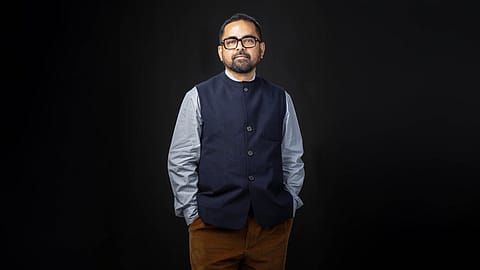
Sabyasachi Mukherjee | Credits: Narendra Bisht
At the recently concluded Fortune India Business of Luxury Summit in Hyderabad, fashion designer Sabyasachi Mukherjee, in an interview with Shivika Goenka, director, luxury and education, RPSG Group, says that his job is not to build a fashion brand, but to tell India’s story to the world without feeling apologetic. Edited excerpts from the conversation:
On his grandmother’s golden words
I grew up very poor. There was a time when we didn’t even have money to eat. My grandmother, she came from Bangladesh as a refugee with five children. She never got married... a very progressive woman who dressed up as a widow so that nobody would question the paternity of her kids. She was a single woman by choice, with five children. She taught me something very early in my life, which I hold true as my Bible: she said that just because you are poor does not mean that you can’t have standards. Sabyasachi was built on the conviction of those words.
On Sabyasachi not being an elitist brand
I don’t consider Sabyasachi to be an elitist brand. A lot of people might talk about price points, but price points sometimes are a marker of excellence, they’re not a marker of elitism. I think it’s a very inclusive brand because I grew on the other side—of the have-nots—and I crossed over to the people with privilege. And I think one of the reasons why people feel sentimental about Sabyasachi is because it gives them the possibility of ambition, success, and belonging... because when you learn to break the glass ceiling on your own terms, people don’t become customers or fans, they become allies. And I think that connection of making people feel proud about who they are, where they come from, their heritage, their identity, is a very potent communication that happens without any billboards.
This wasn’t a conscious effort. It was the only thing that I could do organically. I come from Kolkata... culture comes to us through osmosis. You don’t have to read a book to get culture. It just happens. And I think for us, it wasn’t calculated, but when I look back, I certainly think it was very effective.
On depth versus width
I surround myself with a lot of young people because I think the reason why they challenge us is because we grew [up] differently. We grew up with the privilege of having depth because we didn’t have width. We had no technology, did not have cell phones. We did not have Netflix. We had one Doordarshan, and I remember my father used to say that he would only let me watch Chitrahar on Wednesday evenings. When you have nothing, it’s a big fodder for imagination. I feel sad for the younger generation because they have too much width. When you have too much width, depth comes later. So, for us depth came early and width came later, and for them width came early and depth is going to come later. So, that little tension between how we have been raised and how they are raised is definitely going to change consumption, and if you don’t bridge that, then we are going to fall into the classic generation gap trap.
So, I always like to listen to younger children because I do not want to tell them, this is how things need to be done. We need to learn from them as well because we are now living on the fringes of their world.
On the big shift
There was a time in India where luxury was measured by the status of money. So, if I had money, I had luxury. But today, for the younger generation of India, status is not defined by money anymore. It’s defined by purpose. Just because somebody else has a lot more money and I don’t have any, but I have something that I think is purposeful, it makes me feel rich. So, under these circumstances, fashion, which has historically made a lot of money by feeding on people’s insecurities, it doesn’t work anymore. That is one of the reasons a lot of big brands are failing because what they need to understand is, that you need to back your product with culture, purpose, and relevance. I think the large weddings are going to be a thing of the past, because the younger generation of people, whether middle class or rich, will understand that is not cool to do big weddings anymore, because they need to define their purpose before they define their money.
I think it's more about intimate things. Everyone wants an experience, they want something special, not necessarily something that’s large.
I think today people are pushing away from the periphery and focussing on the core. And it’s a great thing because there was a time when India was corrupt. There was a time when we created a lot of wealth and mindless consumption because of corruption. But the new generation is rebuilding India in a way where they do not want to be trapped by their parents’ ambition of growth, scale, money, greed, and they are redefining their businesses the way they want to, at the scale that they are comfortable with. For them, their ideology matters much more than what you call social success.
On building to outlast
If you see my social communication today, I don’t say, ‘me’, Sabyasachi, I say, ‘we’ at Sabyasachi. Big businesses might start with the vision of a leader or a founder, but it has to be shaped by the confidence and the belief systems and the ambition of a collective. I am doing a very big project with a big organisation, and a lot of it is based in Africa, and, they say that in Africa, when a craftsperson builds something or brings something to the world, they think of how it’s going to impact the fifth generation. They are that profound in their knowledge that we are going to bring something to the world, that is going to create an impact for the next five generations.
You build greatness when you realise that it doesn’t revolve around you and you are only a conduit to creating something that will outlast you and live on for generations. I think that little bit of idealism is important because we are all going to go, but what we leave behind is far more important than what we hold.
{{#most-powerful-women-snapshot-individual.slug}} {{/most-powerful-women-snapshot-individual.slug}} {{^most-powerful-women-snapshot-individual.slug}} {{/most-powerful-women-snapshot-individual.slug}} {{#showRanking}} {{current-rank}} {{/showRanking}} {{#photo.0.url}}
{{name}}
On institutionalising fashion
India is probably 50 years behind in luxury. So, if you look back at how fashion designers in the West founded their businesses, it was pretty much the same thing. You create an idea for so many years. Let's take Chanel, for instance. I don’t think that Coco [Chanel] ever realised that it would become the big business that it is today. But her job was to hold on to her ideals. I think to be able to hold on to a belief system that you believe is yours, creates a potent story for somebody to build a house on. And for us, we have to flush the toilets, we have to pay the bills, paint the ceilings, do everything on our own, because this is the first generation of fashion designers that are building their empires, but when we are gone, corporates will come in.
On building a global luxury fashion brand
I don’t think we have gone global. India celebrates success too early. Far away, one store does not make you global. For me, it is not really about being local or being global. For me, it’s a much deeper conversation, because I think, I have always said that in life, there are short cycles and there are long cycles. In the short cycle, you can be replaced and displaced, but in the long cycle, you always come back home. If you look at the remarkable country that India is, starting from the Indus Valley Civilisation to everything that has happened, people have come to this country, and they have taken and taken and we have willingly given. I think my biggest problem with giving is that somewhere down the line, it’s also broken our confidence. I wish to bring that confidence back.
My job is not to build a fashion brand. My job, collectively with so many other people—whether they are in performing arts, whether they are in the job of creating influence, whether they are in music, architecture—is to tell an India story without apology, so that we can bring confidence back to a lot of people who still think that we are not good enough. Because we truly are good enough. And the narrative, the difference between that is just politics and there is a time when that politics need to change.
On chasing excellence, not success
I live in Kolkata. Most people here don’t even know that I live in Kolkata. I never really go out anywhere. I have a PR in Delhi, and her only job is to build walls so that journalists don’t heckle me. I don’t like giving interviews. I like doing things at my own pace, yet some of the biggest collaborations have come to me... It’s like karma. Because I think that our job is to do what we need to do and not to seek. If you just remain on your path, what you seek will come to you. The right things will eventually fall into your life.
When I turned 43-44, something in my head shifted. I don’t chase success anymore. People can pull me down, they can write anything they want to, they can celebrate me. It doesn’t affect me anymore because success is very public, but excellence is very private. Excellence is something that people don’t even notice. I think I will spend the next 10 years of my life building excellence rather than chasing success. When you choose excellence, success becomes a by-product.
On the jewellery business
The entire jewellery business in India was built on black money. People bought jewellery to store black money. So, what happens, whether you understood jewellery or you did not, housewives and women were trained to ask two pertinent questions: What is the making charge and what is the buyback? Which meant that, if times went bad, you could sell the jewellery and get liquid cash. But what people didn’t understand, and what started biting everybody back, especially when lab-grown diamonds came in, was there would be a time when craftsmanship would become rarer than stones. If luxury is measured by the matrix of rarity, what was truly going to be rare is something that we have destroyed.
I saw a movie called The Help, where a woman tells another woman in the family that courage sometimes skips a generation. But I make it mine by saying that courage can skip a generation, but craftsmanship can’t. Because when craftsmanship skips a generation, it becomes obsolete. You know, when I started doing jewellery in Jaipur, I realised that there were two very big problems. First, because the customers in this country don’t know much about jewellery, there was very poor quality. Secondly, there was lack of integrity of design and craftsmanship was at its lowest.
It’s the same model that I did in Banaras to revive the Banarasi sari by indigenising the yarn, which used to come from China and Korea. We started actually working on craftsmanship because I truly believe that India’s value of jewellery will not come from stones, as stones become more and more artificial. The value will come from craftsmanship and craftsmanship in this country is truly special. I say in many business forums, especially in political forums, that there’s a lot of things that India cannot do yet, because it’s a question of money, politics, and exposure. But there’s a lot of things that India can do, which the world can never catch up, because it’s a part of a culture that has been handed down for generations and generations. Craftsmanship or jewellery is one of them.
I don’t think any other part of the world can produce jewellery like India can. And Indian jewellers need to understand that the true value of Indian jewellery if Indian jewellery was to go global, it will no longer be about the rarity of stones. That’s the reason we built jewellery.
You know, my clothes are nowhere. No Hollywood celebrity wears my clothes, but everybody’s wearing my jewellery. I have always believed that India’s craftsmanship is so exceptional. that we haven’t given it much attention.
On the AI era
I was in Zara the other day and I don’t understand technology very well. I’m a complete technophobe. I was just so uncomfortable because there was nobody at checkout. You had to put everything in a bin. I hate that. I left the clothes and I said, I don’t know how to pay. As AI becomes more and more and more important, you will realise human services will become even more important and luxurious, because at the end of the day, if, you know, even Mr [Arjun] Oberoi said the same thing—that technology is important in hotels, but not as important as human services, because at the end of the day I don’t think computers can service human beings because we are not hardwired to behave like that. We are social animals.
I keep telling people the future of business is the business of humanity.
On the evolution of Brand Sabyasachi
I am 52, so I have already started transitioning. I am training people to take over. I don’t want to be like Mr Armani, and I don’t want to relinquish control when I am very old. I want to do it while I still have dynamism, and the company is still profitable. When I sold the company to Kumar (Kumar Mangalam Birla), I to him, the company does not belong to you. It does not belong to me either. We are just gatekeepers. It belongs to the country. So, at some point of time, I want to IPO the company so that I can give back shares to every single Indian who choose to buy the company, because I want to give them the ownership of building a luxury brand for the country themselves. And I wanted to be able to at least in my lifetime, pave the way, to change the narrative of India from being a third-world country, at least in luxury, to a first-world civilisation.
Follow Fortune India
NEXT STORY