India, Canada advance talks on clean mobility and critical minerals under PM Modi government’s net zero push
/ 2 min read
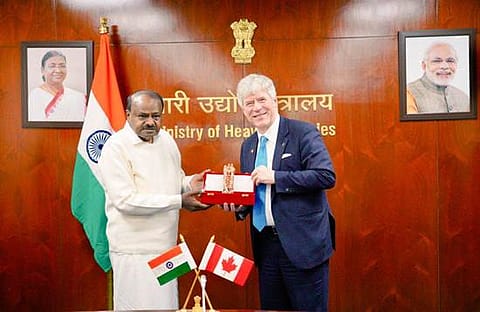
The talks were led by Union Minister for Heavy Industries and Steel H.D. Kumaraswamy and Canadian Minister of Natural Resources Tim Hodgson, | Credits: PIB
India, Canada advance talks on clean mobility and critical minerals under PM Modi government’s net zero push
India and Canada have agreed to enhance cooperation in clean mobility and critical minerals, focusing on electric vehicles and battery manufacturing. The discussions, led by ministers from both countries, aim to align with India's net zero goals and strengthen supply chains, with Canada offering support in technology sharing and mineral resources.
This summary is AI-generated, and Fortune India is not responsible for its content or any associated copyright issues.
High-level talks in New Delhi focus on electric mobility, battery manufacturing and secure critical mineral supply chains aligned with India’s net zero goals
The talks were led by Union Minister for Heavy Industries and Steel H.D. Kumaraswamy and Canadian Minister of Natural Resources Tim Hodgson, | Credits: PIB
India and Canada have agreed to deepen cooperation in clean mobility, battery manufacturing and critical minerals following high-level bilateral discussions held in New Delhi, signalling renewed momentum in strategic industrial collaboration between the two countries.
The talks were led by Union Minister for Heavy Industries and Steel H.D. Kumaraswamy and Canadian Minister of Natural Resources Tim Hodgson, and were aligned with India’s long-term development goals under Viksit Bharat@2047 and its net zero emissions target.
Focus on EVs, batteries and advanced manufacturing
During the meeting, Kumaraswamy highlighted India’s rapid progress in the automotive and electric mobility sectors, noting the country’s position among the world’s leading vehicle manufacturers across segments. He pointed to government-led initiatives that have accelerated EV adoption and expanded charging infrastructure nationwide.
The Minister said India is now focused on strengthening domestic manufacturing capabilities across electric vehicles, batteries and related components, while ensuring alignment with global safety and performance benchmarks.
Critical minerals and supply chain resilience
A key area of discussion was access to critical minerals required for clean energy technologies. Kumaraswamy underlined India’s incentive programme aimed at building indigenous capacity in advanced battery cells and stressed the importance of secure and diversified supply chains.
Canada’s strengths in critical mineral availability and processing were seen as complementary to India’s manufacturing ambitions. The Minister also noted that National Mineral Development Corporation is exploring resource opportunities in Canada to support India’s steel and energy requirements.
Canada signals technology collaboration
The Canadian delegation acknowledged India’s progress in clean mobility and battery technologies and expressed willingness to explore technology sharing and deeper industrial partnerships. Canada conveyed its readiness to support India’s demand for key minerals such as lithium, cobalt, graphite and rare earth elements, which are central to the global energy transition.
Next steps and institutional engagement
Both sides discussed collaboration across battery manufacturing, research and development, testing infrastructure, and sustainable manufacturing processes. Senior officials from the ministries of heavy industries, steel and external affairs, along with public sector enterprise heads, participated in the discussions.
The meeting concluded with an agreement to maintain structured dialogue, technical consultations and industry-level engagement to translate discussions into tangible projects, reinforcing India–Canada cooperation in clean energy and advanced manufacturing.
Follow Fortune India
NEXT STORY