Luxury’s new narrative is not just about price and scarcity, but also about experiences and purpose
/ 3 min read
While the personal luxury consumer base globally may have shrunk from 330 million to 315 million, luxury connoisseurs are increasingly indulging in experiences.
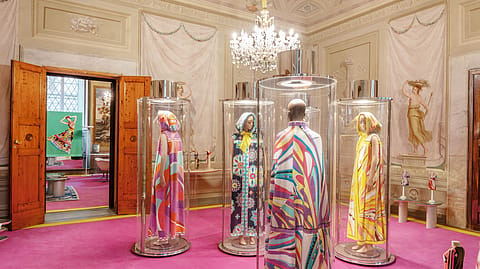
The Emilio Pucci Heritage Hub, an exclusive archive room located inside the historic Palazzo Pucci in Florence.
When Laudomia Pucci (president, Emilio Pucci Heritage), daughter of the iconic Italian designer, Emilio Pucci, started the Emilio Pucci Heritage Hub in 2017 at Florence, the intent was not to create yet another museum. The intent was to get people to experience the heritage and repository of work the legendary designer had left behind and also to get an understanding of what the legacy luxury brand was doing to keep itself relevant.
“After COVID, after I had retired and the headquarters of Pucci had moved from Florence to Milan, I found myself with a large portion of the palazzo and the archives. Rather than keeping them to myself, I wanted to share them with everyone,” said Laudomia at the recently concluded Fortune India Business of Luxury Summit at the Taj Falaknuma Palace in Hyderabad.
The idea clearly has been to attract young talent and fashion connoisseurs to immerse themselves in the world of Emilio Pucci and also know about the history of Florence where Italian fashion was born. “In Florence, we have two kinds of people visiting—tourists and students. So, I am taking the Emilio Pucci Heritage Hub to both. And for me, experiences are about learning a different story, learning something special and being able to connect with local people because it's very important. We are offering something that you can’t buy—a collaboration with excellences in the territory,” she explained.
An Emilio Pucci Heritage Hub experience is by appointment only. “We offer a moment that you just can't find. We are not open to public. We are not even easy to find and that makes us intimate and private. The team that greets the guest ends up being friends with them. We dedicate our soul to our guests,” Laudomia passionately said.
Building experiences
Building experiences is the luxury industry’s newest currency and Laudomia is clearly capitalising on that. It’s well-known that consumption of personal luxury is on the decline. While the personal luxury consumer base globally may have shrunk from 330 million to 315 million, Armando Branchini, founder chairman, European Creative and Cultural Industries Alliance, (ECCIA) & former vice-chairman, Fondazione Altagamma, said at Fortune India’s Business of Luxury Summit that consumers are certainly not abandoning luxury. The needle according to him, is moving towards experiences. “While there's been overall slowdown, there has been a growth in experiential luxury.”
Is this a cyclical or structural trend? “I believe it is structural,” said Branchini. “Structural because not just the Gen-Zs in particular prefer experiences to owning brands, but also the older generation is evolving and changing its approach. They already have boxes full of clothes, shoes and bags…..now the importance of family living, sharing, travelling experiences in new areas of the world is gaining importance,” he added.
Charlotte Keesing, former director, Walpole British Luxury, couldn’t agree more. “You see a real shift towards experiences, and I think that's a philosophical shift—in terms of less about what do I want to own and more about how do I want to live.”
From heritage experiences to getting consumers to experience local cultures and cuisine to branded cafes, most leading luxury brands are moving towards offering experiences. Keesing talked about Café Eight-One, Jaguar’s 38-seater restaurant and café in London. Similarly, Armani has Armani Café.
In India, designer, Rahul Mishra, is building the Rahul Mishra universe, which not just includes fashion, but also Aatman, the designer’s first architectural space. Perched at 6,000 ft in the Kumaon Himalayas, Aatman, an uber luxury home stay is amidst three forest reserves and in between two valleys studded with pine, deodhar and silver oak trees. Guests at Aatman are on invitation only and are served by staff from adjoining villages. The cuisine is curated from local food traditions and the ingredients are sourced from nearby farms.
The luxury narrative today, not just about being pricey or scarce, it is also about being purposeful too. “It's about what do I value and what matters to me. I think that’s the shift that’s happening,” Keesing explained.
Follow Fortune India
NEXT STORY