National Supercomputing Mission powers IIT Madras with 3.1 Petaflop PARAM RUDRA supercomputing facility
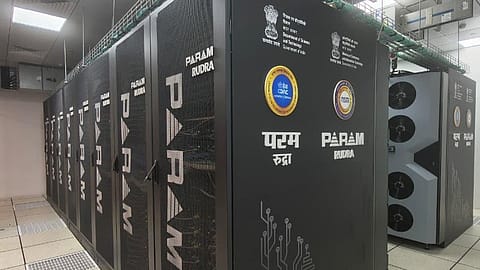
National Supercomputing Mission powers IIT Madras with 3.1 Petaflop PARAM RUDRA supercomputing facility
IIT Madras has launched the 3.1 Petaflop PARAM RUDRA supercomputing facility, enhancing India's research capabilities. Developed under the National Supercomputing Mission, this system supports diverse fields like aerospace and drug discovery, enabling faster, cost-effective research. It runs on open-source software and promotes energy efficiency, strengthening India's global competitiveness.
The Param Shakti houses the Param Rudra supercomputing cluster along with an integrated infrastructure for round-the-clock power, advanced cooling and data centre operations.
IIT Madras has installed ‘Param Shakti’, one of the most powerful computing facilities available for Indian academia on its campus.
The indigenously developed 3.1 Petaflop PARAM RUDRA supercomputing system is entirely built in India. It runs on open-source software, including AlmaLinux.
Param Shakti houses the Param Rudra supercomputing cluster
The Param Shakti houses the Param Rudra supercomputing cluster along with an integrated infrastructure for round-the-clock power, advanced cooling and data centre operations. Designed, developed and implemented by Centre for Development of Advanced Computing (C-DAC), the system has been funded under the National Supercomputing Mission (NSM), jointly led by the Ministry of Electronics and Information Technology (MeitY) and Department of Science and Technology (DST).
According to IIT Madras, the 3.1 petaflop capability signifies that the system can perform over 3.1 quadrillion calculations per second, enabling researchers to solve large, complex problems faster and more accurately, reducing years of experimental work and allowing India to compete at a global scale in areas such as aerospace, materials, climate modelling, drug discovery and advanced manufacturing. In many of these fields, large-scale simulations now eliminate a substantial portion of experimental trial-and-error, enabling faster, more cost-effective and globally competitive research outcomes.
“Under the National Supercomputing Mission, we are supporting a wide range of use cases and application-driven projects with dedicated funding, designed to operate at a scale that can make a real difference. With 37 supercomputers already installed across institutions nationwide and more in the pipeline, including the largest system planned for Bengaluru, these efforts are strengthening India’s research and innovation ecosystem”, S. Krishnan, Secretary, MeitY said.
“Under the IndiaAI Mission, we have been deliberate in not promoting a single technology or a single type of GPU. By enabling access to multiple GPU architectures, we want our innovators, scientists and researchers to gain broad exposure and develop the capability to master diverse platforms. This approach strengthens resilience, encourages informed technology choices and ensures that India’s AI ecosystem does not become dependent on any one solution, even within this rapidly evolving domain”, he added.
With power usage effectiveness (PUE) ranging between 1.2 and 1.4, the PARAM SHAKTI facility also demonstrates high standards in energy-efficient infrastructure integration. Researchers at IIT Madras are currently using the system across multiple length and time scales — from sub-atomic electronic structure calculations to large-scale structural and system-level simulations.