PLI scheme delivers strong gains in electronics, white goods, pharma; newer sectors still in early stages: NITI Aayog
/ 2 min read
NITI Aayog assessment finds investment, production, and jobs gaining momentum across several sectors, though outcomes vary widely depending on industry maturity and investment cycles.
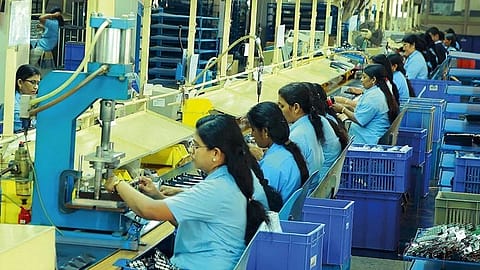
The white goods PLI scheme has also recorded strong progress. By March 2026, cumulative investment had reached ₹6,409 crore, production ₹43,150 crore and employment more than 52,703 jobs.
India’s production-linked incentive (PLI) scheme is beginning to generate meaningful additional investment, production and employment across several manufacturing sectors, with large-scale electronics, pharmaceuticals, food processing, drones, medical devices, and white goods emerging as some of the strongest performers, according to an assessment of the programme’s implementation.
The report, covering all 14 sectors under the PLI scheme, assesses its impact on four key parameters—investment, production, employment, and exports. It finds that the outcomes vary considerably depending on sector maturity, technological complexity and the gestation period of investments.
The scheme links incentives to incremental production and performance and aims to address constraints related to scale, technology, investment and competitiveness, while helping Indian manufacturers integrate more deeply into global value chains.
Electronics leads the way
Large-scale electronics manufacturing (LSEM), with an outlay of ₹34,193 crore, has emerged as one of the strongest-performing schemes, particularly in mobile manufacturing. The programme has driven significant growth in production, sales, exports and employment among domestic as well as global firms.
Its progress has also helped lay the groundwork for the recently launched ₹40,000-crore Electronics Component Manufacturing Scheme.
The white goods PLI scheme has also recorded strong progress. By March 2026, cumulative investment had reached ₹6,409 crore, production ₹43,150 crore and employment more than 52,703 jobs. Domestic value addition rose from 20% to 55%, reflecting greater localisation of critical components and technology transfer through global partnerships.
Pharma, medical devices show strong traction
The ₹15,000-crore pharmaceuticals drugs scheme has delivered broadly positive outcomes, with investment consistently exceeding targets and production and employment recording significant growth. However, MSMEs have reported more uneven outcomes, particularly in exports.
The medical devices scheme, with an outlay of ₹3,420 crore, generated ₹1,151 crore in investment, ₹14,945 crore in sales and 5,268 jobs by March 2026, with investment consistently exceeding targets. The bulk drugs scheme has delivered mixed results across its four segments, although a sharp rise in investment in FY25 indicates renewed industry confidence.
Autos attract major investment
The automobile and auto components PLI scheme has attracted ₹44,326 crore in investment by March 2026, against its ₹25,938-crore outlay. Production of electric vehicles has risen significantly, supported by greater localisation and domestic value addition. However, employment remains below target, while export outcomes cannot yet be comprehensively assessed because of limited data.
Telecom and networking products have also recorded growth in production, investment, exports and employment, though high dependence on imported high-value components remains a key challenge.
Newer sectors still building capacity
The ₹18,100-crore advanced chemistry cell battery scheme remains at an early stage. Only 1.4 GWh of capacity has been developed so far, with commercial production and incentive disbursement yet to begin.
{{#most-powerful-women-snapshot-individual.slug}} {{/most-powerful-women-snapshot-individual.slug}} {{^most-powerful-women-snapshot-individual.slug}} {{/most-powerful-women-snapshot-individual.slug}} {{#showRanking}} {{current-rank}} {{/showRanking}} {{#photo.0.url}}
{{name}}
Similarly, the IT hardware scheme is still in its early stages, with only four firms receiving incentives as of March 2026.
The solar PV module scheme has helped expand India’s manufacturing capacity from 8 GW to nearly 116 GW, with around 24 GW directly attributable to PLI-supported projects.
Dr Ashok Kumar Lahiri, Vice Chairman, NITI Aayog, said manufacturing remains an engine of employment, innovation, and productivity-led growth, with its multiplier effects extending to logistics, infrastructure, services, and skill development.
Follow Fortune India
NEXT STORY