Redevelopment no longer optional in Mumbai; the entire city is set to go for it: Sri Lotus' Chairman Anand Pandit
/ 7 min read
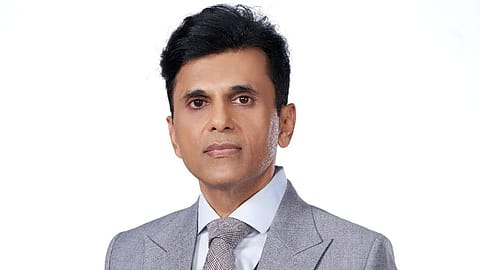
Anand Pandit, Chairman and Managing Director of Sri Lotus Developers and Realty
Redevelopment no longer optional in Mumbai; the entire city is set to go for it: Sri Lotus' Chairman Anand Pandit
In 2025, redevelopment became essential in Mumbai due to space constraints and aging infrastructure. With over 70% of land already built up, developers like Sri Lotus are focusing on ultra-luxury projects. Chairman Anand Pandit highlights the shift in consumer aspirations and the necessity of redevelopment for the city's future, emphasizing the growing demand for luxury housing.
This summary is AI-generated, and Fortune India is not responsible for its content or any associated copyright issues.
In Mumbai, where over 70% of land is already built up and population density exceeds 30,600 persons per sq km, and in this scenario, redevelopment has become a necessity rather than a strategy.
Anand Pandit, Chairman and Managing Director of Sri Lotus Developers and Realty
One of the key themes that reshaped Mumbai’s real estate market in 2025 was redevelopment. Long shaped by vertical ambition and acute space constraints, the city is now being rebuilt from within as developers double down on redevelopment.
In Mumbai, where over 70% of land is already built up and population density exceeds 30,600 persons per sq km, and in this scenario, redevelopment has become a necessity rather than a strategy.
Over the past five years, more than 910 housing societies have initiated redevelopment, unlocking over 326.8 acres of potential buildable area. “This isn’t merely a trend in construction; it is a reset of the city’s planning logic,” Knight Frank chairman and MD Shishir Baijal writes in the Mumbai Redevelopment Report 2025.
Mumbai’s land scarcity is further compounded by the risks posed by ageing buildings. A 2017 BMC audit found that 1.6 lakh buildings across the city were over 30 years old and required structural assessment. In this context, redevelopment has become foundational to Mumbai’s next urban chapter.
This is where players such as Sri Lotus Developers and Realty come in. The Mumbai-based listed real estate player claims to have built over 4.5 million sq ft across upcoming, ongoing, and completed projects spanning ultra-luxury, luxury, and commercial properties.
Anand Pandit, Chairman and Managing Director of Sri Lotus Developers and Realty, in an exclusive conversation, told Fortune India that rising aspirations, post-pandemic lifestyle recalibration, and Mumbai’s chronic land scarcity are reshaping how homes are conceived, priced, and sold, particularly in the city’s ultra-luxury redevelopment market, where the developer has built a niche presence. He also discusses how 2025 unfolded for real estate, the key drivers behind its growth, and Mumbai’s market potential. Edited excerpts follow:
1) How would you summarize the year? There has been a lot of activity on the regulatory front. Amid all this, how do you see the year panning out for the sector?
Anand Pandit: I think it was a reasonably very good year, not only on the regulatory side. On the business side also, it was a fantastic year. Almost everything was positive- good demand, good economy, relief on a lot of regulations, as you mentioned, GST and other things, and also the aspiration of people, especially for the real estate industry.
People want to move into new apartments, new offices, new complexes. New businesses are coming in. A lot of investments are happening. As you know, even the stock market is doing pretty well. So with all this combined, I would say real estate was a beneficiary of that.
2) If we were to pinpoint the key drivers behind the rise in demand, would you attribute it primarily to the surge in luxury housing, or has increased participation from NRI investors played an equally important role?
Anand Pandit: I would say that earlier the luxury segment was very limited. But with the socio-economic changes in society, especially in India- and I would be a little more specific, in Mumbai- people have got a chance to move up in the pyramid.
{{#most-powerful-women-snapshot-individual.slug}} {{/most-powerful-women-snapshot-individual.slug}} {{^most-powerful-women-snapshot-individual.slug}} {{/most-powerful-women-snapshot-individual.slug}} {{#showRanking}} {{current-rank}} {{/showRanking}} {{#photo.0.url}}
{{name}}
A good example: 25 or 30 years back, when I bought a Maruti with air conditioning, it was called “Deluxe.” That was considered luxury. Today, those things are not seen as luxury. The same has happened with other things- clothing, watches, your phone. Almost every other year you change them.
Similarly, people want to move into slightly more spacious houses, fully loaded houses, in good locations, with good neighborhoods. Earlier, these things were not in the bucket list. The bucket list was only budget. Consumer aspirations have changed, and I think that is changing the complete scenario of real estate.
3) Data shows there has been a decline in the sales this year. Affordable segment is doing badly. What are the key reasons behind that?
AP: A brilliant example I will give you for affordable housing is Tata Nano. Tata Nano was such a beautiful dream project- having a car for one lakh rupees, or ninety thousand rupees, or Rs 1,10,000. Nobody bought it, right? That is what is happening with affordable housing. Even though my budget is a little less, I don’t mind going a little far, but I want all the amenities, luxury, connectivity, everything. I don’t want my family to have the tag of “affordable housing.” So that is what is happening with affordable housing.
Second, what is affordable housing, actually? We fail to understand. In Mumbai, one crore is called affordable housing in some classes. In Mumbai, one crore may be luxury for me but affordable for you. It’s very difficult; I think it’s very localized.
Anyway, I feel, as I said earlier, that people want to spend more money now on their houses.
Earlier, if I divide it into four phases: For my grandfather, it was just a requirement; for my father, that requirement shifted to comfort; for my generation, it moved to comfort plus some luxury; and for my kids, it moved further- to things like a social media room.
Now it’s not just about shelter. It’s about breathing space, the way it should be. COVID has played a big role in that. People have now understood the value of their homes.
4) As families increasingly spend more time together at home, buyers are becoming clearer about the kind of spaces they need. In a market like Mumbai, where space is limited but purchasing power is strong, how are developers rethinking design and positioning to attract affluent buyers from across the country?
AP: Real estate here in Mumbai is more of a captive market, as far as developers are concerned. I would say the majority of developers focus on local buyers, because Mumbai is an end-user market.
Unlike the North, which is more investment- or speculative-driven, here we don’t want investors. We don’t want any investors. We want actual users. But they should use it, not just flip around, and there shouldn’t be any speculation.
So I would say the majority of developers are not very interested in pitching outside, because they already have a good market and a good bucket of client hearings here.
5) At the same time, real estate has emerged as a serious wealth asset, with the luxury segment performing particularly well. Do you see high-end real estate increasingly being viewed as a core asset class, alongside gold and equities?
Anand Pandit: I would say, especially for Indians, we consider real estate as the first and most solid investment. That’s the last thing they want to let go. Real estate prices have always given benefits to people- whether it is for actual use, for a second home, or for investment apartments. It has given good results.
There are a couple of reasons:
Developed land area is less.
Infrastructure issues are there.
So the demand is concentrated in small pockets.
The economy is developing fast.
Everyone has that aspiration to have their own house. Many people want their first house to be in Mumbai. Because of the lack of well-developed infrastructure in many other places and because of the way our population is, there is always demand.
6) Mumbai has also seen a lot of traction in redevelopment projects. What are the key changes that are shaping this overall redevelopment market in the financial city of India?
Anand Pandit: I would say the whole of Mumbai is going to go for redevelopment. According to an MCGM report, almost 90,000 buildings are candidates. The reasons behind redevelopment are: Buildings were made 30, 40, 50 years back; the kind of material used at that time- whether it was steel or other materials- was not of great quality; ownership of those buildings was not very well defined, so people never used to maintain them; societies were not properly maintained; and they didn’t have the latest amenities.
Now people want more. After the introduction of the 2034 Development Plan by the government in 2017, which provided more FSI to land, there is an economic thrust for people to go for redevelopment, because they will get, instead of a two-bedroom, a three-bedroom; or instead of a three-bedroom, now they will get a four-bedroom.
They will get much better construction- long-lasting and sustainable construction- with a lot of amenities, fully livable apartments, well planned.
7) For you as a developer, how big is that opportunity if we talk about Mumbai? And what are the key approaches that you are adopting in terms of planning, design, and also project execution?
Anand Pandit: We are primarily a redevelopment player. Ninety-five percent of our business is redevelopment; only five percent is on our own land. Our expertise is in redevelopment. We understand how to convince societies to go for redevelopment, give them full transparency, give them all benefits, and treat them as first buyers rather than old tenants.
We construct the whole new building for the same socio-economic class and complete it much faster- in about two and a half to three and a half years. We give them the delivery; they live in the fully-loaded apartments.
I would say we are one of the few players who are purely in redevelopment. Many people are in redevelopment, but they make, as you say, more kind of affordable or aspirational or just the premium category, and not the ultra-luxury category.
We make all our products- all our redevelopment- in the ultra-luxury category.
8) What sets Sri Lotus Developers’ redevelopment approach apart in terms of planning, design, and execution discipline?
Anand Pandit: From the beginning, we have delivered our product before time and with a high level of luxury. As clients have seen our progress and our consistency in meeting delivery schedules, they’ve feel connected with us, almost like they are part of our company.
Whether it is Bachchan Saab, Shah Rukh Khan, Hrithik Roshan, Ajay Devgn - you name the people - everyone has appreciated our work and supported the projects.
9) What is your prediction for 2026? How do you think 2026 will be for the real estate sector and for your company?
Anand Pandit: I think 2026 will be challenging, because the marketplace is getting more and more competitive. But I actually see that as a positive for Lotus.
We welcome competition, because it helps people understand the difference between products, and it keeps us on our toes to keep making better and better products.
Markets may go up and down, but the overall trajectory is upward. We are focused on maintaining that trajectory rather than reacting to short-term movements. Our emphasis is on our product and our clients.
We are not overly worried about external factors such as interest rates or short-term market fluctuations. As long as we stay committed to quality and to our customers, we don’t see major issues.
NEXT STORY