Slow and Steady: The Akasa game plan to win India's skies
/ 4 min read
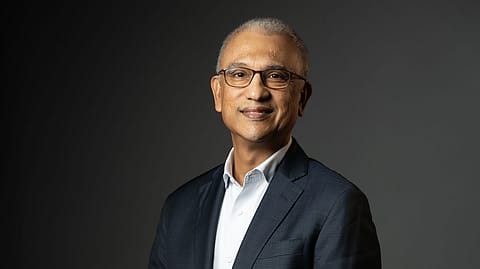
Steering steady | Credits: Nishikant Gamre
Slow and Steady: The Akasa game plan to win India's skies
Akasa Air, founded by Vinay Dube during the Covid-19 pandemic, has swiftly captured a 5% market share in India's aviation sector with a fleet of 34 aircraft. Aiming for 226 aircraft by 2032, Akasa focuses on a strong cost structure and customer satisfaction, positioning itself as a reliable alternative in a market dominated by a duopoly.
This summary is AI-generated, and Fortune India is not responsible for its content or any associated copyright issues.
With a five percent market share and a fleet of 34 aircraft, the airline has emerged as a viable alternative in India’s duopoly-dominated aviation sector.
Steering steady | Credits: Nishikant Gamre
It certainly was the most unusual of decisions.
But, at the end of it, Vinay Dube’s decision to start an airline amidst a surging Covid-19 pandemic seems to have played out well for Akasa Air. With a 5 percent market share and a fleet of 34 aircraft, the airline has emerged as a viable alternative in India’s duopoly-dominated aviation sector.
No other airline in global aviation, according to Vinay, has grown at such a fast pace in the three and a half years of operations. Now, with a target to operate a fleet of 226 aircraft by 2032, Dube’s focus is on building a dependable, viable airline with an excellent cost structure in India’s competitive skies, where airlines frequently fold.
In an interview with Fortune India, Dube discusses Akasa’s early days, plans, the challenges ahead, and what sets Akasa apart from other airlines. Edited Excerpts.
Q. How do you look back at Akasa in these three and a half years?
I think with a sense of pride and purpose, a sense of satisfaction and accomplishment. But, at the same time, with continued hunger and purpose for what lies ahead. In life and in business, there's always something you could have done better. But your satisfaction levels can't be based on an item here or an item there. I think your future is based on the learnings from items A, B, and C.
No other airline in the 125-year history of global aviation has gone from zero to 34. We now have 34 aircraft on our registry. We have done that with a very high degree of dependability. So, how can you not be satisfied?
Q. But starting an airline, especially during peak Covid, must have required some serious conviction?
I'm a math major, and I think in terms of mathematical numbers and patterns. The only airline that succeeded (in India) was founded by an aviation professional. You can look at every other airline that has existed or existed, and none of them was founded by an aviation professional. So it didn’t take much high-level math or AI to tell you there's a pattern here.
The whole idea centered around getting a good aircraft deal that'll give you a highly competitive cost structure, capitalize yourself well, because you never know what twists and turns are coming, and surround yourself with a set of smart professionals and create a professional environment, then allow those professionals to do what they have been trained to do, and that's essentially it.
Q. Was it difficult to convince your investors, when Boeing was down, that you must buy the 737 Max?
{{#most-powerful-women-snapshot-individual.slug}} {{/most-powerful-women-snapshot-individual.slug}} {{^most-powerful-women-snapshot-individual.slug}} {{/most-powerful-women-snapshot-individual.slug}} {{#showRanking}} {{current-rank}} {{/showRanking}} {{#photo.0.url}}
{{name}}
It was difficult to convince people to invest in a startup airline in the middle of the Covid pandemic. So convincing them whether it is a Boeing fleet or something else is a pittance compared to the order of magnitude of just telling people this is the best time ever to start an airline and having people believe you.
My expectation was that Boeing is fundamentally an engineering company. And with its DNA dating back maybe 100 years as a high-quality aircraft producer, I knew that, given Boeing's history and DNA, they would figure it out. I also knew that, given the scrutiny the Max was under, there would likely never be a safer aircraft. So, for me personally, it was very easy to believe that Boeing was going to get out of this.
Q. You are in a market that’s now something of a duopoly. How is it fighting in a market like that?
I would say our core focus will be on the fundamentals and creating India's leading cost structure. We want to build an airline that is dependable, kind, and empathetic. We back ourselves 100% on that. India is a large enough market to support multiple airlines. So if we're able to execute our plan, our market share will go up. But that's not what we're focused on. We are focused on our customers, cost structure, and employees.
Q. With all the 226 aircraft coming in, what’s your plan for domestic and international?
We want to move above 25% (international market share) and, over time, reach a 60-40 split: 60% domestic, 40% national. But again, it won't bother me if it stays at 75 to 25 or 70 to 30. This is just where we think demand is headed today, and we try to follow it.
Q. When you had your last round of funding, it was mentioned that it would be the last before an IPO. Is that the case?
It’s not something that’s cast in stone. What is cast in stone is the desire to always be well capitalised. That is the only thing that's cast in stone.
Q. Over the last few months, there has been a lot of chatter about the FDTL. Where does Akasa stand in terms of that?
Whatever the director general of civil aviation proposes, the first step is compliance. And we were given sufficient time to comply. From a mindset perspective, the first step is to comply. We have a very professional regulator. So where am I on this? I believe in complying and continuing to engage with your regulator; from a regulator's perspective, they are professional enough to continue engaging with airlines as well.
Q. How is the Indian aviation ecosystem today?
First and foremost, from an ecosystem perspective, I think India has some of the cheapest fares compared to any other part of the world. And one needs to put it in perspective, not just to India's GDP per capita, but the fact that airlines spend approximately 70% of their costs in US dollars. I hope that’s something the country's ecosystem and consumers can appreciate. Beyond that, I think we have an extremely fortunate environment, where the country and the economy are generating demand at a pace not seen in any other country. As an aviator, it's good to work in an environment where the economy is firing. It will fire for the next 20 to 30 years. That’s well beyond my lifetime in aviation.
Follow Fortune India
NEXT STORY