Studded gold, silver lift India’s jewellery exports 2.44% to $9.17 billion
/ 3 min read
At the same time, the traditional diamond trade continued to weigh on the broader export performance.
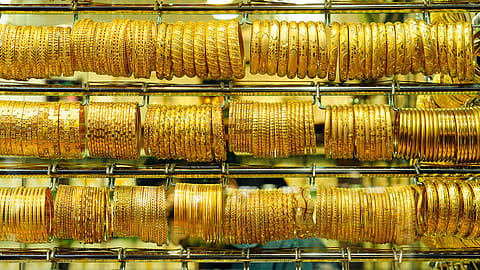
India’s gem and jewellery exports grew 2.44% in dollar terms to $9.17 billion in the first four months of FY27, as demand shifted towards higher value-added jewellery segments even as cut and polished diamond exports remained under pressure. In rupee terms, gross exports rose 13.58% to ₹87,078.01 crore during April to July 2026, according to data released by the Gem and Jewellery Export Promotion Council (GJEPC).
The growth was led by studded gold jewellery, whose exports jumped 21.09% to $2.24 billion from $1.85 billion a year earlier. Silver jewellery was another standout, with exports surging 72.19% to $508.18 million. Platinum jewellery exports rose 17.20% to $77.82 million, while polished lab-grown diamond exports increased 7.47% to $408.50 million.
The shift towards value-added jewellery is particularly notable because plain gold jewellery exports fell 8.46% to $1.80 billion during the period. Overall gold jewellery exports, including plain and studded jewellery, still rose 5.87% to $4.03 billion, supported by demand from the US, Singapore, Hong Kong and the UK.
At the same time, the traditional diamond trade continued to weigh on the broader export performance. Cut and polished diamond exports declined 8% to $3.60 billion in April to July, compared with $3.91 billion in the year ago period. Coloured gemstone exports also fell 13.04% to US$103.54 million.
July shows a sharper divergence between jewellery and diamonds
The divergence became more visible in the month of July. Overall gem and jewellery exports were largely flat at $2.35 billion, up just 0.38% from $2.34 billion a year earlier. In rupee terms, however, exports increased 11.68% to ₹22,511.64 crore. Gold jewellery exports rose 8.73%, with studded gold jewellery climbing 21.36% to $569.44 million. Demand came primarily from markets including the UAE, Hong Kong and Singapore.
In contrast, cut and polished diamond exports fell 18.23% year on year to $876.39 million in July. Polished lab grown diamond exports declined 8.23% to $112.26 million, while silver and platinum jewellery exports also fell marginally during the month.
One factor that could support jewellery demand is the recent easing in gold prices. Gold prices fell 3.88% in July to $4,073.92 per troy ounce from $4,238.32 in June, following a sharper 10.28% month on month correction in June. This marked the second consecutive month of price declines.
“Despite a challenging global environment, India’s gem and jewellery exports have shown encouraging resilience, with value-added segments such as studded gold jewellery, silver and platinum jewellery leading the way,” Kirit Bhansali, chairman of GJEPC, said. He added that easing gold prices are expected to support demand in key consuming markets.
The industry is also looking to upcoming shipments from orders generated at IIJS Bharat Premiere 2026. The trade show attracted more than 61,000 visitors, including over 5,000 international visitors from 80 countries. GJEPC expects business generated at the event to translate into shipments in the coming months.
Separately, the industry sees the Taxation and Other Laws Amendment Bill 2026 as a potential structural shift for India’s diamond trade. The legislation provides a 15-year income tax exemption to foreign companies trading rough diamonds through Special Notified Zones. Bhansali said the move could help India evolve from a processing centre into a global diamond trading hub.
“India is already the world’s leading centre for cutting and polishing diamonds, yet we have been entirely dependent on imports for rough diamonds. By providing a 15-year income tax exemption to foreign companies trading rough diamonds through our Special Notified Zones, this new law removes a long-standing structural barrier. It positions India to evolve from a processing powerhouse into a global diamond trading hub,” said Bhansali.
Follow Fortune India
NEXT STORY