Why IndiGo may be rethinking its regional fleet strategy
/ 3 min read
The reported preliminary evaluations of Embraer's E2 regional jets tell how India's largest airline could be preparing for the next phase of growth, where slot constraints, regional connectivity and network economics matter as much as fleet size.
THIS STORY FEATURES
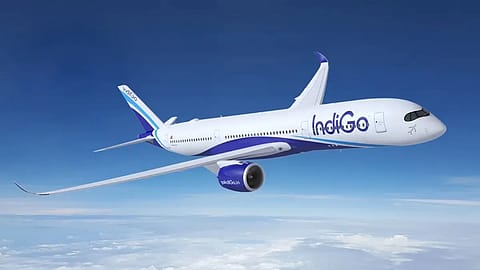
IndiGo regional fleet strategy | Credits: IndiGo/X
India's domestic aviation market is already dominated by two airline groups: IndiGo, controlling roughly two-thirds of domestic seats, and the Tata-owned Air India Group. And it seems that the next competitive frontier is increasingly shifting towards regional and secondary-city markets.
InterGlobe Aviation, IndiGo's parent, is in early, unconfirmed talks with Brazil's Embraer SA over a potential order for dozens of E2-family regional jets, Bloomberg reported this week, citing people familiar with the matter who stressed no agreement has been reached. Structured correctly, such a deal would do more than refresh a turboprop fleet — it would pre-emptively wall off India's fast-growing regional and thin-haul routes from any rival hoping to exploit the gap between micro-markets and mainline jets.
The leadership angle
The timing is not incidental. Willie Walsh formally took charge as IndiGo's chief executive on August 3, 2026, arriving from the directorship-general of IATA after four decades in the industry — as Aer Lingus's CEO, then British Airways', then a decade running International Airlines Group. Walsh built a reputation as an unsentimental cost-cutter with a taste for fleet rationalisation and hard-nosed OEM negotiations. He inherits an airline still absorbing the fallout from Pieter Elbers's abrupt March exit following a pilot-rostering crisis that grounded thousands of flights.
The infrastructure & economic dilemma
IndiGo operates around 44 ATR 72-600 aircraft across its regional network. While turboprops remain highly efficient on thin, short-haul routes, they typically seat about 70-78 passengers and cruise substantially slower than regional jets.
That becomes a limitation as India's busiest airports—including Delhi, Mumbai, Bengaluru and Hyderabad—grapple with severe slot constraints.
Aircraft such as Embraer's E190-E2 and E195-E2, which seat roughly 110-146 passengers depending on configuration, allow airlines to move more passengers using the same airport slot while reducing block times and improving aircraft utilisation. The economics extend beyond additional seats. Regional jets lower trip times, spread fixed airport-slot costs across a larger passenger base and improve network flexibility. On routes that have outgrown turboprops but remain too thin to consistently support an Airbus A320neo, that combination can materially improve route profitability.
Embraer's regional sales chief, Raul Villaron, has described the E2 as sitting in a "sweet spot" for India — too small a market for narrow-body Airbus jets, too long a route for turboprops to serve efficiently. That gap is precisely where India's UDAN regional-connectivity scheme and rising Tier-2/Tier-3 demand are pushing traffic growth.
Taken together, this suggests IndiGo may see greater value in the regional jet segment than in larger small narrow-bodies such as Airbus' A220. While the A220 overlaps more closely with the lower end of the A320neo family, the E2 family fills the gap between turboprops and narrow-body aircraft, allowing capacity to be more closely matched with demand.
Because the Embraer report surfaced only in the past day, formal notes from brokerages such as Jefferies, UBS, and Morgan Stanley have yet to fully price in the implications, though the structural questions they are likely to probe are already visible: introducing an entirely new airframe and engine type into a fleet that has been almost exclusively Airbus and ATR carries real costs — separate pilot type ratings, spare-parts inventory, and maintenance infrastructure — that could offset some of the E2's per-seat efficiency gains. The regulatory groundwork, however, has been laid. India's DGCA granted type certification to the E190, E195, and E195-E2 in early July, adding to an existing E175 certification already operated commercially by regional carrier Star Air. Embraer has simultaneously deepened its industrial ambitions in India through an enhanced memorandum of understanding with Adani Defence & Aerospace, signed in February, to build a final assembly line in Gujarat — contingent on securing at least 200 firm orders, a threshold an IndiGo deal alone could meaningfully advance.
If the economics add up
IndiGo stayed silent on the Embraer talks through its Q1 FY2027 earnings call in late July, where it instead spotlighted a memorandum of understanding with CFM International for more than 1,000 LEAP-1A engines to power 510 Airbus A320neo-family aircraft — the largest single order in CFM's history. That quarter brought a net loss of roughly ₹238 crore as fuel costs, partly linked to West Asia disruptions, ate into a 19-20% revenue rise. Even so, the balance sheet behind an airline with nearly 900 Airbus jets on order suggests it can absorb a parallel regional commitment. Confirmed or not, the Embraer talks read as a pre-emptive move: by the time any rival regional entrant could scale, IndiGo may already have closed the gap between turboprop and narrow-body — extending the duopoly's reach into India's next growth frontier before anyone else gets there.

Follow Fortune India
NEXT STORY