Budget 2026-27: Fiscal deficit projected at 4.3%, debt-to-GDP ratio is seen at 55.6%
Budget 2026-27: Fiscal deficit projected at 4.3%, debt-to-GDP ratio is seen at 55.6%
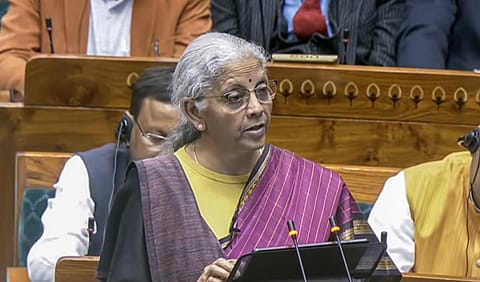
Finance Minister Nirmala Sitharaman presented the 2026-27 Union Budget, projecting a fiscal deficit of 4.3% of GDP, slightly lower than the previous year. The debt-to-GDP ratio is expected at 55.6%, with a focus on sustainable public debt. The budget emphasizes infrastructure development, with significant capital expenditure to support long-term growth.
The total size of the 2026-27 Budget is pegged at ₹53.5 lakh crore. Of this, total expenditure is projected at ₹53,47,315 crore, with ₹12,21,821 crore earmarked for capital expenditure
Finance Minister Nirmala Sitharaman on Sunday, February 1, 2026, presented the Union Budget for 2026-27, outlining a careful plan to reduce the country’s fiscal deficit while supporting growth. The Centre’s fiscal deficit is projected at 4.3% of GDP for 2026-27, slightly lower than the 4.4% budgeted for the current financial year. While the debt-to-GDP ratio is seen at 55.6%
Sitharaman emphasized that the government remains committed to keeping public debt on a sustainable path. From 2026-27 onwards, fiscal policy will aim to gradually reduce central government debt as a proportion of GDP.
The total size of the 2026-27 Budget is pegged at ₹53.5 lakh crore. Of this, total expenditure is projected at ₹53,47,315 crore, with ₹12,21,821 crore earmarked for capital expenditure. Effective capital expenditure, which also includes grants for creation of capital assets, is estimated at ₹17,14,523 crore. This reflects the government’s continued focus on building infrastructure and supporting asset creation for long-term growth.
For comparison, total expenditure in the revised estimates for the current fiscal year (2025-26) is ₹49,64,842 crore, higher than the ₹46,52,867 crore spent in 2024-25. Capital expenditure is also set to rise steadily, estimated at ₹10,95,755 crore in 2025-26, up from ₹10,51,953 crore in 2024-25.
Net tax receipts for 2026-27 are projected at ₹28.7 lakh crore, with ₹1.4 lakh crore set aside as tax devolution to states. Including grants, loans, and other transfers under centrally sponsored schemes, total resources for states are expected to reach ₹25,43,769 crore, up ₹3,78,263 crore from actual transfers in 2024-25.
The fiscal deficit, which measures the gap between government spending and revenue, remains a key macroeconomic indicator. A deficit of 3–4% of GDP is generally seen as prudent for a fast-growing economy like India, balancing the need for growth with fiscal discipline.
As of 2024, India’s general government debt-to-GDP ratio stood at 85%, with central government debt at 57%, highlighting the need for careful fiscal management even as the government invests in growth.