Cabinet raises Power Grid’s equity investment cap to ₹7,500 crore
/ 2 min read
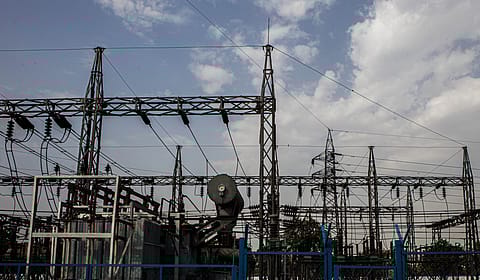
Power Grid Corporation can now participate in the bids for capital-intensive transmission projects | Credits: Sanjay Rawat
Cabinet raises Power Grid’s equity investment cap to ₹7,500 crore
The Union Cabinet has increased Power Grid Corporation's equity investment cap from ₹5,000 crore to ₹7,500 crore, enabling it to participate in more projects and support renewable energy integration. This move is part of broader reforms, including infrastructure projects worth ₹12,236 crore, aimed at strengthening India's power sector and achieving clean energy targets.
This summary is AI-generated, and Fortune India is not responsible for its content or any associated copyright issues.
The government has enhanced the equity contribution limit of Power Grid Corporation from ₹5,000 crore to ₹7,500 crore.
THIS STORY FEATURES
Power Grid Corporation can now participate in the bids for capital-intensive transmission projects | Credits: Sanjay Rawat
The Union Cabinet today approved two major policy reforms, including power sector reforms and MSP for raw jute, along with infrastructure projects worth ₹12,236 crore.
Announcing the decisions, Information and Broadcasting Minister Ashwini Vaishnaw said India’s power grids are considered among the most robust globally, given the investments made over the last ten years.
“Clean and renewable capacity in India is more than 50%. Even developed countries have not been able to achieve that target. India achieved its 2030 targets in 2025 itself. Grids need to be more robust to integrate renewable energy, for which continuous investments are required,” Vaishnaw said.
“Keeping in mind additional power generation and future demand nodes, the grid network needs to be prepared for evolving supply and demand. That is why the decision was taken today to enhance the equity contribution limit of Power Grid Corporation from ₹5,000 crore to ₹7,500 crore. Now the corporation will be able to participate in a higher number of projects,” he added.

The Cabinet Committee on Economic Affairs (CCEA), chaired by Prime Minister Shri Narendra Modi, approved enhanced delegation to POWERGRID under the extant guidelines dated February 4, 2010, issued by the Department of Public Enterprises (DPE) on delegation of powers applicable to Maharatna CPSEs.
The approval enhances the permissible equity investment limit of POWERGRID from the current threshold of ₹5,000 crore per subsidiary to ₹7,500 crore per subsidiary, while retaining the existing cap of 15% of the company’s net worth, according to the government release.
“The approval will enable POWERGRID, the largest and most experienced transmission service provider in the country, to expand its investment in its core business and support the evacuation of renewable energy capacity, helping achieve the target of 500 GW from non-fossil-based sources,” the release said.
“POWERGRID can now participate in bids for capital-intensive transmission projects, such as ultra-high voltage alternating current (UHVAC) and high voltage direct current (HVDC) transmission networks. Additionally, it will broaden competition in tariff-based competitive bidding (TBCB) for the selection of bidders for critical transmission projects. This will ensure better price discovery and ultimately lead to the availability of affordable and clean energy for consumers,” it added.
The Cabinet also fixed the MSP of raw jute (TD-3 grade) at ₹5,925 per quintal for the 2026–27 season.
“This would ensure a return of 61.8% over the all-India weighted average cost of production. The announced MSP of raw jute for the marketing season 2026–27 is in line with the principle of fixing MSP at a level of at least 1.5 times the all-India weighted average cost of production, as announced by the Government in Budget 2018–19,” the release said.
Follow Fortune India
NEXT STORY