Energy ties in focus: Oil imports to dominate India-Russia discussions during Putin's visit
/ 3 min read
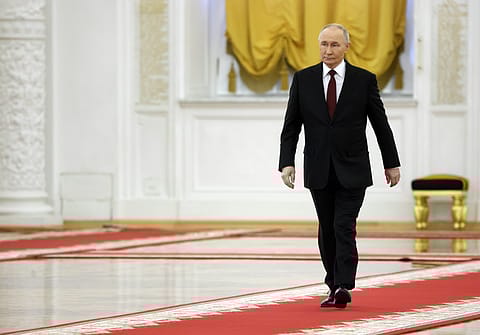
Russian President Vladimir Putin’s visit to India will focus heavily on oil imports, the backbone of the India–Russia partnership | Credits: Getty Images
Energy ties in focus: Oil imports to dominate India-Russia discussions during Putin's visit
Russian President Vladimir Putin’s visit to India for the 23rd Annual Summit will focus heavily on oil imports, the backbone of the India–Russia partnership. Discounted crude has transformed bilateral trade, now worth $68.7 billion, while defence cooperation and efforts to balance trade through increased Indian exports will also feature prominently amid global geopolitical pressures.
This summary is AI-generated, and Fortune India is not responsible for its content or any associated copyright issues.
Bilateral trade between the two countries has undergone a phenomenal shift in the last four years after India accepted Russia’s offer of discounted crude.
Russian President Vladimir Putin’s visit to India will focus heavily on oil imports, the backbone of the India–Russia partnership | Credits: Getty Images
Indian imports of Russian oil will remain a key agenda item during Russian President Vladimir Putin’s visit to India for the 23rd India–Russia Annual Summit tomorrow. Bilateral trade between the two countries has undergone a phenomenal shift in the last four years after India accepted Russia’s offer of discounted crude, helping reduce India’s import bill for the commodity while providing a lifeline to Russia’s war-affected economy.
Total trade between the two countries stood at $68.7 billion in 2024–25, five percent higher than $65.4 billion in 2023–24, which itself marked a 32.5% year-on-year jump from $49.4 billion in 2022–23—driven largely by India’s high crude oil imports from Russia. In 2020–21, before the Ukraine war pushed Russia to offer record-low crude prices to friendly countries like India, bilateral trade was just $8.1 billion. It rose 61.21% to $13.1 billion the following year and then surged 276% to $49.4 billion in 2022–23.
With the US imposing additional tariffs and sanctions on countries continuing to purchase Russian oil, high-level bilateral engagement has become essential for Moscow to ensure India remains a buyer. For India, Russia has become its largest crude supplier, accounting for 30–35% of total oil imports—making discounted crude the backbone of the partnership. “India’s current engagement with Russia rests on three pillars—energy, defence and diplomacy. Energy now dominates the relationship,” says Ajay Srivastava, founder of the Delhi-based think tank Global Trade Research Initiative (GTRI).
A GTRI analysis shows India’s imports from Russia were $63.2 billion in FY24 and inched up to $63.8 billion in FY25; in April–September 2025 alone, imports stood at $31.2 billion. Petroleum dominated overwhelmingly—crude oil ($23.1 billion) and petroleum products ($2.5 billion)—followed by coal ($1.9 billion). Strategic inputs such as fertilisers ($1.3 billion) and sunflower seed oil ($633 million) remain significant, while diamonds ($202 million) also add to the non-energy import bill.
Compared to imports, India’s exports to Russia have remained narrow and concentrated in a few industrial and chemical categories: machinery ($367.8 million), pharmaceuticals ($246 million) and organic chemicals ($165.8 million) accounted for most of the value in the first half of FY26. Exports of consumer-oriented and high-visibility items remain small—smartphones ($75.9 million), Vannamei shrimp ($75.7 million), meat ($63 million) and garments ($20.94 million).
While both sides are expected to explore ways to boost Indian exports to reduce the trade imbalance, the priority will be ensuring the continuation of oil imports amid rising geopolitical pressure.
“In energy, New Delhi is expected to pursue long-term crude contracts with non-US-sanctioned Russian firms like Lukoil and Rosneft, revival of Indian investments in Russian energy projects, and advancement of nuclear cooperation beyond Kudankulam. Cooperation in critical minerals, manufacturing, and maritime connectivity linking India with Russia’s Far East may also be discussed,” says Srivastava.
Defence—another pillar of bilateral partnership—is also likely to see discussions and possible commitments during Putin’s visit. “In defence, Indian officials are expected to seek accelerated delivery of additional S-400 Triumf systems and greater clarity on spares and upgrades for Russia-sourced platforms. The Su-57 stealth fighter may also be discussed, but more as a future possibility than a near-term commitment,” Srivastava adds.
Follow Fortune India
NEXT STORY