India only major economy with strong steel demand growth, says Steel Ministry
/ 3 min read
The domestic consumption has risen from about 95 million tonnes to 152 million tonnes in the past five years, marking growth of over 50%, says Sandeep Poundrik, Secretary, Ministry of Steel
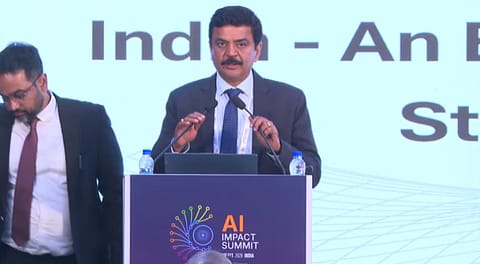
Sandeep Poundrik, Secretary, Ministry of Steel.
India is the only major economy witnessing strong growth in steel demand, even as global consumption stagnates or declines, Sandeep Poundrik, Secretary, Ministry of Steel, said on Wednesday, positioning the country as the world’s fastest-growing large steel market.
At the AI Impact Summit 2026 in New Delhi, Poundrik said, “We are the only country in the world where steel consumption is growing at a very high pace. The domestic consumption has risen from about 95 million tonnes to 152 million tonnes in the past five years, marking growth of over 50%.”
In contrast, global steel consumption fell about 0.4% last year, with most major economies either flat or shrinking. “All other major economies are either stagnant or decreasing. So, we are the bright spot,” he added.
According to Poundrik, the surge in demand is closely tied to India’s economic expansion and infrastructure push. “In India, we are developing very fast. We have one of the fastest GDP growth rates and that is why our steel consumption is growing,” he said.
Capacity addition at scale
He said India is also the only major steel-producing nation adding significant capacity, even as plants elsewhere shut down or operate below capacity.
“In the last five years, we have added more than 50 million tonnes of capacity. The country is currently adding roughly 20 million tonnes annually. India’s total capacity stands at around 200 million tonnes, second only to China’s 1,100 million tonnes,” Poundrik said.
The government expects the momentum to continue. “In the next five years, we are likely to add about 100 million tonnes. In the next 10 years, we are likely to add about 200 million tonnes,” he said, implying that India could double its steel capacity within a decade.
He believed that the expansion would translate into investments of around $200 billion. “One million tonnes of capacity roughly takes about one billion dollars. So that is the investment which is going to happen in the steel sector,” he added.
While large integrated producers such as SAIL, JSW Steel, Tata Steel, and NMDC dominate headlines, nearly 47% of India’s steel output comes from around 2,200 smaller units, widening the scope for technology providers and service firms.
AI as cost lever
The ministry is now pushing for deeper integration of artificial intelligence across the steel value chain, from mining and logistics to plant operations and market intelligence.
“But AI should not be used just because we want to do AI. It should lead to some economic benefit, or it should improve safety, or it should improve time, which will again lead to economic benefit, or address some ESG-related issue,” Poundrik said.
{{#most-powerful-women-snapshot-individual.slug}} {{/most-powerful-women-snapshot-individual.slug}} {{^most-powerful-women-snapshot-individual.slug}} {{/most-powerful-women-snapshot-individual.slug}} {{#showRanking}} {{current-rank}} {{/showRanking}} {{#photo.0.url}}
{{name}}
Opportunities include smart plant operations, drilling and blasting in mines, fleet management and stockpile management. “If you save even one rupee, it matters because the scale is enormous,” he said, highlighting that producing one tonne of steel involves moving about five tonnes of raw material.
Steel research and technology mission of India
To streamline industry collaboration, he said that the Steel Research and Technology Mission of India will act as a single point of contact for startups and solution providers. “We are posing as a single point of contact for startups and firms that can respond to industry challenges or propose their own solutions,” he added.
Follow Fortune India
NEXT STORY