RBI lifts FY26 GDP growth forecast to 7.3%, sees softer inflation
/ 3 min read
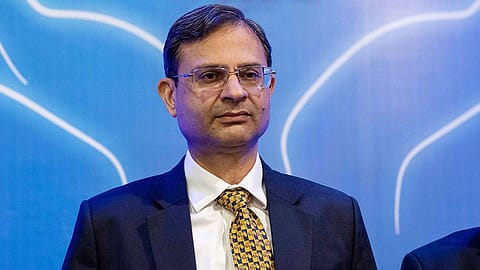
RBI Governor Sanjay Malhotra
RBI lifts FY26 GDP growth forecast to 7.3%, sees softer inflation
RBI has increased India's FY26 GDP growth forecast to 7.3% and lowered inflation expectations, reflecting strong economic performance in Q2. The MPC's decision to cut the repo rate by 25 basis points aims to further stimulate the economy. The Indian economy benefits from domestic demand, GST rationalisation, and favourable monetary conditions.
This summary is AI-generated, and Fortune India is not responsible for its content or any associated copyright issues.
The central bank has announced a 25 basis point repo rate cut to 5.25% to support economic growth. The Indian economy is bolstered by resilient domestic demand and favourable monetary conditions, despite external uncertainties.
RBI Governor Sanjay Malhotra
Buoyed by the recent Q2FY26 GDP numbers announced by the government, the Reserve Bank of India's (RBI) monetary policy committee (MPC) has upgraded India’s FY26 GDP growth forecast to 7.3% from the earlier 6.8%, and also lowered the FY26 CPI inflation forecast to 2.0% from 2.6% projected previously.
Real GDP growth for Q3FY26 is projected at 7.0%, and Q4 at 6.5%, while the numbers for Q1FY27 and Q2FY27 are projected at 6.7% and 6.8%, respectively. CPI inflation for Q3FY26 is projected at 0.6%, and Q4 at 2.9%. CPI inflation for Q1FY27 and Q2 are projected at 3.9% and 4.0%, respectively.
On Friday, the MPC, led by Governor Sanjay Malhotra, announced a 25 basis point repo rate cut to 5.25% after its three-day policy deliberations, thereby providing a further boost to the economy. The MPC’s decision was largely in line with market expectations, with many economists anticipating a 25 bps cut supported by the sharp decline in inflation.
The MPC voted unanimously to reduce the repo rate by 25 bps to 5.25%.
Malhotra, in his MPC policy statement, said real GDP growth had accelerated to 8.2% in Q2, buoyed by strong spending during the festive season, which was further facilitated by the rationalisation of GST rates. “Inflation at a benign 2.2% and growth at 8.0% in H1:2025-26 present a rare goldilocks period.”
Inflation at a benign 2.2% and growth at 8.0% in H1:2025-26 present a rare goldilocks period.
Sanjay Malhotra, Governor, RBI
The RBI Governor said the underlying inflation pressures are even lower as the impact of the increase in the price of precious metals is about 50 bps. Since RBI’s October policy, the Indian economy has witnessed rapid disinflation, with inflation coming down to an unprecedentedly low level, he said. “For the first time since the adoption of flexible inflation targeting (FIT), average headline inflation for a quarter at 1.7% in Q2:2025-26, breached the lower tolerance threshold (2%) of the inflation target (4%). It dipped further to a mere 0.3% in October 2025.”
‘Strong domestic factors continue to support economic activity’
The RBI Governor said the real gross domestic product (GDP) registered a six-quarter high growth of 8.2% in Q2:2025-26, underpinned by resilient domestic demand amidst global trade and policy uncertainties. “On the supply side, real gross value added (GVA) expanded by 8.1%, aided by buoyant industrial and services sectors. Economic activity during the first half of the financial year benefitted from income tax and goods and services tax (GST) rationalisation, softer crude oil prices, front-loading of government capital expenditure, and facilitative monetary and financial conditions supported by benign inflation.”
Economic activity during the first half of the financial year benefitted from income tax and goods and services tax (GST) rationalisation, softer crude oil prices, front-loading of government capital expenditure, and facilitative monetary and financial conditions supported by benign inflation.
Sanjay Malhotra, Governor, RBI
Looking ahead, he believes the domestic factors such as healthy agricultural prospects, continued impact of GST rationalisation, benign inflation, healthy balance sheets of corporates and financial institutions and congenial monetary and financial conditions should continue to support economic activity. “Continuing reform initiatives would further facilitate growth. On the external front, services exports are likely to remain strong, while merchandise exports face some headwinds. External uncertainties continue to pose downside risks to the outlook, while the speedy conclusion of various ongoing trade and investment negotiations presents upside potential.”
'Prices are likely to moderate going forward’
The RBI Governor said the inflation outlook looks to be moderating going forward. “Food supply prospects have improved on the back of higher kharif production, healthy rabi sowing, adequate reservoir levels and conducive soil moisture. Barring some metals, international commodity prices are likely to moderate going forward. Overall, inflation is likely to be softer than what was projected in October, mainly on account of the fall in food prices.”
{{#most-powerful-women-snapshot-individual.slug}} {{/most-powerful-women-snapshot-individual.slug}} {{^most-powerful-women-snapshot-individual.slug}} {{/most-powerful-women-snapshot-individual.slug}} {{#showRanking}} {{current-rank}} {{/showRanking}} {{#photo.0.url}}
{{name}}
Headline CPI inflation declined to an all-time low in October 2025. The faster-than-anticipated decline in inflation was led by a correction in food prices, contrary to the usual trend witnessed during the months of September and October. Core inflation (CPI headline excluding food and fuel) remained largely contained in September and October, despite continued price pressures exerted by precious metals. Excluding gold, core inflation moderated to 2.6% in October. Overall, the decline in inflation has become more generalised.
Follow Fortune India
NEXT STORY