RBI MPC 2026: Central bank holds repo rate at 5.25%, maintains status quo amid currency and yield pressures
/ 3 min read
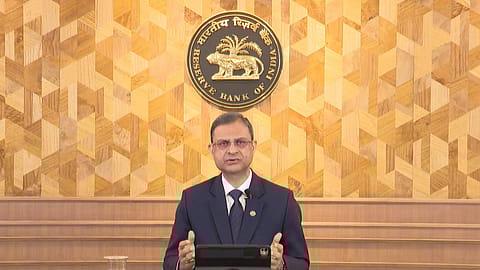
Sanjay Malhotra, Governor, Reserve Bank of India | Credits: Fortune India
RBI MPC 2026: Central bank holds repo rate at 5.25%, maintains status quo amid currency and yield pressures
The Reserve Bank of India, led by Governor Sanjay Malhotra, has maintained the repo rate at 5.25% during its final bi-monthly meeting of FY26, aligning with market expectations. Despite a 125 basis point cut in 2025, the central bank opted for a neutral stance amid currency and yield pressures, prioritizing liquidity management over further rate changes.
This summary is AI-generated, and Fortune India is not responsible for its content or any associated copyright issues.
The RBI MPC, led by Governor Sanjay Malhotra, retained its neutral stance and left all key interest rates unchanged, with the benchmark repo rate held at 5.25%.
Sanjay Malhotra, Governor, Reserve Bank of India | Credits: Fortune India
In line with Street expectations, the Reserve Bank of India (RBI), under Governor Sanjay Malhotra, kept policy settings unchanged in its latest monetary policy announcement on Friday. The six-member Monetary Policy Committee (MPC), concluding its sixth and final bi-monthly meeting of FY26, retained its neutral stance and left all key interest rates unchanged, with the benchmark repo rate held at 5.25%.
"The committee unanimously voted to keep the policy repo rate unchanged at 5.25%. Consequently, the standing deposit facility (SDF) rate remains at 5.0%, while the marginal standing facility (MSF) rate and the bank rate stand at 5.5%," said Malhotra said while announcing the policy decision.
The central bank has already delivered a cumulative repo rate cut of 125 basis points during calendar year 2025 - cutting rates by 25 bps each in February and April, followed by a sharper 50 bps reduction in June and a final 25 bps in December - marking one of the most aggressive easing cycles in recent years.
This policy review comes against the backdrop of several key developments, including the presentation of the Union Budget for 2026-27 and the announcement of trade agreements between India and the U.S., as well as India and the European Union.
In its December policy, the MPC had maintained a neutral stance, lowered its FY26 inflation projection and retained GDP growth for FY2025–26 at a robust 7.3%.
RBI policy in line with expectations
Economists had widely projected no material change in the RBI’s policy stance or macroeconomic outlook. Domestic brokerages including Nuvama, JM Financial, Emkay Global and SBI Ecowrap had flagged a pause, expecting the MPC to remain in a wait-and-watch mode. They noted that liquidity management, currency stability and yield-curve stability are currently far more critical than additional policy rate changes.
SBI Ecowrap pointed out that despite the 125 bps repo rate cut and aggressive liquidity support—including open market operations (OMOs) worth ₹6.6 lakh crore in the current fiscal, the largest in the RBI’s history—government bond yields have failed to soften meaningfully.
Nuvama echoed this assessment, noting that transmission to bank lending rates is still underway and bond yields have remained sticky despite cumulative easing. With the Centre set to roll out a ₹17.2 lakh crore gross borrowing programme, the brokerage said the RBI is likely to prioritise liquidity operations over further rate action. JM Financial and Emkay Global have also pencilled in a pause at the February 26 MPC meeting.
While India’s GDP growth is expected to moderate modestly in the coming quarters, potential growth remains supported by sustained public sector capital expenditure and gains from recently concluded trade agreements with the US and the European Union, said Sujan Hajra, Chief Economist and Executive Director at Anand Rathi Group. However, a calibrated uptick in retail inflation has narrowed the RBI’s near-term policy space.
“In this context, the MPC is likely to remain in a wait-and-watch mode, keeping the repo rate on hold, as the RBI’s room for additional cuts remains constrained,” Hajra said, adding that liquidity management and yield-curve stability matter far more than changes in the policy rate at this stage.
Brokerages also highlighted recent trade agreements with the EU and the US as a key structural positive. Tariffs on Indian goods have been reduced to 18% from 50% earlier, placing India among the lower-tariff economies in Asia and potentially boosting export competitiveness.
Follow Fortune India
NEXT STORY