RBI policy on Feb 6: Will Governor Sanjay Malhotra-led MPC hold rates after 125 bps easing cycle?
/ 4 min read
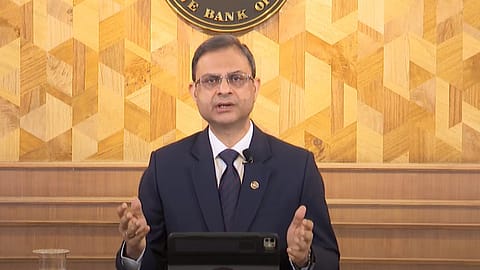
RBI Governor Sanjay Malhotra will announce the MPC policy outcome on February 6
RBI policy on Feb 6: Will Governor Sanjay Malhotra-led MPC hold rates after 125 bps easing cycle?
The Reserve Bank of India is expected to maintain its current policy rates at the February 6 MPC meeting after a 125 bps rate cut in 2025. Economists predict a focus on liquidity management and yield-curve stability amid global volatility, with no significant changes in policy stance or macroeconomic projections anticipated.
This summary is AI-generated, and Fortune India is not responsible for its content or any associated copyright issues.
Economists expect the RBI to maintain a status quo on policy rates at its February 6 Monetary Policy Committee (MPC) meeting.
RBI Governor Sanjay Malhotra will announce the MPC policy outcome on February 6
After delivering a cumulative repo rate cut of 125 basis points (1.25%) in calendar year 2025, the Reserve Bank of India (RBI) is widely expected to maintain a status quo on policy rates at its February 6 Monetary Policy Committee (MPC) meeting. The central bank commenced its first policy meeting of 2026 on February 4, with the outcome due on February 6.
Economists expect no material change in the RBI’s policy stance or its macroeconomic projections at the February review. With the economy showing early signs of bottoming out, but the recovery yet to become broad-based, and global volatility remaining elevated, the central bank is likely to prioritise liquidity management, monetary transmission and yield-curve stability over further rate cuts, at least for now.
Under Governor Sanjay Malhotra, the RBI cut the repo rate four times in 2025—by 25 bps each in February and April, a sharper 50 bps in June, and a final 25 bps in December—marking one of the most aggressive easing cycles in recent years.
The December policy saw the MPC retain a neutral stance, lower its FY26 inflation projection, and hold GDP growth for FY2025–26 at a robust 7.3%. With much of the easing already front-loaded, economists now expect the central bank to pause and assess the transmission of past rate cuts amid a mixed domestic macroeconomic backdrop and heightened global uncertainty.
Experts expect RBI to maintain status quo
According to Sujan Hajra, Chief Economist & Executive Director at Anand Rathi Group, while GDP growth is expected to moderate modestly, potential growth remains supported by sustained public sector capital expenditure and the boost from two major trade agreements with the US and the European Union. However, a calibrated uptick in retail inflation limits the scope for near-term easing.
“In this context, the MPC is likely to remain in a wait-and-watch mode, keeping the repo rate on hold, as the RBI’s room for additional cuts remains constrained,” Hajra said, adding that liquidity management and yield-curve stability will be far more critical than changes in the policy rate.
Nuvama echoed this view, noting that transmission to bank lending rates is still underway and bond yields have remained sticky despite the cumulative easing. “We expect the RBI to keep policy rates unchanged and maintain its neutral stance in the forthcoming MPC review, following 125 bps of cumulative easing from the peak that has taken the policy rate to 5.25%,” the brokerage said.
The RBI is likely to focus more on liquidity management than rate action, particularly with a ₹17.2 lakh crore gross borrowing programme lined up for the Centre, Nuvama added.
Among others, JM Financial and Emkay Global also expect that the RBI could opt for a pause in the February 26 MPC.
SBI Ecowrap also expects the RBI to maintain a status quo in the upcoming policy, noting that government bond yields have shown persistent hardening despite policy rate cuts.
Bond yields defy record liquidity injection
SBI Ecowrap flagged that despite a 125 bps repo rate cut and proactive liquidity injections—including open market operations (OMOs) worth ₹6.6 lakh crore in the current fiscal, the largest in RBI’s history—government bond yields have refused to soften meaningfully.
{{#most-powerful-women-snapshot-individual.slug}} {{/most-powerful-women-snapshot-individual.slug}} {{^most-powerful-women-snapshot-individual.slug}} {{/most-powerful-women-snapshot-individual.slug}} {{#showRanking}} {{current-rank}} {{/showRanking}} {{#photo.0.url}}
{{name}}
“Factoring in CRR injections, term repos, buy-sell swaps and currency leakage, total liquidity injection is around ₹6.6 lakh crore. Yet yields continue to harden, which is unprecedented,” the report said, adding that the choice of eligible securities in OMO operations could be influencing their effectiveness.
According to SBI Ecowrap, one of the most significant developments since the last policy has been the India–EU and India–US trade agreements, which have reduced tariffs on Indian goods to 18% from 50% earlier. This places India among countries with relatively lower tariffs in Asia, potentially improving export competitiveness.
However, global economic conditions remain uncertain. SBI’s Geo-Economics Stress Index suggests that heightened uncertainty typically translates into economic stress with a lag of three to four months. Meanwhile, global metal prices have recovered after a sharp sell-off last week.
In the US, slack in the labour market, stagnant real disposable incomes and easing inflationary pressures could prompt the Federal Reserve to consider rate cuts.
Against this backdrop, the Indian rupee has remained volatile, trading in the range of 89–92 against the US dollar over the past two months. The currency has depreciated by about 5.8% since April 2, 2025—when the US announced sweeping tariff hikes—but has appreciated by over ₹1 following the India–US trade deal.
Nuvama noted that despite rate cuts, India’s 10-year government bond yield continues to trade at elevated levels, while commercial paper (CP) and certificate of deposit (CD) rates have firmed up. Banking system liquidity has also remained tight, averaging below 1% of Net Demand and Time Liabilities (NDTL) over the past few months and dipping to around 0.2% in January.
Persistent exchange-rate pressures and intermittent RBI intervention in the forex market have limited the impact of OMOs. However, recent trade agreements, particularly the India–US deal, could support foreign inflows and the rupee, providing the RBI greater flexibility to manage domestic liquidity.
Follow Fortune India
NEXT STORY