SBI flags global trade uncertainty after US Supreme Court strikes down Trump tariff order
/ 3 min read
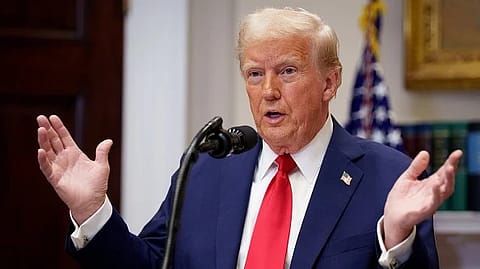
US President Donald Trump. | Credits: Getty Images
SBI flags global trade uncertainty after US Supreme Court strikes down Trump tariff order
The US Supreme Court's decision to strike down Trump's tariff order under the International Emergency Economic Powers Act has introduced significant uncertainty in global trade, according to SBI. The ruling emphasizes Congress's authority over taxation, while the executive branch has imposed a temporary 10% tariff under Section 122, affecting global trade dynamics and necessitating strategic recalibration.
This summary is AI-generated, and Fortune India is not responsible for its content or any associated copyright issues.
The US Supreme Court, in a 6-3 verdict, invalidated the President’s use of the International Emergency Economic Powers Act (IEEPA), 1977, to impose tariffs.
THIS STORY FEATURES
US President Donald Trump. | Credits: Getty Images
The recent ruling by the Supreme Court of the United States striking down the US administration’s tariff actions under emergency powers could significantly alter the global trade landscape, State Bank of India (SBI) Research said in a report, warning of heightened uncertainty and complex negotiations in the months ahead.
On February 20 (Friday), the US Supreme Court, in a 6-3 verdict, invalidated the President’s use of the International Emergency Economic Powers Act (IEEPA), 1977, to impose tariffs. The Act had never previously been invoked by a President to levy tariffs and was not designed for peacetime trade actions.
Judgment reinforces constitutional principle that the power to tax rests with Congress
SBI noted that the judgment reinforces the constitutional principle that the power to tax rests with Congress. Citing Article I, Section 8 of the US Constitution, the court reiterated that “Congress alone” has the authority to impose duties and taxes. The ruling also referenced past precedents such as Biden v. Nebraska, West Virginia v. EPA, and National Federation of Independent Business v. OSHA, where the court declined to infer broad executive authority without explicit congressional backing.
However, the report highlighted that the executive branch has swiftly invoked Section 122 of the Trade Act of 1974 to impose a temporary 10% global tariff on all imports into the US for 150 days, effective February 24, 2026. This marks the first-ever use of Section 122 powers.
Under Section 122, the President may impose temporary import surcharges of up to 15% or quotas to address balance of payments concerns, with the measures valid for a maximum of 150 days unless ratified by Congress. The new 10% tariff exempts goods from Canada and Mexico that comply with the USMCA, as well as certain national security-related tariffs already in place.
SBI expects that during this 150-day window, the US administration may complete investigations under Section 301 and Section 232 of the Trade Act to impose more durable tariffs. Section 232 tariffs on sectors such as steel, aluminium, automobiles and copper remain in force and continue to affect Indian companies and global exporters. For India and other exporting nations, the evolving US tariff regime underscores the need for strategic calibration, as the global trading system navigates renewed volatility.
The report observed that the court’s ruling was “cautious and delicately woven,” with the majority highlighting constitutional “originalism” while the dissent, authored by Justice Brett Kavanaugh, maintained that the tariffs were lawful as a matter of statutory interpretation. Importantly, the dissent also suggested that alternative statutory provisions could allow the executive to reimpose similar tariffs through other routes.
Tariff rollback may ease uncertainty but spark fresh strategic realignments
SBI cautioned that the scrapping of the earlier tariff structure may temporarily ease uncertainty but could also trigger counter-intuitive strategic negotiations among trading partners. With ultimate authority resting in a closely divided US Congress, jurisdictions may need to reposition themselves during this intermittent phase of policy flux.
The report also warned that the judgment could cast a shadow over existing trade agreements facilitated by earlier tariff measures, potentially affecting deals involving countries such as China, the UK, and Japan. The convergence of inter-sovereign treaties and claims by private “juristic persons”—including firms that successfully challenged the tariffs—could create legal and financial complications, particularly around refund claims and treaty interpretations.
According to SBI, the broader tug-of-war between the executive and legislative branches over tariff powers is likely to persist. Tariffs, the report said, remain both a fiscal instrument impacting national revenues and a politically sensitive tool in trade diplomacy.
“The shifting sands of bilateral relations and the interplay between sovereign trade agreements and private sector litigation could reshape global trust, supply chains and trade dynamics,” the report noted.

Follow Fortune India
NEXT STORY