Sebi in process to develop technology roadmap for MIIs: Tuhin Kanta Pandey
/ 3 min read
Regulator plans 5-year and 10-year tech vision for exchanges and other MIIs, with focus on governance, AI and cyber security
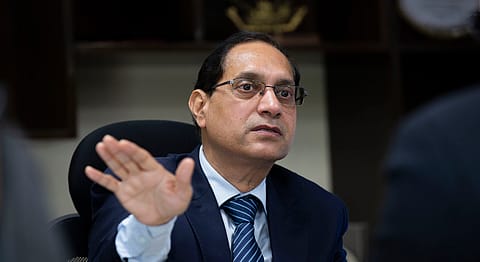
Sebi Chairman Tuhin Kanta Pandey | Credits: Sanjay Rawat
Tuhin Kanta Pandey, Chairman, Sebi, said that the regulator is in the process of constituting a working group to develop a technology roadmap for market infrastructure institutions (MIIs). Speaking at the marquee event of Sensex completing 40 years at the Bombay Stock Exchange, Pandey said that this roadmap will provide MIIs a structured 5-year and 10-year strategic technology vision for the securities market ecosystem.
"Amid rapidly evolving market ecosystem exchanges, other MIIs and market institutions must continue to invest in technology, risk management and cyber resilience, ensuring that innovation strengthens not weakens market integrity," the Sebi chief said.
Pandey said that as market infrastructure institutions such as exchanges, clearing corporations and depositories are the foundational pillars of the securities ecosystem, the governance must therefore be unimpeachable. "To this end, we have mandated external independent performance evaluations of MIIs and their statutory committees once every three years in addition to internal evaluations."
Sebi has issued guidelines to strengthen broad governance including norms relating to appointment of key directors and clearer reporting lines for key management personnel to executive directors (ED). "The chief technology officer and chief information security officer will report to the ED of critical operations who will report to the governing board of the MII on a quarterly basis."
Pandey also noted that as markets evolve, emerging technologies particularly artificial intelligence along with deeper global linkages bring new efficiencies but also fresh complexities. "The next frontier therefore lies in anticipating risks before they surface. At Sebi, we are continuously upgrading our technological capabilities to enhance market integrity, supervision and investor protection."
He spoke on how the regulator has adopted the use of AI through different tools that support this objective. For surveillance of unauthorized digital activity, Sebi Sudarshan is an AI-powered market surveillance system detects fraudsters who pose as registered IA and RA to mislead the public on social media platforms.
SEBI Radar is a regulatory AI-driven advertisement reviewer which monitors and analyses the AMC advertisements for any potential violation of code of conduct of advertisement issues by the SEBI. Sentiment analysis of corporate announcement is a tool that classifies disclosures by listed entities as material or non-material and assists in the generation of timely surveillance alerts.
"AI-driven inspection tools are currently under development to strengthen risk-based supervision of regulated entities. This tool will analyse cyber audit reports, identify control gaps, and classify entities based on their risk exposure, thereby enhancing supervisory effectiveness," Pandey said.
On Sensex completing 40 years
The Sebi chief said that in the last four decades, the Sensex has stood the test of time as a robust market indicator, mirroring India's economic transformation, and the growing maturity of our capital markets.
"As we celebrate 40 years of the SENSEX, we are reminded that enduring markets are not built on momentary highs or cycles of optimism. They are built on institutions that inspire trust, regulation that evolves with markets and systems that continuously adapt and upgrade. The SENSEX today stands not merely as an index but as a testament to India's capital market journey, one shaped by continuity, reform, institutional strength and a forward-looking embrace of technology."
He said that the launch of the Sensex in 1986 marked a defining moment in the evolution of India's capital markets. "When the Sensex was introduced, India's economy and markets were very different from what we see today. Trading was manual, market participation was limited, and the economy was relatively inward-looking. Yet the idea behind the Sensex was forward-looking, to create a transparent, representative and credible benchmark that reflected the performance of leading companies in the economy."
{{#most-powerful-women-snapshot-individual.slug}} {{/most-powerful-women-snapshot-individual.slug}} {{^most-powerful-women-snapshot-individual.slug}} {{/most-powerful-women-snapshot-individual.slug}} {{#showRanking}} {{current-rank}} {{/showRanking}} {{#photo.0.url}}
{{name}}
With companies continuing their presence, it reflects sustained attention to governance, competitiveness and long-term value creation, Pandey noted.
Follow Fortune India
NEXT STORY