Trump raises global tariffs to 15% after SC ruling: How India is affected
/ 2 min read
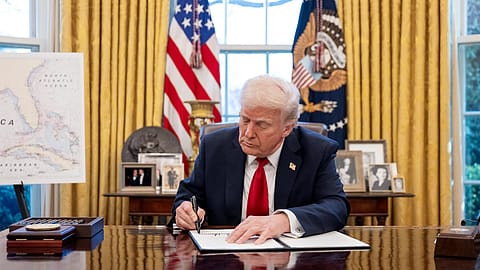
Donald Trump said his decision followed a “thorough, detailed, and complete review” of what he described as the court’s “ridiculous, poorly written, and extraordinarily anti-American decision” on tariffs. | Credits: White House
Trump raises global tariffs to 15% after SC ruling: How India is affected
President Trump announced a 15% global tariff on imports following a Supreme Court ruling that deemed his previous tariff actions unconstitutional. This decision slightly increases India's effective tariff rate to 18.5%. Despite the court's decision, Trump plans to continue imposing tariffs under different legal provisions, maintaining his focus on reviving US manufacturing.
This summary is AI-generated, and Fortune India is not responsible for its content or any associated copyright issues.
India, which faced 25% reciprocal tariffs last year—later raised to 50% over its Russian oil imports—saw rates reduced to 18% in February 2026 following an interim trade framework.
Donald Trump said his decision followed a “thorough, detailed, and complete review” of what he described as the court’s “ridiculous, poorly written, and extraordinarily anti-American decision” on tariffs. | Credits: White House
President Donald Trump on Saturday proposed a 15% global tariff on imports, up from the 10% rate he had announced a day earlier, in a swift response to a ruling by the Supreme Court of the US that struck down many of the sweeping levies he imposed over the past year.
In a post on social media, Trump said his decision followed a “thorough, detailed, and complete review” of what he described as the court’s “ridiculous, poorly written, and extraordinarily anti-American decision” on tariffs.
What it means for India
India, which faced 25% reciprocal tariffs last year—later raised to 50% over its Russian oil imports—saw rates reduced to 18% in February 2026 following an interim trade framework. With the proposed 15% global tariff, India’s effective rate would stand at 18.5%, a marginal increase.
US Supreme Court ruled that tariff-setting powers lie with Congress
The court, in a 6-3 ruling on Friday, held that it was unconstitutional for the president to unilaterally impose and alter tariffs under an emergency powers law, noting that the authority to tax rests with Congress. Chief Justice John Roberts wrote the majority opinion, joined by Justices Neil Gorsuch and Amy Coney Barrett, both Trump appointees. Justice Brett Kavanaugh authored a 63-page dissent and was praised by Trump along with Justices Clarence Thomas and Samuel Alito.
Despite the setback, Trump said he would invoke a different, though more limited, legal authority. He has already signed an executive order to impose a 10% tariff on imports from nearly all countries starting Tuesday, coinciding with his State of the Union address. These tariffs would lapse after 150 days unless extended by Congress. The White House has not indicated when an updated order raising the rate to 15% would be signed.
The ruling had implied a rollback to pre-Trump tariff levels of around 3.5%. However, Trump signalled he would continue pursuing tariffs under other provisions of federal law that require Commerce Department investigations.
Tariffs have been central to Trump’s economic agenda, which he argues will revive US manufacturing and address trade imbalances. Federal data shows the Treasury collected over $133 billion in import taxes under the emergency powers law as of December, though the court’s ruling did not clarify the status of funds already collected.
Democrats sharply criticised the move. Members of the House Ways and Means Committee accused Trump of “pickpocketing the American people,” while California Governor Gavin Newsom said the president “does not care about you.”
Follow Fortune India
NEXT STORY