Passions: Regal retreats turn boutique hotels
/ 5 min read
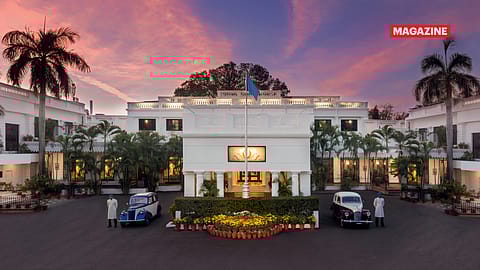
The Jehan Numa Palace in Bhopal balances colonial elegance with Indo-Islamic motifs.
Passions: Regal retreats turn boutique hotels
India's palace hotels offer a unique blend of historical charm and modern luxury, transforming regal residences into boutique hotels. These properties, once homes to maharajas and nawabs, now serve as living museums, showcasing India's princely past. From Rajasthan to lesser-known gems, each hotel provides a rich tapestry of legacy, landscape, and luxury, redefining travel through time.
This summary is AI-generated, and Fortune India is not responsible for its content or any associated copyright issues.
Across India, royal families and private hoteliers are turning timeworn palaces into decadent boutique stays.
The Jehan Numa Palace in Bhopal balances colonial elegance with Indo-Islamic motifs.
This story belongs to the Fortune India Magazine indias-largest-companies-december-2025 issue.
IN A WORLD INCREASINGLY enamoured with speed, minimalism, and modernity, a stay in one of India’s palace hotels feels like stepping into an illuminated manuscript — each corner echoing with centuries-old secrets, each wall steeped in stories. These regal residences, once the sanctuaries of maharajas and nawabs, now welcome guests with a blend of old-world charm and contemporary indulgence. They are not merely hotels — they are living museums, painstakingly restored and reflective of India’s princely past.
Once relics of faded grandeur, these properties are staging a comeback as haute hospitality destinations. But behind every mosaic-tiled room service suite lies a fascinating story of finance, family politics — and the billion-rupee bet on nostalgia.
While Rajasthan dominates the heritage hotel landscape, beyond its borders lie lesser-known gems that are equally rich in history and character. The Jehan Numa Palace in Bhopal, Taj Nadesar Palace in Varanasi, Kasmanda Palace in Mussoorie, and The Belgadia Palace in Odisha collectively offer a magical mix of legacy, landscape, and luxury. Each property, still stewarded by its royal lineage, blends the gravitas of historical architecture with the intimacy of a home — and in doing so, they redefine what it means to travel through time.
Jehan Numa Palace, Bhopal
Nestled amidst the verdant Shamla Hills and facing Bhopal’s Upper Lake, Jehan Numa Palace is a tribute to a unique chapter in Indian history — one ruled by formidable female nawabs.
Built in 1890 by General Obaidullah Khan, son of Nawab Sultan Jehan Begum (one of four successive female rulers of Bhopal), the palace was originally designed as a royal residence that balanced colonial elegance with Indo-Islamic motifs. Converted into a hotel by the family in the 1980s, it has retained its aristocratic soul.
Mosaic floors, vintage photographs, arched porticos, and wrought iron balustrades conjure up images of equestrian tournaments, Persian poetry recitals, and diplomatic dinners. The family’s equine heritage is on proud display at the adjoining stables and polo grounds, still operational.
More Stories from this Issue
Guests can stroll through mango groves, laze by the emerald-tiled pool, or dine at ‘Under the Mango Tree,’ where grilled kebabs and live ghazals recreate the bygone ambiance. The library-cum-bar ‘Shergar’ is named after the legendary racehorse and is still frequented by the current royal scions.
(L-R, clockwise): Mrinalika and Akshita Bhanj Deo have converted The Belgadia Palace to part family home and part socially conscious heritage stay; The Taj Nadesar Palace in Varanasi, a royal guest house earlier, offers an oasis of tranquility amid the city’s frenetic pace; The Kasmanda Palace in Mussoorie, just above the bustling Mall Road, is a glorious throwback to the days of the British Raj.
Taj Nadesar Palace, Varanasi
On the banks of the sacred Ganga, Taj Nadesar Palace offers a rare tranquillity in the otherwise frenetic city of Varanasi. Built in the late 18th century, this elegant white-marble residence served as a guest house for British officials and later the Maharaja of Varanasi’s royal visitors. Its gardens, blooming with jasmine and champa, were once known for elephant processions and elaborate durbars.
Initially build after the Battle of Plassey by the East India company between 1780 and 1788, the hotel changed hands and was transferred in 1890 to the royal family of Banaras. The property then because a royal guest house for personalities like Lord Mountbatten and Jawaharlal Nehru.
{{#most-powerful-women-snapshot-individual.slug}} {{/most-powerful-women-snapshot-individual.slug}} {{^most-powerful-women-snapshot-individual.slug}} {{/most-powerful-women-snapshot-individual.slug}} {{#showRanking}} {{current-rank}} {{/showRanking}} {{#photo.0.url}}
{{name}}
After its acquisition by the Taj group, the nine-suite property was lovingly restored to preserve its heritage — each suite named after royal guests like Prince of Wales or Queen Elizabeth, who once stayed here. The palace’s name is derived from the nearby shrine of the goddess Nadesari, a patron deity of the region.
Guests arrive in style — via a horse-drawn carriage or vintage Ambassador — then are showered with rose petals and ushered into a world of colonial-era comfort. Four-poster beds, Persian rugs, antique writing desks, and bespoke brass bath fixtures coalesce into a royal dreamscape. Every suite offers a unique view — be it the lotus pond, mango orchard, or the ancient banyan tree said to be over 200 years old.
Daily itineraries can include sunrise boat rides on the Ganges, curated visits to the colonies of silk weavers, or evening aartis witnessed from private ghats. For those who seek spiritual indulgence as much as sensory, Nadesar Palace offers both, wrapped in the quiet dignity of its historic bones.
Kasmanda Palace, Mussoorie
Perched dramatically above Mussoorie’s bustling Mall Road, Kasmanda Palace is a relic of the British Raj — where the winds whisper through deodar forests and the views stretch beyond mist-shrouded mountains. Originally constructed in 1836 by Captain Rennie Taylor of the Bengal Engineers, the property was used by the British Army before being acquired by the Nawabs of Kasmanda in the early 20th century.
Still managed by the royal family and its current owner Dinraj Pratap Singh, the palace is a glorious throwback to an era of hunting expeditions, garden picnics, and velvet-draped drawing rooms. Its sunny terraces overlook the Doon Valley, offering views that once captivated Rudyard Kipling and Ruskin Bond. Inside, the 29 rooms and suites blend colonial details with family memorabilia — each telling a different story of the Kasmandis who summered here.
Afternoons are best spent with a book and a cup of masala chai on the sun-dappled verandah, while evenings transform the palace into a fairytale fortress bathed in a gossamer golden light.
Guests often gather in the drawing room for pre-dinner conversations, where tales of royal escapades, British ghosts, and Himalayan leopards abound.
The Belgadia Palace, Odisha
Few know that the erstwhile princely state of Mayurbhanj in Odisha was once one of the largest and most progressive in India, home to Odisha’s first railway, university, and tribal welfare programmes. At the heart of this legacy lies The Belgadia Palace, a neoclassical gem built in 1804 and still inhabited by the Bhanja family.
Unlike many palaces that gleam with manicured perfection, Belgadia wears its age with honesty and elegance. Its sepia-tinted yellow façade, Ionic columns, and louvered shutters evoke the grace of a colonial estate, while interiors brim with tribal art, Pattachitra paintings, and dusty tomes that reveal a vibrant cultural amalgam.
Revived by princesses Mrinalika and Akshita Bhanj Deo, the palace now functions as a hybrid: part family home, part socially conscious heritage stay. The sisters’ mission is bold — to create a platform where royalty meets responsibility. Hence, along with royal suites and English breakfasts, guests are offered tribal art workshops, forest hikes, and storytelling sessions with local historians.
Every aspect of the stay is immersive. Meals include heirloom recipes using millets, forest greens, and spices grown in the palace garden. The staff, largely from nearby villages, are trained in hospitality while also given opportunities for skill development. Visits to Simlipal National Park — home to Bengal tigers and wild elephants — are arranged with ecological sensitivity.
Follow Fortune India
Sign in to read full story
To access our exclusive magazine content, sign in to your Fortune India account.
Sign In NowNEXT STORY